Egypt High Strength Steel Market Size, Share & Growth Rate
The Egypt High Strength Steel Market was estimated at USD 417 Million in 2025 and is projected to reach USD 562 Million by 2032, growing at a CAGR of 4.4% from 2026 to 2032. This growth trajectory is primarily driven by the burgeoning demand for high-performance materials in the construction and automotive sectors. As infrastructure projects proliferate across Egypt, coupled with an increasing focus on vehicle safety and fuel efficiency, the appetite for high-strength steel continues to rise.
Egypt High Strength Steel Market Year-wise Growth Rate and Key Drivers
This graph highlights how the Egypt High Strength Steel Market has steadily grown over the years, supported by major growth factors.
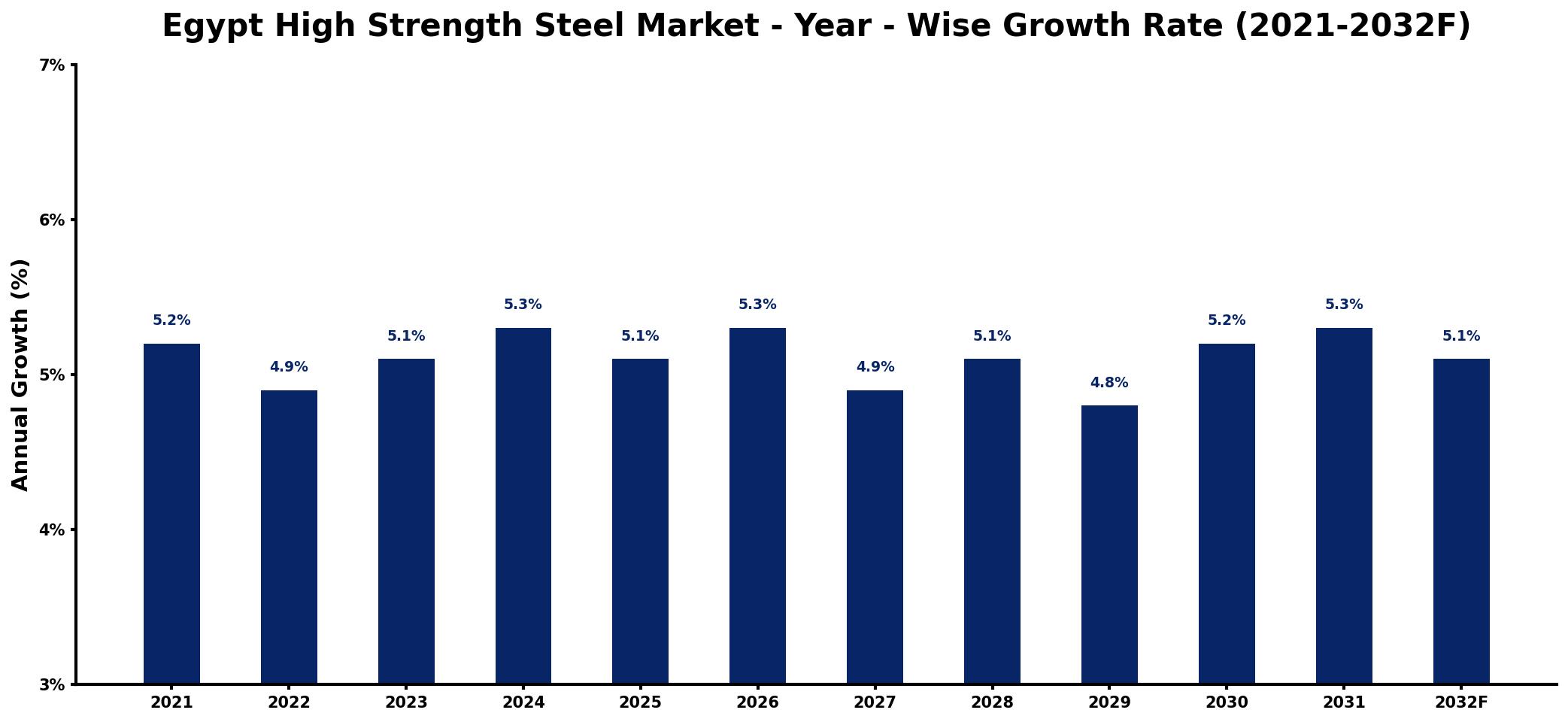
The table below presents the year‑wise growth rates along with the key drivers influencing the market
| Year | Growth Rate | Major Drivers |
| 2021 | 5.2% | Infrastructure projects increase demand |
| 2022 | 4.9% | Automotive sector expands production capacity |
| 2023 | 5.1% | Construction industry experiences growth |
| 2024 | 5.3% | Renewable energy investments rise significantly |
| 2025 | 5.1% | increased pharmaceutical industry usage |
| 2026 | 5.3% | Government initiatives support industrialization |
| 2027 | 4.9% | Urbanization drives construction activities |
| 2028 | 5.1% | Technological advancements enhance efficiency |
| 2029 | 4.8% | Export markets open new opportunities |
| 2030 | 5.2% | Real estate development accelerates rapidly |
| 2031 | 5.3% | Public sector projects boost investments |
| 2032 | 5.1% | Transportation infrastructure upgrades increase demand |
Note: Market size estimations and growth projections presented in this report are based on 6Wresearch's proprietary forecasting methodology, utilizing the latest available industry data, government publications, and primary research inputs.
Egypt High Strength Steel Market Synopsis
The most significant force shaping the Egypt High Strength Steel Market is the governments commitment to infrastructure development. This focus has invigorated the construction industry, with high-strength steel being a crucial component for ensuring safety and durability in modern buildings and structures. Concurrently, the automotive sectors evolution toward enhanced safety standards necessitates the use of robust materials, further supporting the market.
As companies strive for weight reduction without compromising strength, high-strength steel becomes a preferred choice across diverse applications. However, while the market outlook is promising, it must navigate challenges related to production costs and material sourcing to maintain its growth momentum.
Egypt High Strength Steel Market Key Takeaways
- The market is experiencing robust growth driven by infrastructure development and automotive safety regulations.
- High-strength steel provides a competitive advantage due to its lightweight yet durable properties, attracting various sectors.
- Government incentives for local production are enhancing competitiveness in the high-strength steel market.
- Fluctuations in global steel prices can significantly impact local manufacturing profitability.
- Regulatory compliance poses ongoing challenges that manufacturers must address to maintain market position.
Evaluation of Restraints in Egypt High Strength Steel Market
Despite the positive growth outlook, the Egypt High Strength Steel Market faces notable restraints. High production costs associated with high-strength steel manufacturing can deter potential entrants and challenge existing players. Moreover, reliance on imported raw materials exposes the market to vulnerabilities stemming from global price fluctuations and supply chain disruptions. Competition from alternative materials like aluminum and composites also poses a threat, as manufacturers seek to balance strength, weight, and cost-effectiveness. Furthermore, navigating the regulatory landscape related to safety and environmental standards requires significant investments in compliance and quality assurance, which can hinder profitability.
Egypt High Strength Steel Market Trends
Several trends are emerging that shape demand in the Egypt High Strength Steel Market. The push toward sustainable construction practices is leading to an increased emphasis on energy-efficient materials, prompting manufacturers to innovate in high-strength steel formulations. Additionally, advancements in steel processing technologies are enhancing the performance characteristics of high-strength steel, making it an even more attractive option for builders and manufacturers. The automotive industry's shift toward electric vehicles also necessitates lighter and stronger materials, further boosting demand for high-strength steel as automakers design vehicles with improved energy efficiency.
Egypt High Strength Steel Market Opportunities
The Egypt High Strength Steel Market presents substantial growth and investment opportunities, particularly in the construction and automotive sectors. As the government prioritizes infrastructure development, businesses can capitalize on large-scale projects that require high-strength steel for sustainable construction. Additionally, opportunities exist for manufacturers to expand their product offerings by exploring advanced steel formulations that meet evolving automotive standards, especially for electric and hybrid vehicles. The shift toward localization of production further allows market participants to enhance supply chain resilience and reduce costs, creating avenues for competitive advantage.
Government Initiatives in the Egypt High Strength Steel Market
The Egyptian government has introduced several initiatives aimed at bolstering the high-strength steel market. These include tax incentives for local production and investment in infrastructure projects that necessitate the use of high-quality steel. Additionally, the government is focused on enforcing quality standards to ensure that materials used in construction and manufacturing are durable and comply with international safety regulations. Such policies not only facilitate market growth but also promote the development of local manufacturing capabilities, which is essential for the economy.
Future Insights of the Egypt High Strength Steel Market
Looking forward to the period from 2026 to 2032, the Egypt High Strength Steel Market is poised for steady expansion. As investment in infrastructure projects continues to rise, along with a commitment to safety in automotive manufacturing, demand for high-strength steel is expected to grow. Moreover, the increasing emphasis on sustainability will likely drive innovations in material science, further enhancing the appeal of high-strength steel. With a supportive regulatory environment and a focus on local production, the market is well-positioned to navigate challenges and seize emerging opportunities.
Egypt High Strength Steel Market Latest Developments (2025 - 2026)
Recent developments in the Egypt High Strength Steel Market indicate a trend toward greater collaboration between public and private sectors to enhance production capabilities. Initiatives aimed at improving the sustainability of steel production processes are gaining traction, and there is an increasing focus on research and development to innovate new high-strength steel applications. These industry directions align with government priorities and reflect the market's adaptability to evolving demands.
Egypt High Strength Steel Market - Key Attractiveness of the Report
- 10 Years of Market Numbers
- Historical Data Starting from 2022 to 2025
- Base Year: 2025
- Forecast Data until 2032
- Key Performance Indicators Impacting the Market
- Major Upcoming Developments and Projects
Key Highlights of the Report:
- Egypt High Strength Steel Market Outlook
- Market Size of Egypt High Strength Steel Market, 2025
- Forecast of Egypt High Strength Steel Market, 2032
- Historical Data and Forecast of Egypt High Strength Steel Revenues & Volume for the Period 2022-2032F
- Egypt High Strength Steel Market Trend Evolution
- Egypt High Strength Steel Market Drivers and Challenges
- Egypt High Strength Steel Price Trends
- Egypt High Strength Steel Porter's Five Forces
- Egypt High Strength Steel Industry Life Cycle
- Historical Data and Forecast of Egypt High Strength Steel Market Revenues & Volume By Product Type for the Period 2022-2032F
- Historical Data and Forecast of Egypt High Strength Steel Market Revenues & Volume By Dual Phase Steel for the Period 2022-2032F
- Historical Data and Forecast of Egypt High Strength Steel Market Revenues & Volume By Bake Hardenable Steel for the Period 2022-2032F
- Historical Data and Forecast of Egypt High Strength Steel Market Revenues & Volume By Carbon Manganese Steel for the Period 2022-2032F
- Historical Data and Forecast of Egypt High Strength Steel Market Revenues & Volume By Other Product Types for the Period 2022-2032F
- Historical Data and Forecast of Egypt High Strength Steel Market Revenues & Volume By Application for the Period 2022-2032F
- Historical Data and Forecast of Egypt High Strength Steel Market Revenues & Volume By Automotive for the Period 2022-2032F
- Historical Data and Forecast of Egypt High Strength Steel Market Revenues & Volume By Construction for the Period 2022-2032F
- Historical Data and Forecast of Egypt High Strength Steel Market Revenues & Volume By Yellow Goods and Mining Equipment for the Period 2022-2032F
- Historical Data and Forecast of Egypt High Strength Steel Market Revenues & Volume By Aviation and Marine for the Period 2022-2032F
- Historical Data and Forecast of Egypt High Strength Steel Market Revenues & Volume By Other Applications for the Period 2022-2032F
- Egypt High Strength Steel Import Export Trade Statistics
- Market Opportunity Assessment By Product Type
- Market Opportunity Assessment By Application
- Egypt High Strength Steel Top Companies Market Share
- Egypt High Strength Steel Competitive Benchmarking By Technical and Operational Parameters
- Egypt High Strength Steel Company Profiles
- Egypt High Strength Steel Key Strategic Recommendations






































