Egypt Microprocessor Market Size, Share & Growth Rate
The Egypt Microprocessor Market was estimated at USD 925 Million in 2025 and is projected to reach USD 1354 Million by 2032, growing at a CAGR of 5.6% from 2026 to 2032. This upward trajectory is primarily fueled by the escalating demand for smart devices and the rapid proliferation of IoT technologies across various sectors. As industries increasingly integrate advanced computing capabilities into their operations, the necessity for high-performance microprocessors becomes paramount.
Egypt Microprocessor Market Year-wise Growth Rate and Key Drivers
This graph highlights how the Egypt Microprocessor Market has steadily grown over the years, supported by major growth factors.
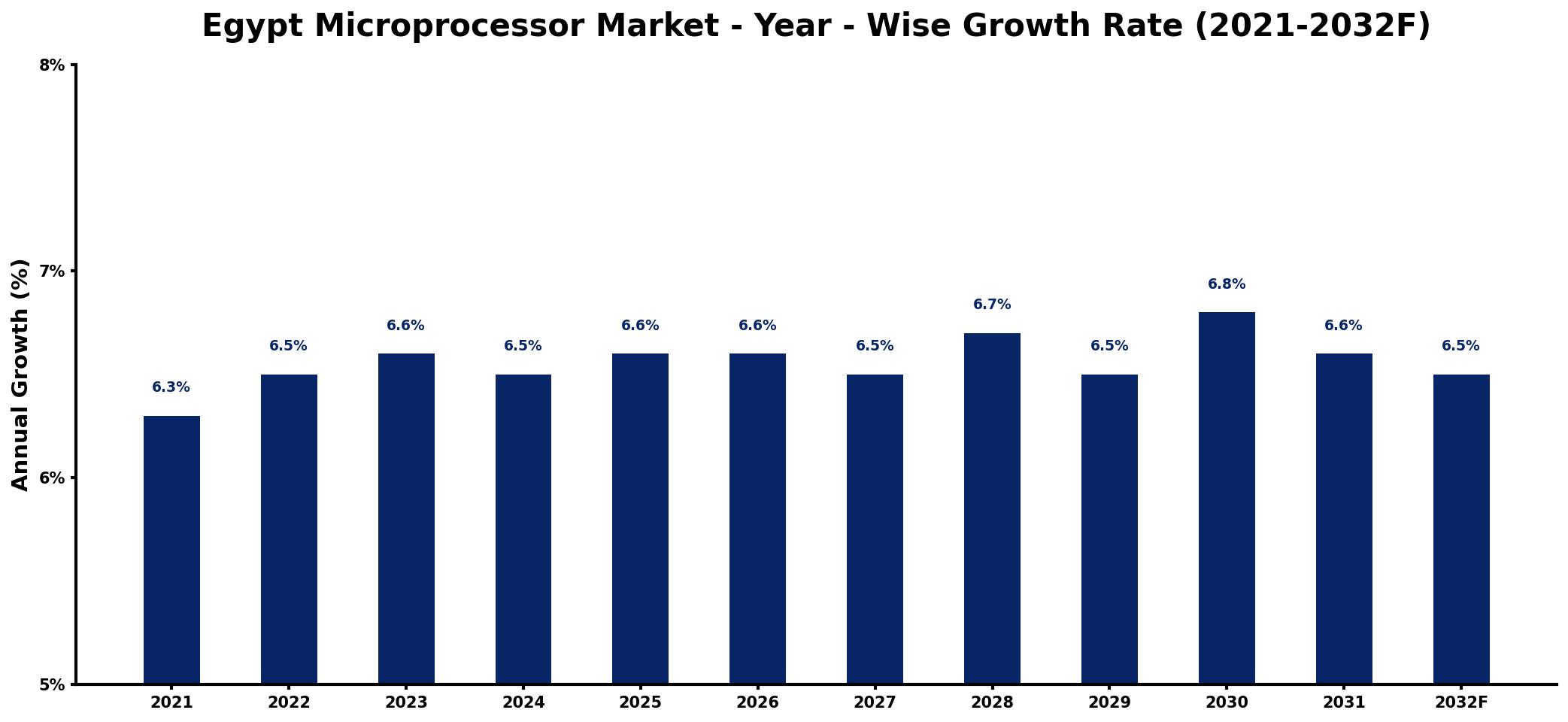
The table below presents the year‑wise growth rates along with the key drivers influencing the market
| Year | Growth Rate | Major Drivers |
| 2021 | 6.3% | Rising demand for smart devices |
| 2022 | 6.5% | Increased investment in technology |
| 2023 | 6.6% | Growth in gaming industry applications |
| 2024 | 6.5% | Expansion of data center infrastructure |
| 2025 | 6.6% | Surge in IoT device connectivity |
| 2026 | 6.6% | Advancements in artificial intelligence |
| 2027 | 6.5% | Boost in automotive technology integration |
| 2028 | 6.7% | Growing popularity of edge computing |
| 2029 | 6.5% | Increased focus on renewable energy |
| 2030 | 6.8% | increased production capacity utilization |
| 2031 | 6.6% | Development of cloud computing services |
| 2032 | 6.5% | Rise in home automation solutions |
Note: Market size estimations and growth projections presented in this report are based on 6Wresearch's proprietary forecasting methodology, utilizing the latest available industry data, government publications, and primary research inputs.
Egypt Microprocessor Market Synopsis
The market for microprocessors in Egypt is experiencing a surge in demand as electronic device consumption rises. This trend is not only driven by consumer electronics but also by the growing automotive sector, where advanced microprocessors are critical for performance and safety features.
Furthermore, with the advent of smart technologies and IoT applications, the need for efficient and reliable processing units is becoming essential. As a result, the market is gravitating towards developing innovative solutions that cater to complex computing needs across various industries.
Egypt Microprocessor Market Key Takeaways
- The Egypt Microprocessor Market is poised for significant growth due to rising electronic device demand and technological advancements.
- Innovations in AI capabilities, energy efficiency, and security features are shaping the future of microprocessor development.
- The increasing deployment of IoT devices highlights the necessity for integrated connectivity in microprocessors.
- Government policies are fostering a favorable environment for investments and research in microprocessor technology.
- Challenges such as a skills gap and economic instability present hurdles that need to be addressed for sustainable growth.
Evaluation of Restraints in Egypt Microprocessor Market
Despite its growth potential, the Egypt microprocessor market faces significant hurdles. A critical limitation is the lack of a skilled workforce adept in microprocessor design and development, which restrains local companies from innovating and competing globally. Economic factors, including fluctuating currency exchange rates and regional instability, further exacerbate challenges by affecting import costs and pricing structures. Moreover, limited access to advanced technology and research capabilities continues to pose barriers to local industry advancement.
Egypt Microprocessor Market Trends
The Egypt microprocessor market is currently witnessing a paradigm shift towards high-performance multi-core processors. Industries such as telecommunications and automotive are increasingly integrating advanced microprocessors, enabling sophisticated applications and improved efficiency. Additionally, theres a growing trend toward energy-efficient solutions that reduce environmental impact while maintaining performance. The integration of artificial intelligence into microprocessor design is emerging as a notable trend, allowing for more intelligent and adaptive devices.
Egypt Microprocessor Market Opportunities
Investment opportunities in the Egypt microprocessor market are substantial, driven primarily by the surge in demand for intelligent computing solutions across various sectors. The burgeoning IoT landscape opens avenues for specialized microprocessor development tailored to smart cities and healthcare applications. Furthermore, as companies increasingly focus on localization and domestic production, there are prospects for investments in microprocessor manufacturing and R&D initiatives aimed at innovation and efficiency.
Government Initiatives in the Egypt Microprocessor Market
The Egyptian government has undertaken several initiatives to promote the growth of the microprocessor market. These include tax incentives designed to encourage research and development in microprocessor technology, as well as subsidies aimed at bolstering local manufacturing. Collaborations with academic institutions are also being fostered to build a skilled workforce capable of meeting industry demands. Such policies aim to attract foreign investment and enhance the competitive landscape of the Egyptian microprocessor sector.
Future Insights of the Egypt Microprocessor Market
The outlook for the Egypt microprocessor market appears robust, supported by the accelerating adoption of digital technologies across sectors. As the demand for advanced computing capabilities continues to rise, particularly in areas like AI and cloud computing, microprocessors will play a crucial role in this evolution. With ongoing government efforts to stimulate digital transformation and infrastructure development, the market is anticipated to experience steady growth, albeit with the need for continuous innovation to stay competitive in a dynamic global landscape.
Egypt Microprocessor Market Latest Developments (2025 - 2026)
Recent developments in the Egypt microprocessor market indicate a strategic pivot towards enhancing local manufacturing capabilities and fostering partnerships with global technology firms. Industry stakeholders are increasingly investing in R&D initiatives to develop next-generation microprocessors that integrate AI and IoT functionalities. Additionally, collaborations between public and private sectors are emerging, aimed at building a supportive ecosystem for technological innovation and manufacturing excellence.
Egypt Microprocessor Market - Key Attractiveness of the Report
- 10 Years of Market Numbers
- Historical Data Starting from 2022 to 2025
- Base Year: 2025
- Forecast Data until 2032
- Key Performance Indicators Impacting the Market
- Major Upcoming Developments and Projects
Key Highlights of the Report:
- Egypt Microprocessor Market Outlook
- Market Size of Egypt Microprocessor Market, 2025
- Forecast of Egypt Microprocessor Market, 2032
- Historical Data and Forecast of Egypt Microprocessor Revenues & Volume for the Period 2022-2032F
- Egypt Microprocessor Market Trend Evolution
- Egypt Microprocessor Market Drivers and Challenges
- Egypt Microprocessor Price Trends
- Egypt Microprocessor Porter's Five Forces
- Egypt Microprocessor Industry Life Cycle
- Historical Data and Forecast of Egypt Microprocessor Market Revenues & Volume By Technology for the Period 2022-2032F
- Historical Data and Forecast of Egypt Microprocessor Market Revenues & Volume By CISC for the Period 2022-2032F
- Historical Data and Forecast of Egypt Microprocessor Market Revenues & Volume By RISC for the Period 2022-2032F
- Historical Data and Forecast of Egypt Microprocessor Market Revenues & Volume By ASIC for the Period 2022-2032F
- Historical Data and Forecast of Egypt Microprocessor Market Revenues & Volume By Superscalar for the Period 2022-2032F
- Historical Data and Forecast of Egypt Microprocessor Market Revenues & Volume By DSP for the Period 2022-2032F
- Historical Data and Forecast of Egypt Microprocessor Market Revenues & Volume By Application for the Period 2022-2032F
- Historical Data and Forecast of Egypt Microprocessor Market Revenues & Volume By Smartphones for the Period 2022-2032F
- Historical Data and Forecast of Egypt Microprocessor Market Revenues & Volume By Personal Computers for the Period 2022-2032F
- Historical Data and Forecast of Egypt Microprocessor Market Revenues & Volume By Servers for the Period 2022-2032F
- Historical Data and Forecast of Egypt Microprocessor Market Revenues & Volume By Tablets for the Period 2022-2032F
- Historical Data and Forecast of Egypt Microprocessor Market Revenues & Volume By Embedded Devices for the Period 2022-2032F
- Historical Data and Forecast of Egypt Microprocessor Market Revenues & Volume By Others for the Period 2022-2032F
- Egypt Microprocessor Import Export Trade Statistics
- Market Opportunity Assessment By Technology
- Market Opportunity Assessment By Application
- Egypt Microprocessor Top Companies Market Share
- Egypt Microprocessor Competitive Benchmarking By Technical and Operational Parameters
- Egypt Microprocessor Company Profiles
- Egypt Microprocessor Key Strategic Recommendations






































