Egypt Rubber Compound Market Size, Share & Growth Rate
The Egypt Rubber Compound Market was estimated at USD 229 Million in 2025 and is projected to reach USD 313 Million by 2032, growing at a CAGR of 4.6% from 2026 to 2032. This growth is largely fueled by the thriving automotive sector, which increasingly demands high-performance rubber compounds, particularly for tires and various components. Additionally, the construction industry's expansion and a growing focus on sustainable materials are bolstering the market's upward trajectory.
Egypt Rubber Compound Market Year-wise Growth Rate and Key Drivers
This graph highlights how the Egypt Rubber Compound Market has steadily grown over the years, supported by major growth factors.
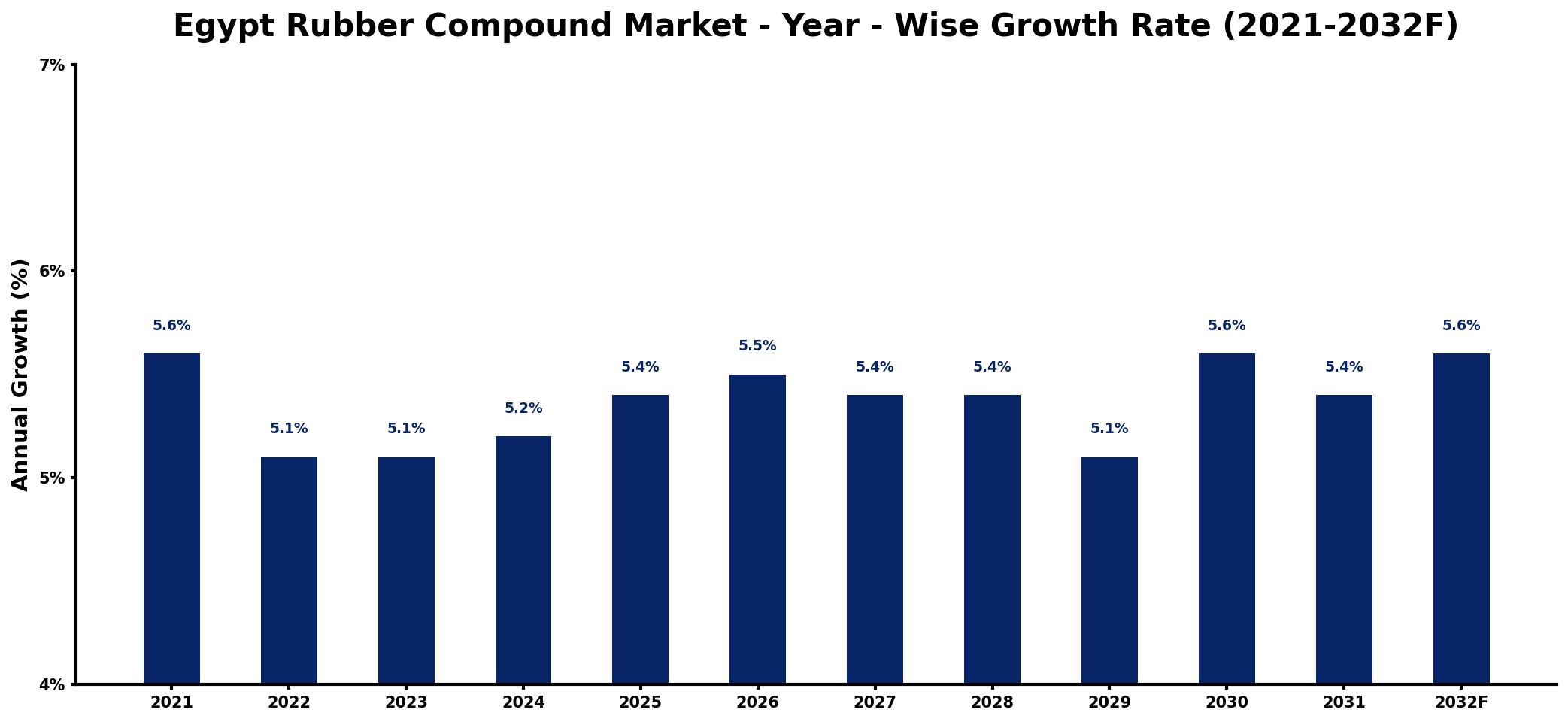
The table below presents the year‑wise growth rates along with the key drivers influencing the market
| Year | Growth Rate | Major Drivers |
| 2021 | 5.6% | Rising automotive manufacturing activities |
| 2022 | 5.1% | Growing construction sector investments |
| 2023 | 5.1% | Increased demand from electronics |
| 2024 | 5.2% | Expansion of renewable energy projects |
| 2025 | 5.4% | Surge in consumer goods production |
| 2026 | 5.5% | Boost in infrastructure development projects |
| 2027 | 5.4% | Increased exports to neighboring countries |
| 2028 | 5.4% | Growth in medical device applications |
| 2029 | 5.1% | Rising demand for industrial applications |
| 2030 | 5.6% | rising export shipment volumes |
| 2031 | 5.4% | Increased focus on sustainability initiatives |
| 2032 | 5.6% | increased overall sector activity |
Note: Market size estimations and growth projections presented in this report are based on 6Wresearch's proprietary forecasting methodology, utilizing the latest available industry data, government publications, and primary research inputs.
Egypt Rubber Compound Market Synopsis
The Egypt Rubber Compound Market is on an upward swing, driven by rising demand across multiple sectors, particularly automotive and construction. Domestic manufacturers are competing alongside international players, delivering a diverse array of rubber compounds tailored for specific applications.
As sustainability becomes a central theme in manufacturing processes, key market participants are innovating eco-friendly compounds that minimize environmental impact. Coupled with ongoing investments in research and development, the market is well-positioned for sustained growth, highlighting Egypt's strategic importance in the global rubber landscape.
Egypt Rubber Compound Market Key Takeaways
- The market is projected to grow from USD 229 Million in 2025 to USD 313 Million by 2032, with a CAGR of 4.6%.
- Demand for eco-friendly rubber compounds is rising as manufacturers focus on sustainability.
- The automotive and construction sectors are the primary drivers of market growth.
- Technological advancements in manufacturing processes are improving efficiency and product quality.
- The Egyptian government is actively supporting the rubber industry through various incentives and quality regulations.
Evaluation of Restraints in Egypt Rubber Compound Market
Despite the promising growth of the Egypt Rubber Compound Market, several limitations persist. Chief among these are the fluctuating prices of essential raw materials, including natural rubber and various chemicals. These price instabilities can adversely affect production costs and manufacturers' profit margins. Furthermore, the market is characterized by intense domestic and international competition, compelling manufacturers to engage in continuous innovation and pricing strategies. Regulatory challenges also present hurdles, as evolving standards necessitate ongoing investments in compliance and technology. Collectively, these factors require companies to adopt strategic adaptability while focusing on enhancing quality and efficiency to navigate the complexities of this dynamic market.
Egypt Rubber Compound Market Trends
Current trends in the Egypt Rubber Compound Market are heavily influenced by the push for sustainability. Manufacturers are actively pursuing eco-friendly alternatives, emphasizing the development of recyclable compounds that reduce environmental footprints. Additionally, technological advancements are reshaping the landscape, with automation and digitalization playing crucial roles in enhancing production efficiency. This intersection of sustainability and technology is evident as industries, particularly automotive, increasingly demand high-performance rubber compounds tailored to meet rigorous standards.
Egypt Rubber Compound Market Opportunities
Investment opportunities within the Egypt Rubber Compound Market are abundant, particularly driven by the burgeoning automotive and construction sectors. With a population exceeding 100 million, Egypt presents a significant consumer base for rubber products, ranging from industrial machinery to tires. Government initiatives aimed at infrastructure development further bolster market potential, providing a fertile ground for investors. Opportunities exist in establishing manufacturing plants, upgrading technologies, and forming strategic alliances with local players, all aimed at capitalizing on the growing demand for rubber compounds.
Government Initiatives in the Egypt Rubber Compound Market
The Egyptian government has taken a proactive stance to nurture the rubber compound market. By offering incentives and subsidies to local manufacturers, the government aims to bolster domestic production and reduce dependency on imports. Quality assurance regulations have also been established, ensuring that industry standards are met and fostering competitiveness within the market. Furthermore, the government supports research and development initiatives, encouraging innovation and technological advancements in the rubber industry.
Future Insights of the Egypt Rubber Compound Market
Looking ahead to the period from 2026 to 2032, the Egypt Rubber Compound Market is poised for steady growth. This growth will be propelled by heightened demand across various industries, including automotive and construction. The increasing emphasis on sustainable and environmentally friendly materials will shape market offerings, as manufacturers strive to deliver improved performance with a reduced ecological footprint. Continued government support for domestic manufacturing and infrastructure investments will further enhance the market's growth potential, despite potential challenges such as raw material price volatility and competitive pressures.
Egypt Rubber Compound Market Latest Developments (2025 - 2026)
In recent months, the Egypt Rubber Compound Market has experienced notable developments driven by technological innovations and sustainability initiatives. There has been a marked increase in partnerships between local manufacturers and international players, focused on research and development aimed at improving product quality and performance. Additionally, various manufacturers are now exploring alternative materials and production processes to meet the rising demand for eco-friendly solutions. The market is evolving, reflecting broader global trends while remaining anchored in local industry needs.
Egypt Rubber Compound Market - Key Attractiveness of the Report
- 10 Years of Market Numbers
- Historical Data Starting from 2022 to 2025
- Base Year: 2025
- Forecast Data until 2032
- Key Performance Indicators Impacting the Market
- Major Upcoming Developments and Projects
Key Highlights of the Report:
- Egypt Rubber Compound Market Outlook
- Market Size of Egypt Rubber Compound Market, 2025
- Forecast of Egypt Rubber Compound Market, 2032
- Historical Data and Forecast of Egypt Rubber Compound Revenues & Volume for the Period 2022-2032F
- Egypt Rubber Compound Market Trend Evolution
- Egypt Rubber Compound Market Drivers and Challenges
- Egypt Rubber Compound Price Trends
- Egypt Rubber Compound Porter's Five Forces
- Egypt Rubber Compound Industry Life Cycle
- Historical Data and Forecast of Egypt Rubber Compound Market Revenues & Volume By Rubber Type for the Period 2022-2032F
- Historical Data and Forecast of Egypt Rubber Compound Market Revenues & Volume By Silicone Rubber for the Period 2022-2032F
- Historical Data and Forecast of Egypt Rubber Compound Market Revenues & Volume By Fluoro Rubber for the Period 2022-2032F
- Historical Data and Forecast of Egypt Rubber Compound Market Revenues & Volume By Butyronitrile Rubber for the Period 2022-2032F
- Historical Data and Forecast of Egypt Rubber Compound Market Revenues & Volume By EPDM Rubber for the Period 2022-2032F
- Historical Data and Forecast of Egypt Rubber Compound Market Revenues & Volume By Chloroprene Rubber for the Period 2022-2032F
- Historical Data and Forecast of Egypt Rubber Compound Market Revenues & Volume By Others for the Period 2022-2032F
- Historical Data and Forecast of Egypt Rubber Compound Market Revenues & Volume By End-User for the Period 2022-2032F
- Historical Data and Forecast of Egypt Rubber Compound Market Revenues & Volume By Tires for the Period 2022-2032F
- Historical Data and Forecast of Egypt Rubber Compound Market Revenues & Volume By Hose & Belting for the Period 2022-2032F
- Historical Data and Forecast of Egypt Rubber Compound Market Revenues & Volume By Roofing & Geo Membranes for the Period 2022-2032F
- Historical Data and Forecast of Egypt Rubber Compound Market Revenues & Volume By Footwear for the Period 2022-2032F
- Historical Data and Forecast of Egypt Rubber Compound Market Revenues & Volume By Wire & Cable Insulation for the Period 2022-2032F
- Historical Data and Forecast of Egypt Rubber Compound Market Revenues & Volume By Others for the Period 2022-2032F
- Egypt Rubber Compound Import Export Trade Statistics
- Market Opportunity Assessment By Rubber Type
- Market Opportunity Assessment By End-User
- Egypt Rubber Compound Top Companies Market Share
- Egypt Rubber Compound Competitive Benchmarking By Technical and Operational Parameters
- Egypt Rubber Compound Company Profiles
- Egypt Rubber Compound Key Strategic Recommendations






































