Egypt Smart Kitchen Appliances Market Size, Share & Growth Rate
The Egypt Smart Kitchen Appliances Market was estimated at USD 1036 Million in 2025 and is projected to reach USD 1737 Million by 2032, growing at a CAGR of 7.7% from 2026 to 2032. This upward trajectory is underpinned by a rapidly urbanizing population eager for modern conveniences in food preparation, coupled with an increasing awareness of the energy efficiency benefits associated with smart appliances. As disposable incomes rise among the expanding middle class, there is a notable shift toward adopting technology-driven kitchen solutions, making smart appliances more attractive.
Egypt Smart Kitchen Appliances Market Year-wise Growth Rate and Key Drivers
This graph highlights how the Egypt Smart Kitchen Appliances Market has steadily grown over the years, supported by major growth factors.
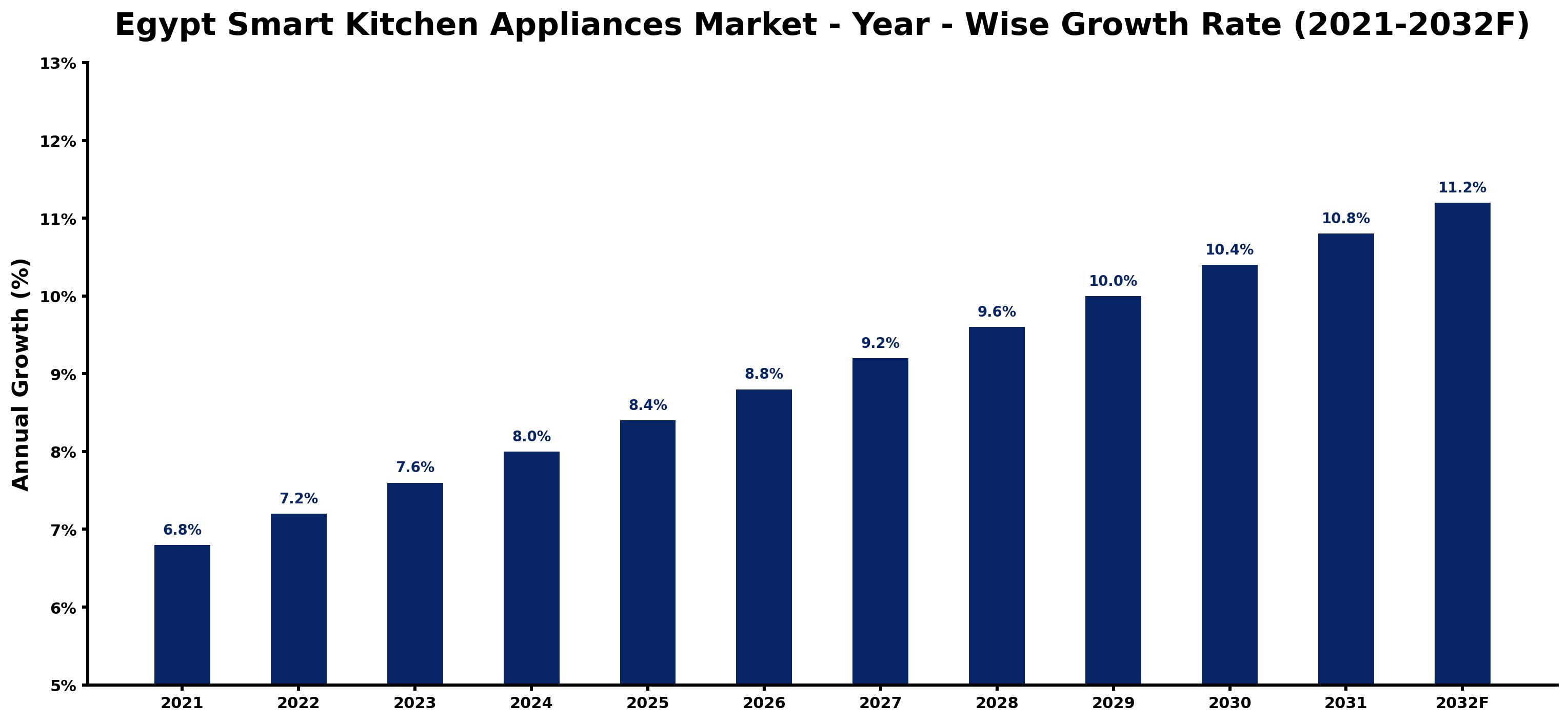
The table below presents the year‑wise growth rates along with the key drivers influencing the market
| Year | Growth Rate | Major Drivers |
| 2021 | 6.8% | Growing renewable energy integration projects |
| 2022 | 7.2% | Increasing industrial automation investments |
| 2023 | 7.6% | Increasing industrial infrastructure investments |
| 2024 | 8.0% | Increasing industrial automation investments |
| 2025 | 8.4% | Rising electricity demand across industries |
| 2026 | 8.8% | Growing urbanization and commercial development |
| 2027 | 9.2% | Increasing smart city development projects |
| 2028 | 9.6% | Expansion of manufacturing activities |
| 2029 | 10.0% | Increasing industrial automation investments |
| 2030 | 10.4% | Increasing smart city development projects |
| 2031 | 10.8% | Increasing smart city development projects |
| 2032 | 11.2% | Growing urbanization and commercial development |
Note - Market size estimations and growth projections presented in this report are based on 6Wresearch's advanced forecasting approach, validated with industry datasets as of June 2026.
Egypt Smart Kitchen Appliances Market Synopsis
As urban life becomes more complex, Egyptian households are increasingly prioritizing efficiency in meal preparation. Smart kitchen appliances—ranging from refrigerators with inventory tracking capabilities to app-controlled ovens—are being welcomed as essential tools for the modern kitchen, signifying a profound shift in consumer behavior. This transition is bolstered by a younger demographic, characterized by tech-savvy consumers keen on integrating technology into their daily lives.
In Egypt, the combination of rising energy costs and a growing commitment to sustainability is influencing the choice of kitchen appliances. Energy-efficient models are becoming more popular, as consumers recognize the long-term savings and environmental benefits associated with smart technologies. This shift not only promotes a smarter home ecosystem but also aligns with broader global trends towards sustainability.
Egypt Smart Kitchen Appliances Market Key Takeaways
- The market is witnessing significant growth due to urbanization and increased disposable income among the middle class.
- Smart appliances are gaining popularity, thanks to enhanced connectivity through IoT technologies.
- Energy efficiency and sustainability are key consumer drivers, influencing purchasing decisions.
- Challenges related to market awareness and affordability continue to affect adoption rates.
- Government policies aimed at promoting energy efficiency are positively impacting market dynamics.
Evaluation of Restraints in Egypt Smart Kitchen Appliances Market
Despite its growth potential, the Egypt Smart Kitchen Appliances Market faces notable constraints. A lack of widespread awareness about the benefits of smart appliances hampers rapid adoption among consumers. Many Egyptian households remain unfamiliar with the functionalities and advantages these technologies offer, leading to hesitancy in investment. Furthermore, the upfront costs associated with acquiring smart appliances can be prohibitive for many families, particularly in lower-income brackets. Intermittent internet connectivity in several regions also presents a barrier, reducing the appeal of devices that rely heavily on consistent online access.
Egypt Smart Kitchen Appliances Market Trends
Current trends in the Egypt Smart Kitchen Appliances Market are heavily influenced by the growing interest in sustainability. More consumers are actively seeking out appliances that reduce energy consumption and have a minimal environmental footprint. Additionally, the integration of voice-activated technology and AI in kitchen appliances is shaping consumer expectations, driving demand for smarter, more intuitive devices. Moreover, the trend of remote access control through mobile applications continues to foster a deeper connection between consumers and their kitchen gadgets.
Egypt Smart Kitchen Appliances Market Opportunities
The market presents substantial growth and investment opportunities in areas such as product innovation and targeted marketing campaigns. Companies focusing on educating consumers about the advantages of smart kitchen appliances can significantly improve market penetration. Moreover, partnerships with technology firms could lead to enhanced product offerings that appeal to the tech-savvy youth demographic. Additionally, as connectivity improves across the country, the full potential of smart kitchen technologies is likely to be unlocked, encouraging broader adoption.
Government Initiatives in the Egypt Smart Kitchen Appliances Market
The Egyptian government is actively promoting energy efficiency and sustainability through various policies and incentives aimed at the consumer sector. Regulatory standards encourage the adoption of energy-efficient appliances, contributing to lower electricity consumption across households. These initiatives are part of a broader commitment to sustainable development in line with Egypt's Vision 2030, which encompasses the promotion of technological innovation, including smart home devices. Such policies not only facilitate market growth but also foster greater environmental responsibility among consumers.
Future Insights of the Egypt Smart Kitchen Appliances Market
Looking ahead to 2026-2032, the Egypt Smart Kitchen Appliances Market is poised for dynamic growth. Continued urbanization, coupled with rising disposable incomes, will likely enhance consumer willingness to invest in smart technologies. As more households become familiar with the benefits of energy-efficient appliances, their adoption is expected to accelerate. Additionally, advancements in connectivity and reductions in device costs will further catalyze growth, positioning smart appliances as essential components of modern Egyptian kitchens.
Egypt Smart Kitchen Appliances Market Latest Developments (May 2025 - June 2026)
Recent developments within the Egypt Smart Kitchen Appliances Market indicate a strong movement towards enhancing consumer engagement through educational initiatives. Many companies are focusing on informing potential buyers about the functionalities and benefits of smart devices. Additionally, local manufacturers are exploring collaborations with technology providers to develop more integrated smart appliance systems, aligning with global trends while catering to local consumer needs. This strategic direction is expected to create a more competitive landscape that benefits consumers.
Egypt Smart Kitchen Appliances Market - Key Attractiveness of the Report
- 10 Years of Market Numbers
- Historical Data Starting from 2022 to 2025
- Base Year: 2025
- Forecast Data until 2032
- Key Performance Indicators Impacting the Market
- Major Upcoming Developments and Projects
Key Highlights of the Report:
- Egypt Smart Kitchen Appliances Market Outlook
- Market Size of Egypt Smart Kitchen Appliances Market, 2025
- Forecast of Egypt Smart Kitchen Appliances Market, 2032
- Historical Data and Forecast of Egypt Smart Kitchen Appliances Revenues & Volume for the Period 2022-2032F
- Egypt Smart Kitchen Appliances Market Trend Evolution
- Egypt Smart Kitchen Appliances Market Drivers and Challenges
- Egypt Smart Kitchen Appliances Price Trends
- Egypt Smart Kitchen Appliances Porter's Five Forces
- Egypt Smart Kitchen Appliances Industry Life Cycle
- Historical Data and Forecast of Egypt Smart Kitchen Appliances Market Revenues & Volume By Products for the Period 2022-2032F
- Historical Data and Forecast of Egypt Smart Kitchen Appliances Market Revenues & Volume By Smart Refrigerators for the Period 2022-2032F
- Historical Data and Forecast of Egypt Smart Kitchen Appliances Market Revenues & Volume By Smart Cookware and Cooktops for the Period 2022-2032F
- Historical Data and Forecast of Egypt Smart Kitchen Appliances Market Revenues & Volume By Smart Ovens for the Period 2022-2032F
- Historical Data and Forecast of Egypt Smart Kitchen Appliances Market Revenues & Volume By Other for the Period 2022-2032F
- Historical Data and Forecast of Egypt Smart Kitchen Appliances Market Revenues & Volume By Applications for the Period 2022-2032F
- Historical Data and Forecast of Egypt Smart Kitchen Appliances Market Revenues & Volume By Residential for the Period 2022-2032F
- Historical Data and Forecast of Egypt Smart Kitchen Appliances Market Revenues & Volume By Commercial for the Period 2022-2032F
- Egypt Smart Kitchen Appliances Import Export Trade Statistics
- Market Opportunity Assessment By Products
- Market Opportunity Assessment By Applications
- Egypt Smart Kitchen Appliances Top Companies Market Share
- Egypt Smart Kitchen Appliances Competitive Benchmarking By Technical and Operational Parameters
- Egypt Smart Kitchen Appliances Company Profiles
- Egypt Smart Kitchen Appliances Key Strategic Recommendations






































