Egypt Vegetable oils Market Summary
The egypt vegetable oils market was estimated at USD 166 Million in 2025 and is projected to reach USD 230 Million by 2032, growing at a CAGR of 5.5% from 2026 to 2032.
Egypt Vegetable oils Market Year-wise Growth Rate and Key Drivers
This graph highlights how the Egypt Vegetable oils Market has steadily grown over the past five years, supported by major growth factors.
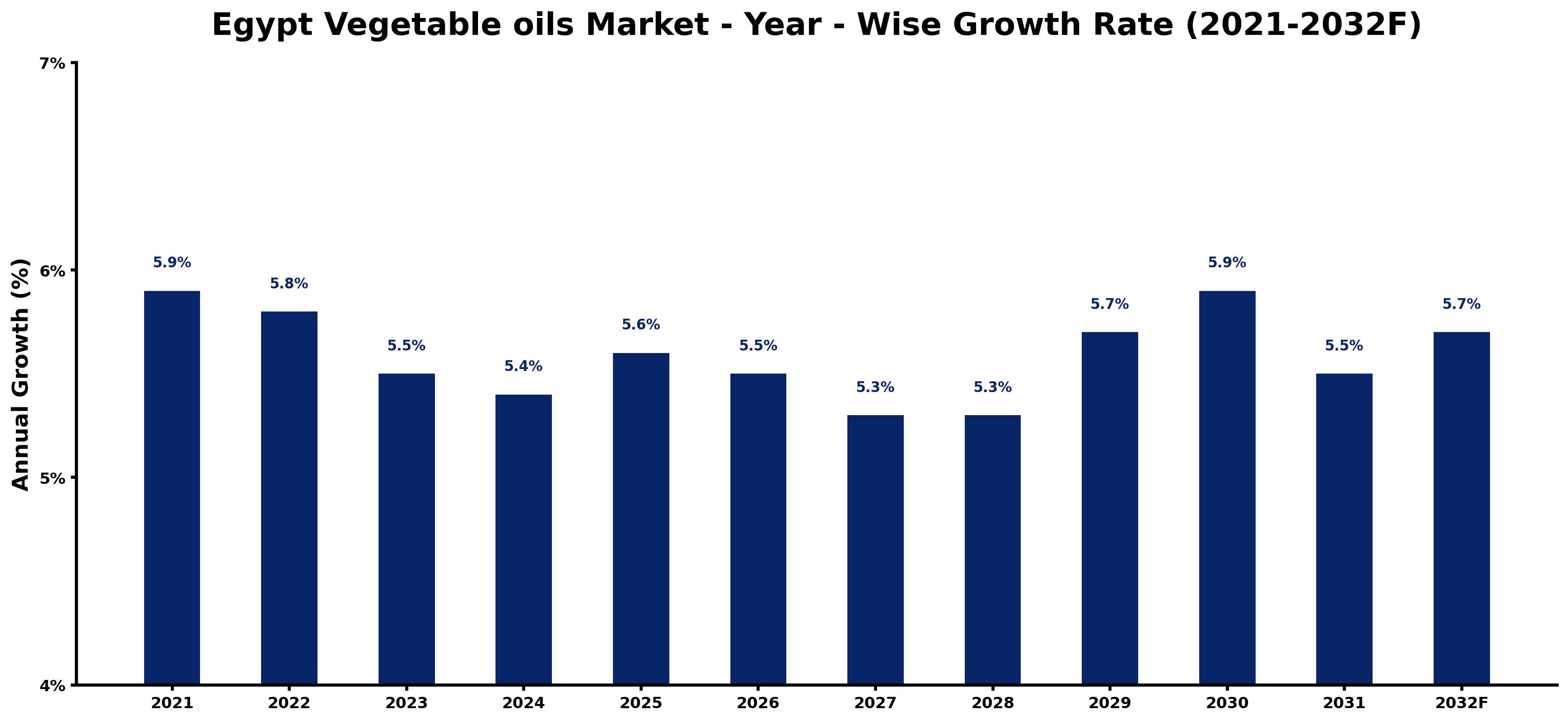
The table below presents the year wise growth rates along with the key drivers influencing the market
| Year | Growth Rate | Major Drivers |
| 2021 | 5.9% | Consumer preference for healthy cooking options gradually influences vegetable oil choices. |
| 2022 | 5.8% | Shifts in dietary habits reflect an increasing interest in plant-based foods. |
| 2023 | 5.5% | Inflationary pressures lead to heightened price sensitivity among Egyptian consumers. |
| 2024 | 5.4% | Local producers enhance efficiency, positioning themselves against imported vegetable oils. |
| 2025 | 5.6% | Sustainability initiatives within food production spark interest in eco-friendly oils. |
| 2026 | 5.5% | Expansion of retail networks helps improve vegetable oil accessibility across urban areas. |
| 2027 | 5.3% | Youth market dynamics show a shift towards organic and health-focused products. |
| 2028 | 5.3% | E-commerce platforms gain popularity, changing how consumers purchase cooking oils. |
| 2029 | 5.7% | Health awareness campaigns highlight the benefits of high-quality cooking oils. |
| 2030 | 5.9% | Emerging culinary trends feature traditional dishes incorporating diverse vegetable oils. |
| 2031 | 5.5% | Investments in cold-pressed extraction technology boost product quality and market appeal. |
| 2032 | 5.7% | International partnerships foster innovation, expanding the range of available oils. |
Note - Market size estimations and growth projections presented in this report are based on 6Wresearch's advanced forecasting approach, validated with industry datasets as of June 2026.
Egypt Vegetable oils Market Synopsis
The Egypt Vegetable oils Market is projected to reach 5.5% and witness significant growth during the forecast period (2026-2032). This market serves as a cornerstone of the food industry, encompassing a variety of oils such as soybean, corn, sunflower, and palm, which find widespread applications in cooking, food processing, and various industrial uses. The increasing health consciousness among consumers is steering the demand towards oils that are lower in saturated and trans fats, thereby altering purchasing preferences. The local production capabilities, supplemented by the agricultural strength of Egypt, are pivotal in reducing the reliance on imported oils, as well as enhancing food security in the country.
Egypt Vegetable oils Market Growth Drivers
The drivers of the Egypt Vegetable oils Market are multi-faceted, largely grounded in the escalating demand from food services and household cooking. Some key growth drivers include:
- The rising consumption of vegetable oils in the food service industry, primarily due to urbanization and changing dietary habits, has fostered increased demand for oils such as palm and soybean.
- The growing inclination towards healthier cooking options is pushing consumers to seek alternatives like olive and sunflower oil, prompting the market to evolve accordingly.
- Government initiatives aimed at enhancing local oilseed production contribute significantly to the supply chain, boosting market availability and stability.
- Quality standards enforced by the government ensure that consumers receive safe and nutritious products, thereby elevating overall market confidence.
- The ongoing efforts to improve agricultural practices and technology enhance production efficiency, further supporting market growth.
Egypt Vegetable oils Market Challenges and Restraints
While the market shows promising prospects, several challenges could hinder its growth trajectory:
- The shift towards premium-quality and healthier oil options increases pressure on producers to transition from traditional oils, creating potential operational challenges.
- Fluctuations in global oil prices can create instability in the domestic market, affecting production costs and retail prices.
- Dependence on imported raw materials can lead to vulnerabilities in the supply chain, particularly during global disruptions.
- Environmental concerns surrounding certain vegetable oils, notably palm oil, have led to regulatory scrutiny, challenging producers to adopt more sustainable practices.
- Consumer preferences are continually evolving, necessitating adaptability and innovation from market participants to remain competitive.
Egypt Vegetable oils Market Government Investment and Initiatives
The Egyptian government plays a crucial role in the development of the vegetable oils market through various investment frameworks and initiatives. Promoting local oilseed crop cultivation has been a focal point of government policy, aimed at reducing dependency on imports while bolstering domestic production capabilities. Additionally, financial incentives are being provided to enhance the efficiency of vegetable oil extraction processes, aligning with broader food security goals.
Public spending on agricultural research and development is directed toward innovative practices that improve yield and sustainability. This investment aims to elevate the quality of locally produced oils, ensuring they meet international standards. Furthermore, the government has initiated campaigns to encourage the consumption of vegetable oils as healthier cooking alternatives to animal fats, reinforcing public health awareness and supporting the market's expansion.
Egypt Vegetable oils Market Latest Developments (May 2025 - June 2026)
The period from May 2025 to June 2026 has seen several noteworthy developments within the Egypt Vegetable oils Market. The ongoing push for sustainability is reshaping supply chains, with a growing number of stakeholders focusing on responsible sourcing and production methods. Innovations in extraction technologies have also emerged, enhancing production efficiencies and product quality.
Consumer education regarding health benefits associated with various vegetable oils has gained traction, with significant campaigns aimed at promoting healthier dietary choices. In addition, collaborative projects between government agencies and local producers are focused on improving agricultural productivity for oilseed crops. The net effect of these developments is a continuously evolving market landscape that is responsive to both consumer needs and regulatory expectations.
Egypt Vegetable oils Market - Key Attractiveness of the Report
- 10 Years of Market Numbers
- Historical Data Starting from 2022 to 2025
- Base Year: 2025
- Forecast Data until 2032
- Key Performance Indicators Impacting the Market
- Major Upcoming Developments and Projects
Key Highlights of the Report:
- Egypt Vegetable oils Market Outlook
- Market Size of Egypt Vegetable oils Market, 2025
- Forecast of Egypt Vegetable oils Market, 2032
- Historical Data and Forecast of Egypt Vegetable oils Revenues & Volume for the Period 2022-2032F
- Egypt Vegetable oils Market Trend Evolution
- Egypt Vegetable oils Market Drivers and Challenges
- Egypt Vegetable oils Price Trends
- Egypt Vegetable oils Porter's Five Forces
- Egypt Vegetable oils Industry Life Cycle
- Historical Data and Forecast of Egypt Vegetable oils Market Revenues & Volume By Types for the Period 2022-2032F
- Historical Data and Forecast of Egypt Vegetable oils Market Revenues & Volume By Palm Oil for the Period 2022-2032F
- Historical Data and Forecast of Egypt Vegetable oils Market Revenues & Volume By Soybean Oil for the Period 2022-2032F
- Historical Data and Forecast of Egypt Vegetable oils Market Revenues & Volume By Rapeseed Oil for the Period 2022-2032F
- Historical Data and Forecast of Egypt Vegetable oils Market Revenues & Volume By Sunflower Oil for the Period 2022-2032F
- Historical Data and Forecast of Egypt Vegetable oils Market Revenues & Volume By Olive Oil for the Period 2022-2032F
- Historical Data and Forecast of Egypt Vegetable oils Market Revenues & Volume By Others for the Period 2022-2032F
- Historical Data and Forecast of Egypt Vegetable oils Market Revenues & Volume By Applications for the Period 2022-2032F
- Historical Data and Forecast of Egypt Vegetable oils Market Revenues & Volume By Food for the Period 2022-2032F
- Historical Data and Forecast of Egypt Vegetable oils Market Revenues & Volume By Feed for the Period 2022-2032F
- Historical Data and Forecast of Egypt Vegetable oils Market Revenues & Volume By Industrial for the Period 2022-2032F
- Egypt Vegetable oils Import Export Trade Statistics
- Market Opportunity Assessment By Types
- Market Opportunity Assessment By Applications
- Egypt Vegetable oils Top Companies Market Share
- Egypt Vegetable oils Competitive Benchmarking By Technical and Operational Parameters
- Egypt Vegetable oils Company Profiles
- Egypt Vegetable oils Key Strategic Recommendations






































