Egypt Workspace as a Service Market Size & Growth Rate (2026-2032)
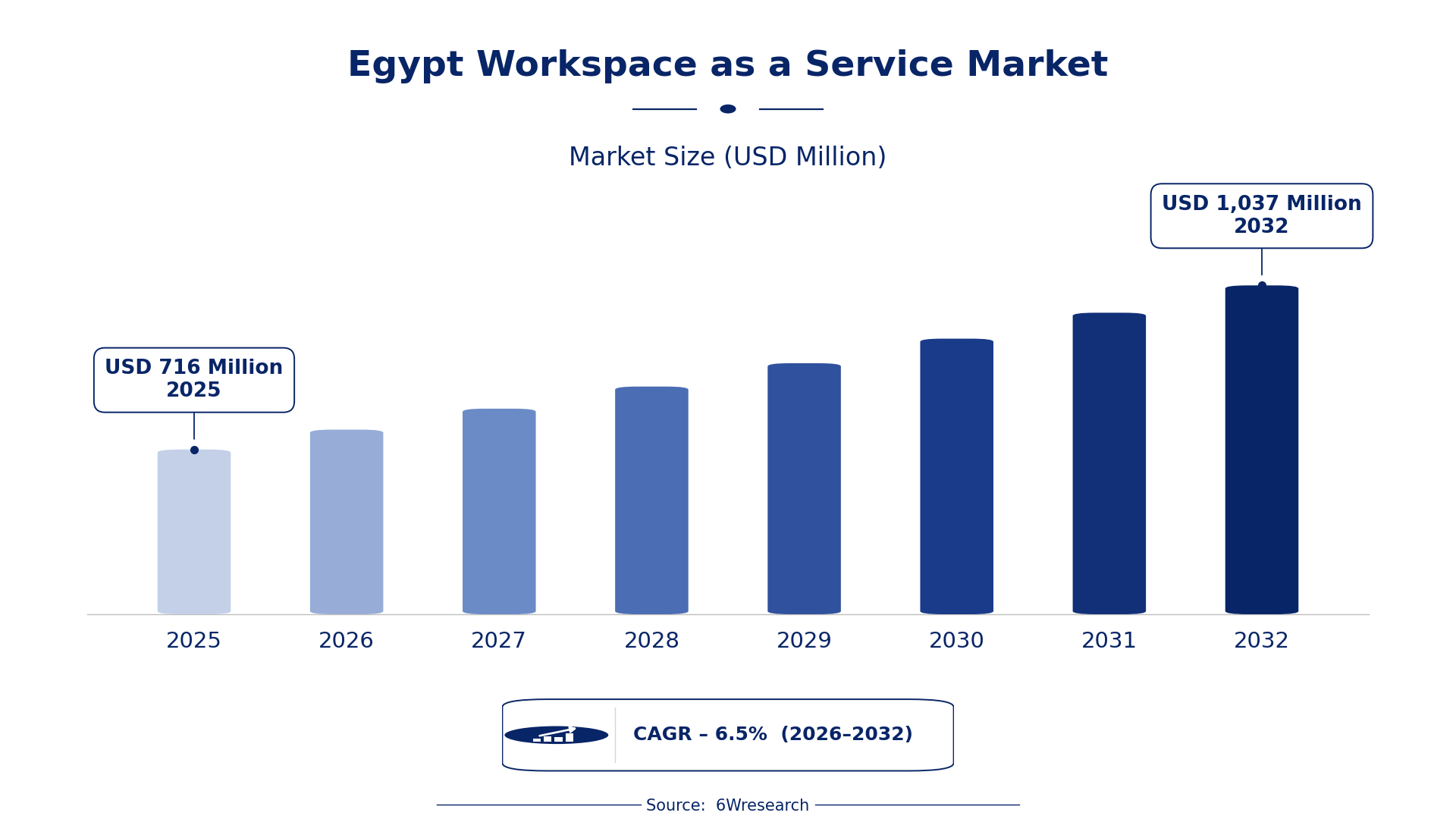
The Egypt Workspace as a Service Market was estimated at USD 716 Million in 2025 and is projected to reach USD 1037 Million by 2032, growing at a CAGR of 6.5% from 2026 to 2032.
Egypt Workspace as a Service Market Synopsis
The demand for flexible work arrangements in Egypt is propelling the growth of the Workspace as a Service (WaaS) market. As businesses increasingly embrace remote and hybrid work models, WaaS solutions are emerging as essential tools for enhancing productivity and collaboration, particularly in urban centers where the workforce is rapidly digitizing.
The integration of cloud-based technologies is reshaping how organizations operate, enabling them to reduce costs associated with traditional office spaces. As the shift towards digital transformation continues, companies are turning to WaaS for its scalability and efficiency in managing work environments, further fueling market expansion.
Egypt Workspace as a Service Market Year-wise Growth Rate and Key Drivers
This graph illustrates the annual growth rates of the Egypt Workspace as a Service Market from 2021 to 2032, highlighting a steady upward trajectory and projected expansion over the forecast period.
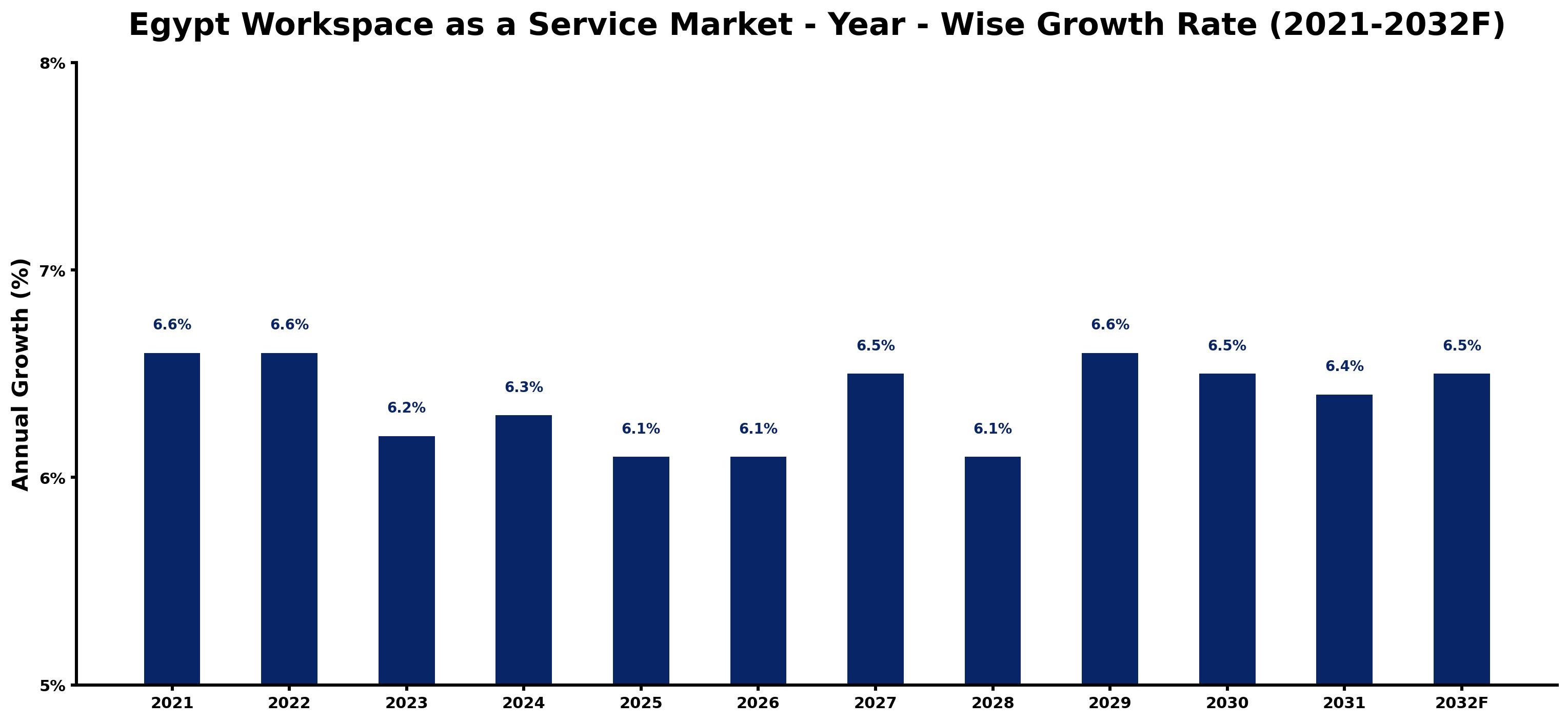
The table below presents the year‑wise growth rates along with the key drivers influencing the market
| Year | Growth Rate | Major Drivers |
| 2021 | 6.6% | Increase in remote work policies by Egyptian companies. |
| 2022 | 6.6% | Government support for innovation through new tech grants. |
| 2023 | 6.2% | Surge in freelancers driving demand for flexible workspaces. |
| 2024 | 6.3% | Rise in startup culture boosts workspace-as-a-service adoption. |
| 2025 | 6.1% | Corporate shift towards hybrid work models in Egypt. |
| 2026 | 6.1% | Growth of local coworking spaces attracts digital entrepreneurs. |
| 2027 | 6.5% | Investment in cloud infrastructure by Egyptian telecommunication firms. |
| 2028 | 6.1% | Focus on workforce agility in Egypt’s private sector. |
| 2029 | 6.6% | Increased uptake of SaaS solutions among large corporations. |
| 2030 | 6.5% | Government digital initiatives enhancing tech ecosystem. |
| 2031 | 6.4% | Emerging demand for remote collaboration tools in schools. |
| 2032 | 6.5% | Expanding urban population increases need for flexible workspaces. |
Note: Market size estimations and growth projections presented in this report are based on 6Wresearch's proprietary forecasting methodology, utilizing the latest available industry data, government publications, and primary research inputs.
Egypt Workspace as a Service Market Key Takeaways
Below are some of the specific key takeaways from the market, including:
- Strong growth potential driven by the rising adoption of remote work solutions.
- Increasing cloud computing capabilities supporting WaaS implementation.
- Significant cost savings for businesses transitioning from traditional office setups.
- Government initiatives promoting digital transformation and remote work policies.
- Challenges related to data security and infrastructure still persist.
Evaluation of Restraints in Egypt Workspace as a Service Market
Despite the positive outlook, several factors restrain the growth of the WaaS market in Egypt. Economic uncertainties can lead to hesitance among companies to invest in cloud solutions, primarily due to concerns about data security and the potential loss of control over sensitive information. on top of that, the existing internet infrastructure is often insufficient, especially in rural areas, creating hurdles for seamless WaaS adoption. Businesses are also challenged by the complexity of integrating new WaaS solutions with legacy systems, which can require extensive customization and training efforts.
Egypt Workspace as a Service Market Trends
Several trends are shaping the Egypt Workspace as a Service market. Firstly, there's a noticeable shift towards hybrid work models, which necessitate flexible, cloud-based solutions that allow employees to work from various locations. Additionally, the focus on enhancing cybersecurity measures is becoming increasingly critical as companies become more reliant on cloud infrastructures. The growing acceptance of mobile workforces is also pushing organizations to adopt WaaS solutions that ensure secure access to essential tools and data.
Egypt Workspace as a Service Market Opportunities
Investment opportunities in the WaaS sector are expanding as organizations look to modernize their operations. The increasing demand for tailored solutions that integrate seamlessly with existing workflows presents a ripe area for growth. on top of that, as Egypt’s digital transformation initiatives gain momentum, companies offering WaaS solutions that prioritize security and user experience are likely to see heightened interest. Partnerships between technology providers and local businesses can also foster innovation and expand service offerings.
Government Initiatives in the Egypt Workspace as a Service Market
Government policies in Egypt are increasingly focused on fostering a digital economy, which directly influences the growth of the Workspace as a Service market. By improving internet infrastructure and implementing supportive regulations, the government is creating an environment conducive to the adoption of WaaS solutions. This regulatory framework is crucial as it reassures businesses about the viability of transitioning to cloud-based operations.
- A national digital infrastructure upgrade programme now in its rollout phase aims to enhance connectivity across urban and rural areas.
- Current initiatives include regulatory reforms to facilitate remote work and cloud adoption, promoting flexibility in business operations.
- A planned public-private initiative expected to expand telecom infrastructure access by 2028, particularly in underserved regions.
- Recent efforts to establish cybersecurity standards for cloud services to bolster business confidence in WaaS solutions.
- Ongoing workshops and training programmes designed to educate companies on the benefits and implementation of WaaS.
Future Insights of the Egypt Workspace as a Service Market
Looking ahead to 2026-2032, the Egypt Workspace as a Service market is expected to evolve significantly. As digital adoption accelerates, businesses will increasingly seek WaaS solutions that offer enhanced security and integration capabilities. The emphasis on sustainability and energy efficiency is likely to drive the development of green cloud solutions. With the government backing, coupled with an evolving corporate mindset towards remote work, the market's trajectory appears promising.
Egypt Workspace as a Service Market Latest Developments
Recent activity in the Egypt Workspace as a Service market highlights a trend towards rapid digital adoption and innovation. Companies are making strides in enhancing their service offerings, focusing on user experience and security. This ongoing evolution reflects a commitment to meeting the needs of modern workforces and adapting to market demands.
- A major technology vendor announced a new WaaS platform in early 2025, focusing on scalability and enhanced collaboration features.
- An ongoing initiative to partner with local businesses for pilot programmes that showcase the effectiveness of WaaS in various sectors.
- A service upgrade launched in Q1 2025 aims to improve data security measures for WaaS clients, responding to rising concerns.
- By mid-2026, a new user-friendly interface for existing WaaS solutions is expected to enhance user engagement and satisfaction.
- A planned expansion of WaaS offerings into rural areas scheduled for the second half of 2026 to broaden market reach.
Egypt Workspace as a Service Market - Key Attractiveness of the Report
- 10 Years of Market Numbers
- Historical Data Starting from 2022 to 2025
- Base Year: 2025
- Forecast Data until 2032
- Key Performance Indicators Impacting the Market
- Major Upcoming Developments and Projects
Key Highlights of the Report:
- Egypt Workspace as a Service Market Outlook
- Market Size of Egypt Workspace as a Service Market, 2025
- Forecast of Egypt Workspace as a Service Market, 2032
- Historical Data and Forecast of Egypt Workspace as a Service Revenues & Volume for the Period 2022-2032F
- Egypt Workspace as a Service Market Trend Evolution
- Egypt Workspace as a Service Market Drivers and Challenges
- Egypt Workspace as a Service Price Trends
- Egypt Workspace as a Service Porter's Five Forces
- Egypt Workspace as a Service Industry Life Cycle
- Historical Data and Forecast of Egypt Workspace as a Service Market Revenues & Volume By Solutions for the Period 2022-2032F
- Historical Data and Forecast of Egypt Workspace as a Service Market Revenues & Volume By VDI and Applications for the Period 2022-2032F
- Historical Data and Forecast of Egypt Workspace as a Service Market Revenues & Volume By Desktop as a Service for the Period 2022-2032F
- Historical Data and Forecast of Egypt Workspace as a Service Market Revenues & Volume By Hosted Applications (Unified Communication Applications) for the Period 2022-2032F
- Historical Data and Forecast of Egypt Workspace as a Service Market Revenues & Volume By Security Solutions for the Period 2022-2032F
- Historical Data and Forecast of Egypt Workspace as a Service Market Revenues & Volume By Others (Browser-based WaaS solutions) for the Period 2022-2032F
- Historical Data and Forecast of Egypt Workspace as a Service Market Revenues & Volume By Services for the Period 2022-2032F
- Historical Data and Forecast of Egypt Workspace as a Service Market Revenues & Volume By System Integration for the Period 2022-2032F
- Historical Data and Forecast of Egypt Workspace as a Service Market Revenues & Volume By Consulting services for the Period 2022-2032F
- Historical Data and Forecast of Egypt Workspace as a Service Market Revenues & Volume By Managed services for the Period 2022-2032F
- Historical Data and Forecast of Egypt Workspace as a Service Market Revenues & Volume By Deployment Type for the Period 2022-2032F
- Historical Data and Forecast of Egypt Workspace as a Service Market Revenues & Volume By Public for the Period 2022-2032F
- Historical Data and Forecast of Egypt Workspace as a Service Market Revenues & Volume By Private for the Period 2022-2032F
- Historical Data and Forecast of Egypt Workspace as a Service Market Revenues & Volume By Hybrid for the Period 2022-2032F
- Historical Data and Forecast of Egypt Workspace as a Service Market Revenues & Volume By End-Users for the Period 2022-2032F
- Historical Data and Forecast of Egypt Workspace as a Service Market Revenues & Volume By Enterprises for the Period 2022-2032F
- Historical Data and Forecast of Egypt Workspace as a Service Market Revenues & Volume By Small and medium businesses(SMB) for the Period 2022-2032F
- Historical Data and Forecast of Egypt Workspace as a Service Market Revenues & Volume By Verticals for the Period 2022-2032F
- Historical Data and Forecast of Egypt Workspace as a Service Market Revenues & Volume By Banking, Financial Services and Insurance (BFSI) for the Period 2022-2032F
- Historical Data and Forecast of Egypt Workspace as a Service Market Revenues & Volume By Retail for the Period 2022-2032F
- Historical Data and Forecast of Egypt Workspace as a Service Market Revenues & Volume By Government for the Period 2022-2032F
- Historical Data and Forecast of Egypt Workspace as a Service Market Revenues & Volume By Healthcare for the Period 2022-2032F
- Historical Data and Forecast of Egypt Workspace as a Service Market Revenues & Volume By Manufacturing for the Period 2022-2032F
- Historical Data and Forecast of Egypt Workspace as a Service Market Revenues & Volume By Telecom and IT for the Period 2022-2032F
- Historical Data and Forecast of Egypt Workspace as a Service Market Revenues & Volume By Utilities for the Period 2022-2032F
- Historical Data and Forecast of Egypt Workspace as a Service Market Revenues & Volume By Travel and Hospitality for the Period 2022-2032F
- Egypt Workspace as a Service Import Export Trade Statistics
- Market Opportunity Assessment By Solutions
- Market Opportunity Assessment By Services
- Market Opportunity Assessment By Deployment Type
- Market Opportunity Assessment By End-Users
- Market Opportunity Assessment By Verticals
- Egypt Workspace as a Service Top Companies Market Share
- Egypt Workspace as a Service Competitive Benchmarking By Technical and Operational Parameters
- Egypt Workspace as a Service Company Profiles
- Egypt Workspace as a Service Key Strategic Recommendations






































