El Salvador Mining Lubricants Market Top 5 Importing Countries and Market Competition (HHI) Analysis
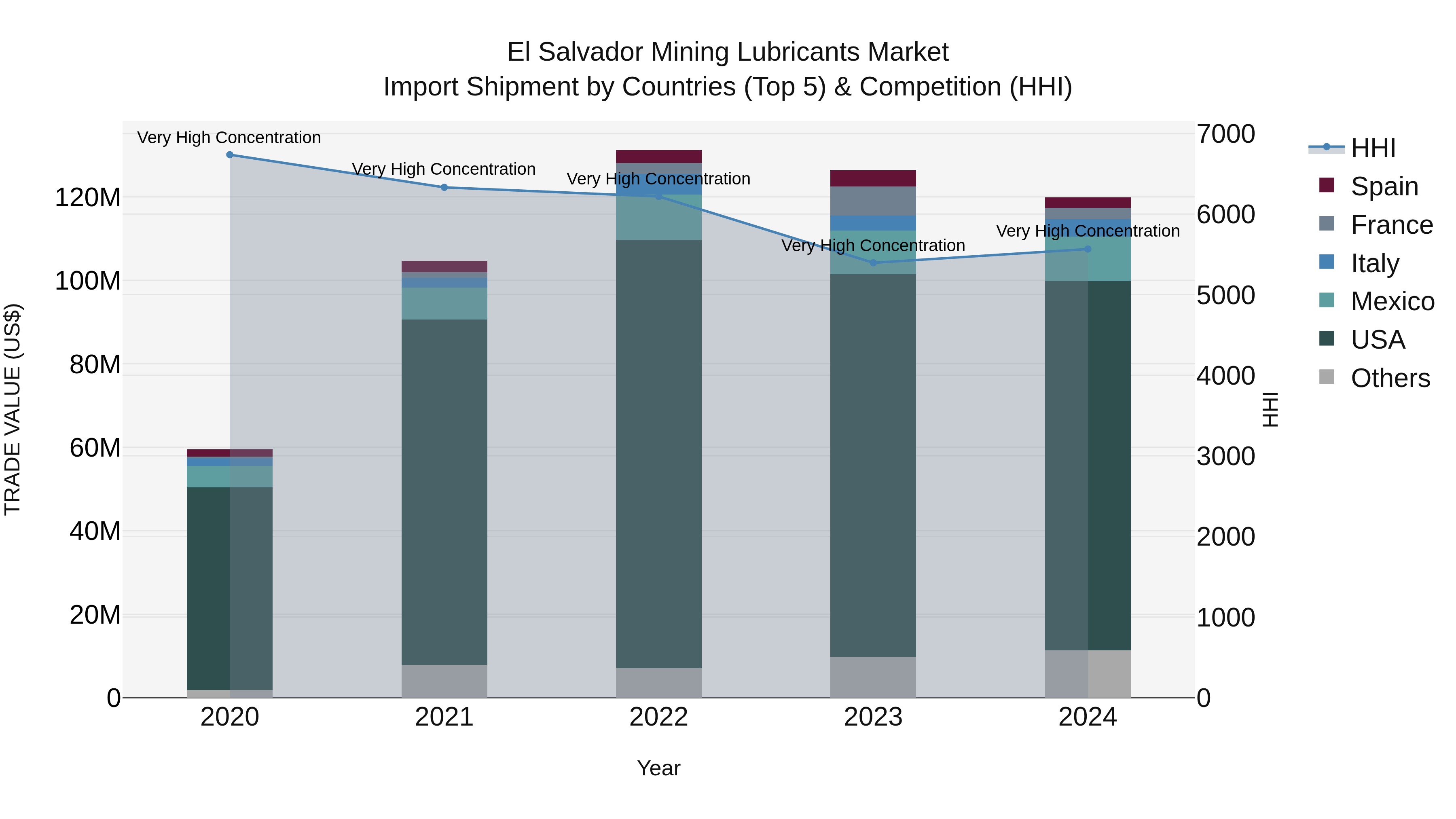
El Salvador`s import of mining lubricants in 2024 continued to be dominated by key players like the USA, Mexico, Italy, Singapore, and France. Despite a slight decline in growth rate from 2023 to 2024, the compound annual growth rate (CAGR) over the past four years remained strong at 19.14%. The high Herfindahl-Hirschman Index (HHI) indicates a concentrated market, suggesting potential challenges for new entrants. El Salvador`s reliance on these top exporting countries highlights the importance of maintaining strong trade relationships and strategic sourcing in the mining lubricants sector.
El Salvador Mining Lubricants Market Overview
Mining lubricants reduce friction and wear in heavy-duty mining equipment, enhancing operational efficiency and equipment longevity. The market is supported by demand from the mining sector, which requires reliable lubricants to maintain productivity.
Drivers of the market
The Mining Lubricants Market in El Salvador is growing due to the increasing demand for high-performance lubricants that can ensure the smooth operation of mining equipment in challenging conditions. Mining lubricants are critical for reducing wear and tear on machinery, enhancing equipment lifespan, and improving operational efficiency. The growing mining activities in the country, particularly in the extraction of metals and minerals, are driving the demand for specialized lubricants. Additionally, advancements in lubricant formulations that offer better performance and environmental benefits are contributing to the market`s expansion.
Challenges of the market
The mining lubricants market in El Salvador is constrained by the reliance on imported products and the high cost of advanced lubricants required for mining operations. There is limited local production of specialized lubricants for heavy-duty mining machinery, which increases operating costs for local mining companies. Furthermore, the lack of awareness about the benefits of high-quality lubricants in improving machinery efficiency and reducing downtime slows market growth. The market is also affected by fluctuations in the price of raw materials used in lubricant production.
Government Policy of the market
El Salvadors mining lubricants market is growing, supported by government policies promoting efficient and sustainable mining operations. These policies emphasize environmental responsibility, mandating the use of high-performance lubricants that reduce equipment wear and energy consumption. Tax incentives are provided for companies that invest in advanced lubricants, which contribute to operational efficiency and reduced environmental impact. This regulatory framework positions El Salvador as a promising market for mining lubricants, meeting both productivity and sustainability goals.
Key Highlights of the Report:
- El Salvador Mining Lubricants Market Outlook
- Market Size of El Salvador Mining Lubricants Market, 2024
- Forecast of El Salvador Mining Lubricants Market, 2031
- Historical Data and Forecast of El Salvador Mining Lubricants Revenues & Volume for the Period 2021-2031
- El Salvador Mining Lubricants Market Trend Evolution
- El Salvador Mining Lubricants Market Drivers and Challenges
- El Salvador Mining Lubricants Price Trends
- El Salvador Mining Lubricants Porter`s Five Forces
- El Salvador Mining Lubricants Industry Life Cycle
- Historical Data and Forecast of El Salvador Mining Lubricants Market Revenues & Volume By End Use Industry for the Period 2021-2031
- Historical Data and Forecast of El Salvador Mining Lubricants Market Revenues & Volume By Coal Mining for the Period 2021-2031
- Historical Data and Forecast of El Salvador Mining Lubricants Market Revenues & Volume By Iron ORE Mining for the Period 2021-2031
- Historical Data and Forecast of El Salvador Mining Lubricants Market Revenues & Volume By Bauxite Mining for the Period 2021-2031
- Historical Data and Forecast of El Salvador Mining Lubricants Market Revenues & Volume By Rare Earth Mineral Mining for the Period 2021-2031
- Historical Data and Forecast of El Salvador Mining Lubricants Market Revenues & Volume By Precious Metals Mining for the Period 2021-2031
- Historical Data and Forecast of El Salvador Mining Lubricants Market Revenues & Volume By Type for the Period 2021-2031
- Historical Data and Forecast of El Salvador Mining Lubricants Market Revenues & Volume By Mineral Oil Lubricants for the Period 2021-2031
- Historical Data and Forecast of El Salvador Mining Lubricants Market Revenues & Volume By Synthetic Lubricants for the Period 2021-2031
- El Salvador Mining Lubricants Import Export Trade Statistics
- Market Opportunity Assessment By End Use Industry
- Market Opportunity Assessment By Type
- El Salvador Mining Lubricants Top Companies Market Share
- El Salvador Mining Lubricants Competitive Benchmarking By Technical and Operational Parameters
- El Salvador Mining Lubricants Company Profiles
- El Salvador Mining Lubricants Key Strategic Recommendations






































