El Salvador Windows Market Top 5 Importing Countries and Market Competition (HHI) Analysis
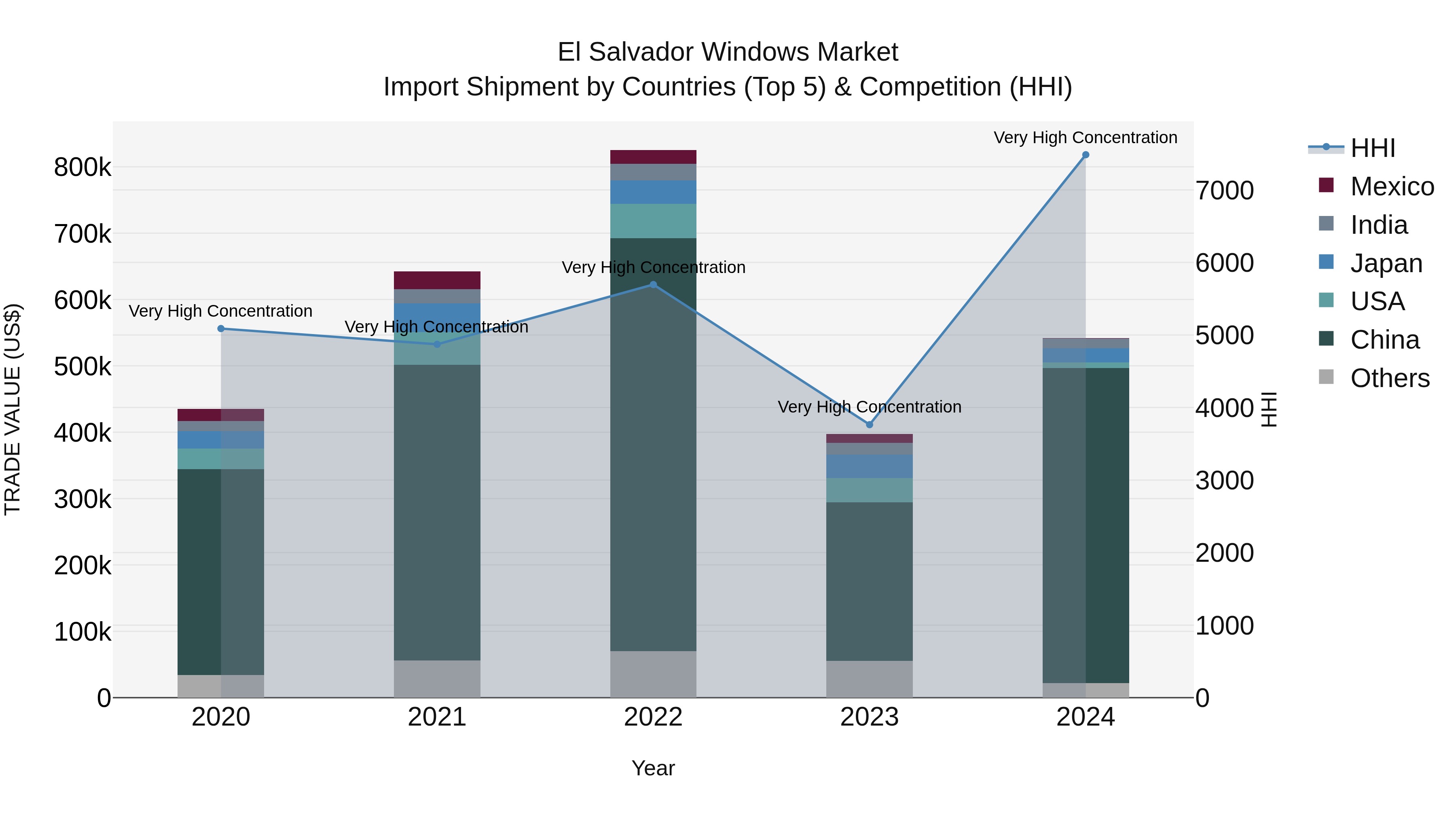
El Salvador`s windows import market in 2024 continued to be dominated by top exporting countries such as China, Japan, India, USA, and Thailand. The high Herfindahl-Hirschman Index (HHI) indicates a concentrated market landscape. With a compound annual growth rate (CAGR) of 5.63% from 2020 to 2024 and a notable growth rate of 36.42% from 2023 to 2024, the market shows promising expansion and increased demand for imported windows in El Salvador. It is essential for market players to monitor these trends and adapt strategies to capitalize on the growing opportunities.
El Salvador Windows Market Overview
In El Salvador, the windows market is driven by both new construction and renovation activities. Consumers are becoming more conscious of the environmental impact of their choices, leading to a rise in demand for energy-efficient window systems. Additionally, durability, noise reduction, and ease of maintenance are important considerations for consumers. The market is seeing the introduction of modern window solutions, including double-glazed and insulated glass windows, to cater to these growing demands.
Drivers of the market
The windows market in El Salvador is propelled by the surge in construction activities and the growing demand for energy-efficient products. As urbanization increases and more people move into urban areas, there is a greater need for new housing, which in turn drives the demand for high-performance windows. Consumers are also seeking windows that offer improved insulation and weather resistance, particularly to cope with the country`s warm climate and occasional storms. The rise of modern architecture and design preferences for larger, more visually striking windows also contributes to the growth of the market. Additionally, the need for windows with greater durability and lower maintenance is fueling the shift toward advanced materials like uPVC and aluminum.
Challenges of the market
El Salvador`s windows market faces challenges primarily related to durability and affordability. Due to the country`s climate, there is a strong demand for windows that can resist humidity, storm damage, and heat, which increases the production cost. Import dependence for high-quality materials also raises prices. Additionally, local manufacturers struggle to keep up with the growing demand for energy-efficient windows, which are often more expensive than conventional options. The need for both resilient and affordable solutions makes it difficult for manufacturers to balance quality and cost while expanding their market share.
Government Policy of the market
Government policies in the El Salvador Windows Market focus on urban housing development and modernization efforts. With a growing urban population, the government has been promoting policies that favor the construction of affordable and energy-efficient housing. These policies include incentives for developers to use quality, durable, and energy-efficient window systems. There is also an emphasis on fostering local manufacturing and reducing the reliance on imports. However, challenges such as limited consumer awareness and financing options for energy-efficient products hinder broader adoption in the residential segment.
Key Highlights of the Report:
- El Salvador Windows Market Outlook
- Market Size of El Salvador Windows Market, 2024
- Forecast of El Salvador Windows Market, 2031
- Historical Data and Forecast of El Salvador Windows Revenues & Volume for the Period 2021-2031
- El Salvador Windows Market Trend Evolution
- El Salvador Windows Market Drivers and Challenges
- El Salvador Windows Price Trends
- El Salvador Windows Porter`s Five Forces
- El Salvador Windows Industry Life Cycle
- Historical Data and Forecast of El Salvador Windows Market Revenues & Volume By Material for the Period 2021-2031
- Historical Data and Forecast of El Salvador Windows Market Revenues & Volume By uPVC for the Period 2021-2031
- Historical Data and Forecast of El Salvador Windows Market Revenues & Volume By Wood for the Period 2021-2031
- Historical Data and Forecast of El Salvador Windows Market Revenues & Volume By Metal for the Period 2021-2031
- Historical Data and Forecast of El Salvador Windows Market Revenues & Volume By Others for the Period 2021-2031
- Historical Data and Forecast of El Salvador Windows Market Revenues & Volume By Application for the Period 2021-2031
- Historical Data and Forecast of El Salvador Windows Market Revenues & Volume By Residential for the Period 2021-2031
- Historical Data and Forecast of El Salvador Windows Market Revenues & Volume By Commercial for the Period 2021-2031
- El Salvador Windows Import Export Trade Statistics
- Market Opportunity Assessment By Material
- Market Opportunity Assessment By Application
- El Salvador Windows Top Companies Market Share
- El Salvador Windows Competitive Benchmarking By Technical and Operational Parameters
- El Salvador Windows Company Profiles
- El Salvador Windows Key Strategic Recommendations






































