El Salvador Wood Pellets Market Top 5 Importing Countries and Market Competition (HHI) Analysis
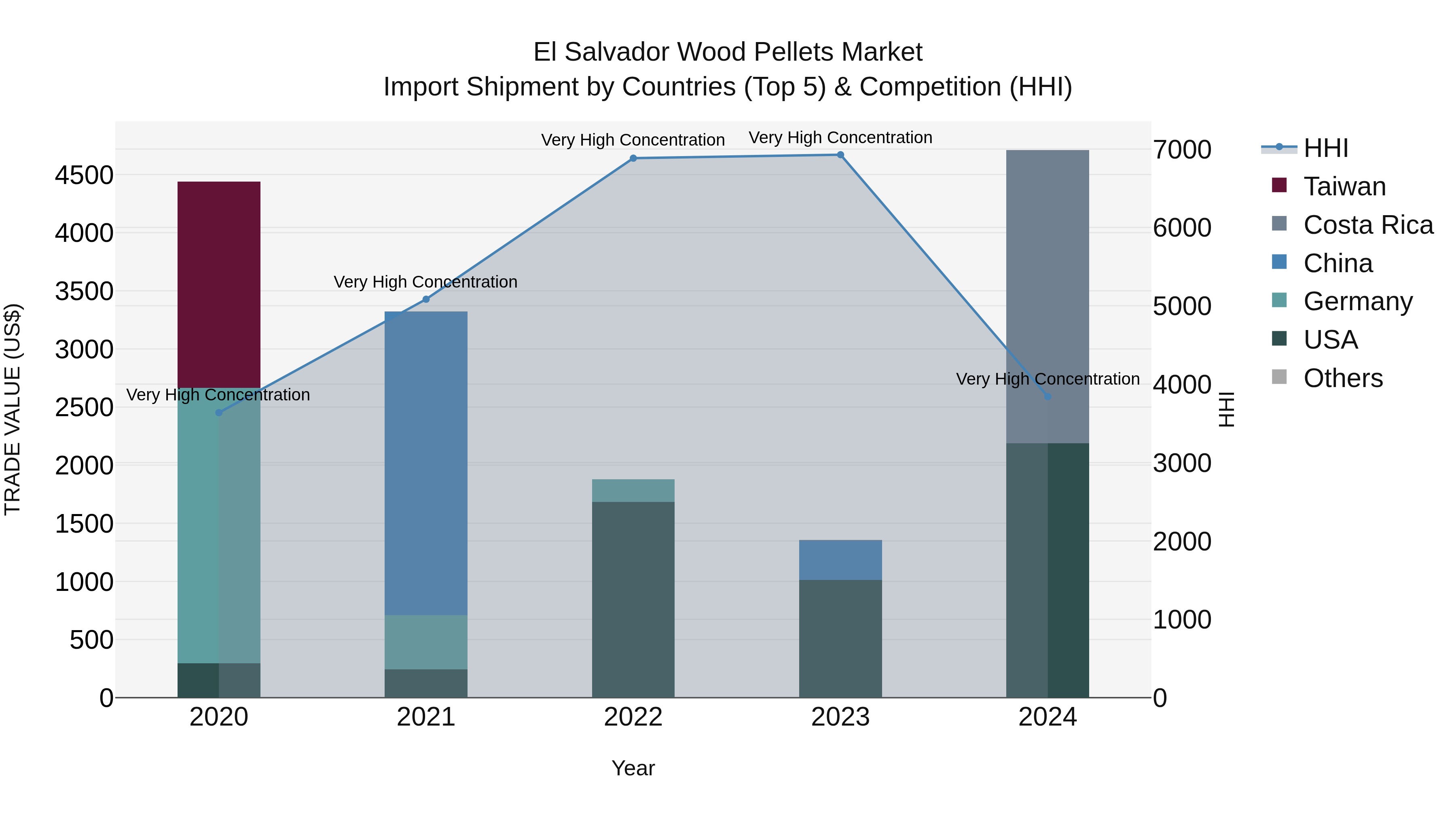
El Salvador`s wood pellets import market in 2024 continued to be dominated by Costa Rica, USA, China, Germany, and Taiwan. With a high Herfindahl-Hirschman Index indicating concentration, these top exporting countries maintained a strong presence. The market showed steady growth with a Compound Annual Growth Rate (CAGR) of 1.49% from 2020 to 2024. Particularly noteworthy is the remarkable growth rate of 246.96% from 2023 to 2024, suggesting a surge in demand or shifts in supply dynamics during that period.
El Salvador Wood Pellets Market Overview
The wood pellets market in El Salvador is gaining momentum, driven by the growing emphasis on renewable energy sources. Wood pellets are increasingly used for heating and electricity generation, offering a sustainable alternative to traditional fossil fuels. With the government`s focus on promoting clean energy initiatives, the demand for wood pellets is expected to rise in both residential and industrial sectors. Additionally, as global markets for biomass products expand, El Salvador has the potential to increase its export of wood pellets, further driving market growth. Sustainability and energy efficiency trends will continue to shape the markets trajectory in the coming years.
Drivers of the market
The wood pellets market in El Salvador is growing due to the increasing shift towards renewable energy sources and the growing demand for sustainable heating solutions. As consumers and businesses seek to reduce their carbon footprint, wood pellets are becoming an attractive alternative to traditional fossil fuels for heating purposes. The availability of local raw materials and the countrys focus on reducing environmental impact also contribute to the growth of the market. Additionally, government policies promoting renewable energy and biomass solutions support the expansion of the wood pellets market as a cleaner, cost-effective option for residential and commercial heating.
Challenges of the market
The wood pellets market in El Salvador is impacted by supply chain issues and competition from other forms of renewable energy. The availability of raw materials for pellet production is subject to fluctuations, which can lead to disruptions in supply and higher costs for producers. Additionally, the market faces competition from other biomass and renewable energy sources, such as solar and wind, which may be seen as more sustainable or cost-effective alternatives. Regulatory challenges, particularly those related to environmental sustainability and certification requirements for biomass products, add complexity to market operations and can limit access to certain markets.
Government Policy of the market
El Salvadors wood pellets market is shaped by government policies that promote the use of renewable energy sources. The government has focused on developing clean energy initiatives and reducing dependence on fossil fuels. Policies that encourage the use of biomass as an alternative energy source have spurred the demand for wood pellets, particularly in the industrial and residential sectors. The governments initiatives to support green energy production and reduce emissions have created a favorable environment for the growth of the wood pellets market, contributing to the country`s energy diversification efforts.
Key Highlights of the Report:
- El Salvador Wood Pellets Market Outlook
- Market Size of El Salvador Wood Pellets Market, 2024
- Forecast of El Salvador Wood Pellets Market, 2031
- Historical Data and Forecast of El Salvador Wood Pellets Revenues & Volume for the Period 2021-2031
- El Salvador Wood Pellets Market Trend Evolution
- El Salvador Wood Pellets Market Drivers and Challenges
- El Salvador Wood Pellets Price Trends
- El Salvador Wood Pellets Porter`s Five Forces
- El Salvador Wood Pellets Industry Life Cycle
- Historical Data and Forecast of El Salvador Wood Pellets Market Revenues & Volume By Types for the Period 2021-2031
- Historical Data and Forecast of El Salvador Wood Pellets Market Revenues & Volume By Hardwood for the Period 2021-2031
- Historical Data and Forecast of El Salvador Wood Pellets Market Revenues & Volume By Softwood for the Period 2021-2031
- Historical Data and Forecast of El Salvador Wood Pellets Market Revenues & Volume By Applications for the Period 2021-2031
- Historical Data and Forecast of El Salvador Wood Pellets Market Revenues & Volume By Power Plants for the Period 2021-2031
- Historical Data and Forecast of El Salvador Wood Pellets Market Revenues & Volume By Residential Heating for the Period 2021-2031
- Historical Data and Forecast of El Salvador Wood Pellets Market Revenues & Volume By Commercial Heating for the Period 2021-2031
- Historical Data and Forecast of El Salvador Wood Pellets Market Revenues & Volume By Combined Heat and Power (CHP) for the Period 2021-2031
- El Salvador Wood Pellets Import Export Trade Statistics
- Market Opportunity Assessment By Types
- Market Opportunity Assessment By Applications
- El Salvador Wood Pellets Top Companies Market Share
- El Salvador Wood Pellets Competitive Benchmarking By Technical and Operational Parameters
- El Salvador Wood Pellets Company Profiles
- El Salvador Wood Pellets Key Strategic Recommendations






































