Estonia Coal Market Size Growth Rate
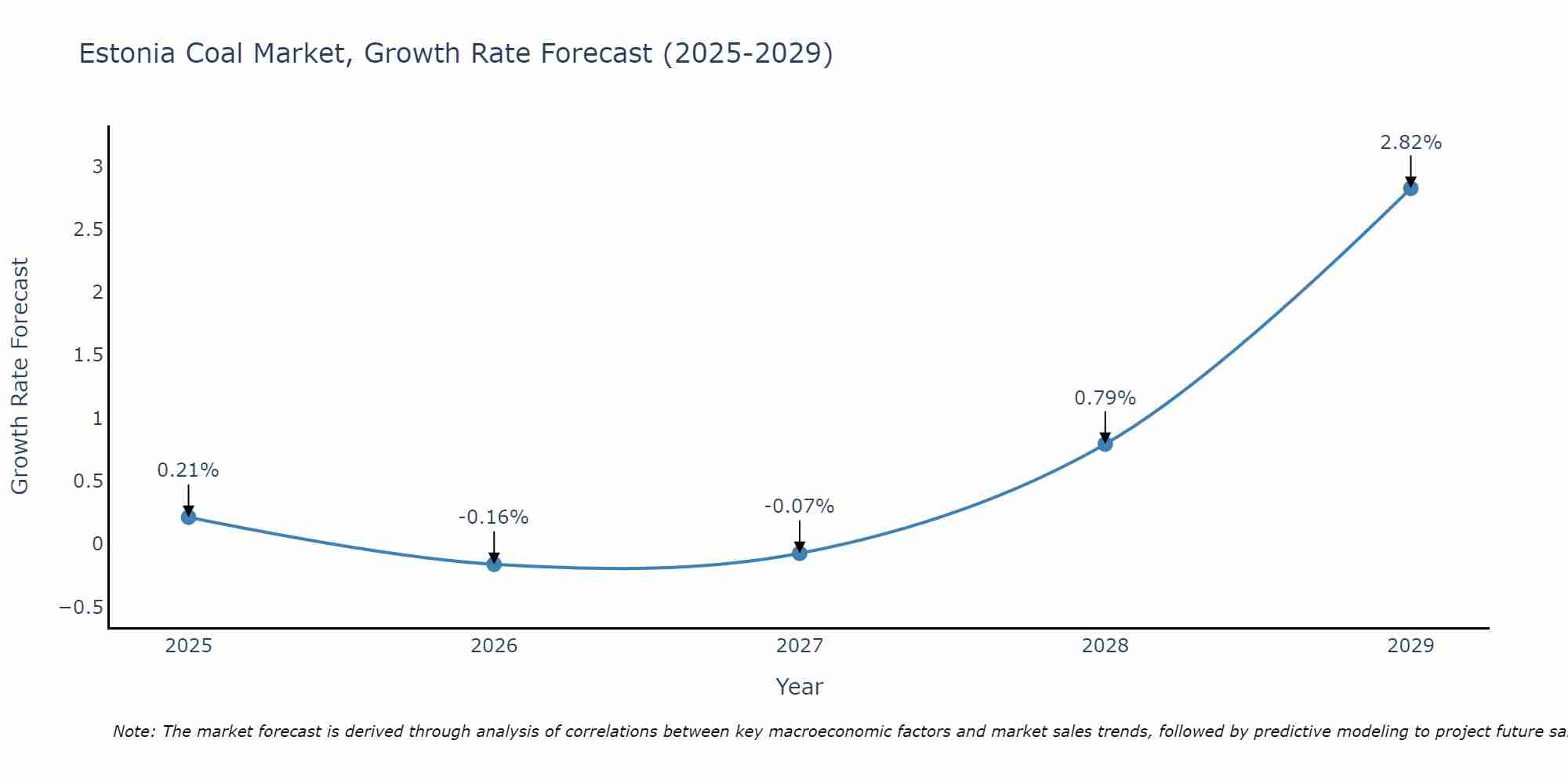
The Estonia Coal Market is projected to witness mixed growth rate patterns during 2025 to 2029. Commencing at 0.21% in 2025, growth builds up to 2.82% by 2029.
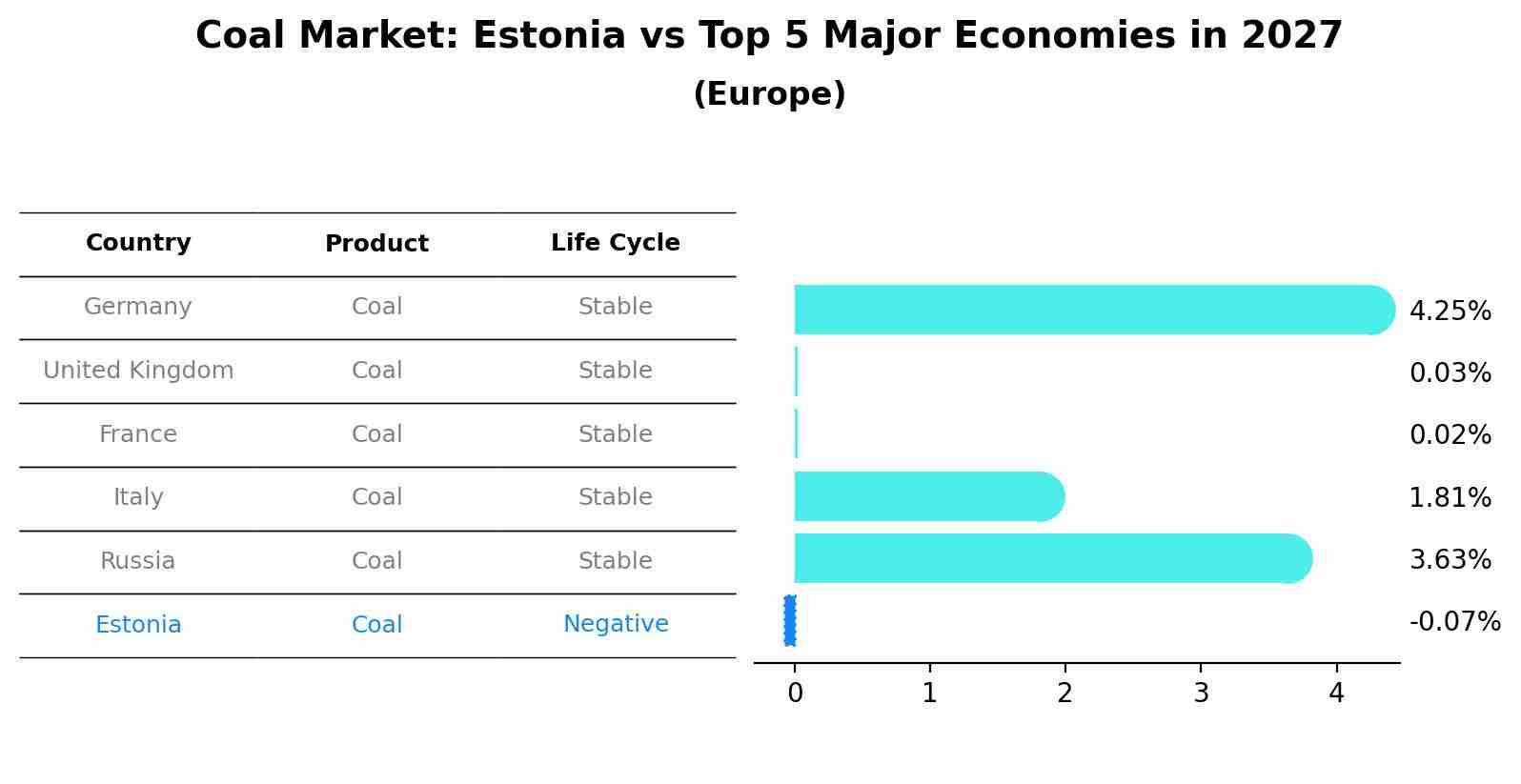
Coal Market: Estonia vs Top 5 Major Economies in 2027 (Europe)
By 2027, the Coal market in Estonia is anticipated to reach a growth rate of -0.07%, as part of an increasingly competitive Europe region, where Germany remains at the forefront, supported by United Kingdom, France, Italy and Russia, driving innovations and market adoption across sectors.
Estonia Coal Market Overview
Coal remains a significant energy source in Estonia, though its use faces challenges from renewable energy initiatives. The market is stable but influenced by regulations and global trends toward cleaner energy sources.
Drivers of the market
Estonias coal market is driven by the countrys significant reliance on coal for electricity generation and industrial use. Despite the global shift toward renewable energy, coal remains a crucial energy source in Estonias energy mix. The demand for coal is further influenced by government policies, industrial activities, and the need for energy security, with coal-fired power plants continuing to play a key role in providing base-load electricity.
Challenges of the market
The Estonia Coal Market is hindered by increasing global pressure to reduce carbon emissions and transition to renewable energy sources. Coal, being a high-emission fuel, faces regulatory challenges and declining demand as countries shift toward cleaner energy alternatives. Additionally, Estonia`s domestic coal production is limited, and reliance on imports makes the market vulnerable to price volatility and geopolitical risks. The market also faces competition from natural gas and renewables, which are becoming more cost-competitive and environmentally sustainable. Public perception of coal as an environmentally harmful fuel further complicates its adoption.
Government Policy of the market
Estonias coal market policies are focused on ensuring a transition to greener energy sources. The government encourages the reduction of coal dependency by promoting renewable energy development and alternative sources of energy. Policies include financial support for the mining sector to ensure compliance with environmental standards and a gradual shift toward cleaner energy alternatives.
Key Highlights of the Report:
- Estonia Coal Market Outlook
- Market Size of Estonia Coal Market, 2024
- Forecast of Estonia Coal Market, 2031
- Historical Data and Forecast of Estonia Coal Revenues & Volume for the Period 2021-2031
- Estonia Coal Market Trend Evolution
- Estonia Coal Market Drivers and Challenges
- Estonia Coal Price Trends
- Estonia Coal Porter`s Five Forces
- Estonia Coal Industry Life Cycle
- Historical Data and Forecast of Estonia Coal Market Revenues & Volume By Types for the Period 2021-2031
- Historical Data and Forecast of Estonia Coal Market Revenues & Volume By Bituminous Coal for the Period 2021-2031
- Historical Data and Forecast of Estonia Coal Market Revenues & Volume By Sub-Bituminous Coal for the Period 2021-2031
- Historical Data and Forecast of Estonia Coal Market Revenues & Volume By Anthracite for the Period 2021-2031
- Historical Data and Forecast of Estonia Coal Market Revenues & Volume By Lignite for the Period 2021-2031
- Historical Data and Forecast of Estonia Coal Market Revenues & Volume By End-Users for the Period 2021-2031
- Historical Data and Forecast of Estonia Coal Market Revenues & Volume By Electricity for the Period 2021-2031
- Historical Data and Forecast of Estonia Coal Market Revenues & Volume By Steel for the Period 2021-2031
- Historical Data and Forecast of Estonia Coal Market Revenues & Volume By Cement for the Period 2021-2031
- Historical Data and Forecast of Estonia Coal Market Revenues & Volume By Others for the Period 2021-2031
- Estonia Coal Import Export Trade Statistics
- Market Opportunity Assessment By Types
- Market Opportunity Assessment By End-Users
- Estonia Coal Top Companies Market Share
- Estonia Coal Competitive Benchmarking By Technical and Operational Parameters
- Estonia Coal Company Profiles
- Estonia Coal Key Strategic Recommendations






































