Estonia Colorants Market Top 5 Importing Countries and Market Competition (HHI) Analysis
Estonia`s colorants import market experienced significant growth in 2024, with top exporters including Poland, Romania, Germany, Belgium, and Lithuania. The market concentration, as measured by the HHI, remained at a moderate level, indicating a competitive landscape. The impressive compound annual growth rate (CAGR) of 15.84% from 2020 to 2024 reflects the increasing demand for colorants in Estonia. Moreover, the notable growth rate of 43.98% in 2024 alone underscores the momentum and opportunities present in the colorants import industry in the country.
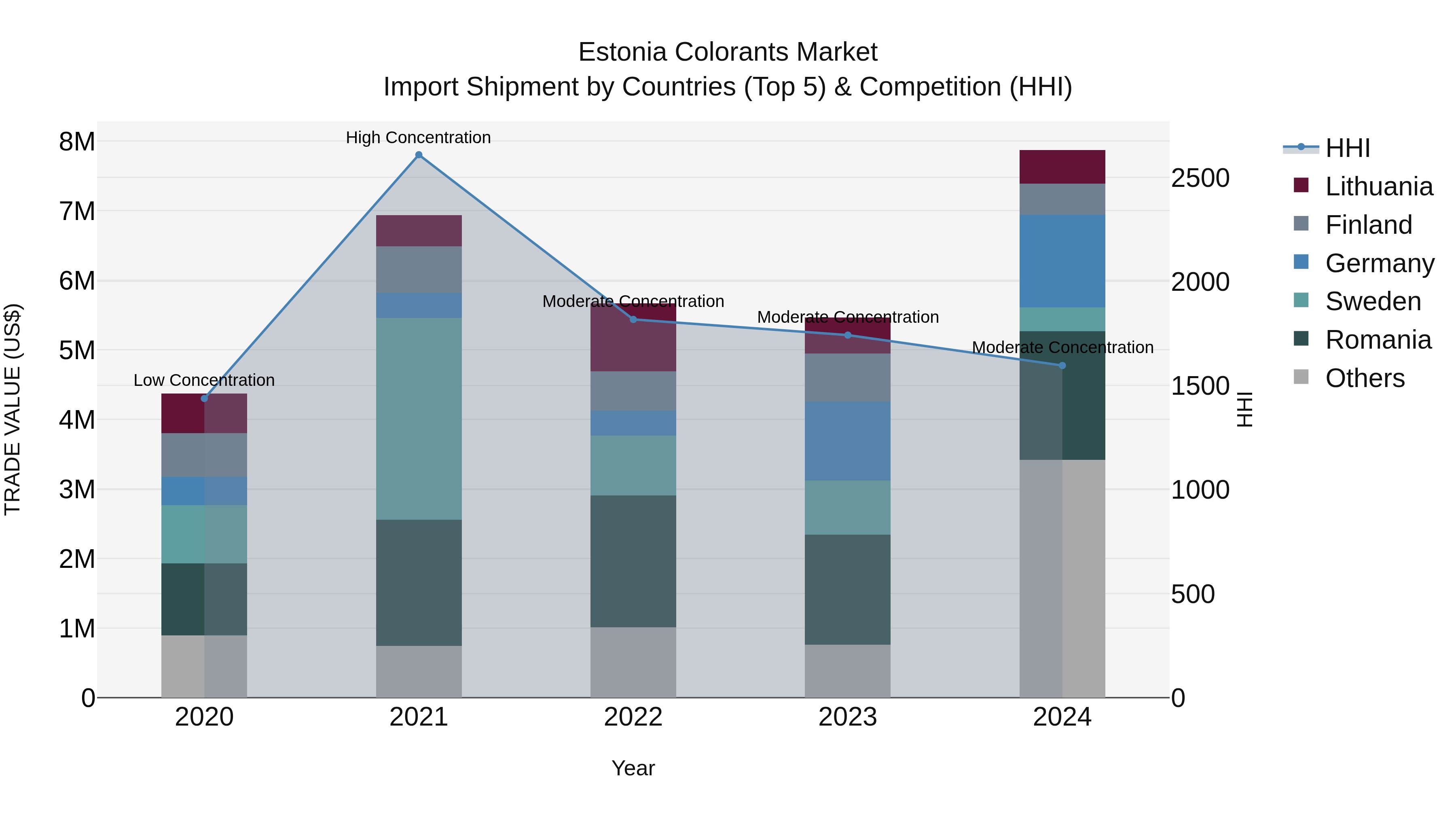
Estonia Colorants Market Overview
Colorants are widely used in Estonias food, textile, and plastics industries. The market growth aligns with demand for vibrant and stable colors, though it faces regulatory scrutiny over ingredient safety.
Drivers of the market
The colorants market in Estonia is growing as the demand for vibrant and visually appealing products increases in industries such as food and beverages, textiles, and cosmetics. Colorants are widely used to enhance the appearance of products, making them more attractive to consumers. The food and beverage industry, in particular, is a major driver, as manufacturers look for natural and synthetic colorants to meet consumer preferences. The increasing focus on clean-label products, as well as the rise in demand for non-toxic and organic colorants, is shaping the market and leading to innovations in colorant technologies.
Challenges of the market
The Estonia Colorants Market is influenced by challenges such as regulatory constraints and the increasing demand for sustainable and non-toxic alternatives. Colorants, which are used in industries ranging from textiles to food and beverages, require compliance with stringent EU regulations regarding safety and environmental impact. In Estonia, the small size of the market for colorants means that companies often struggle to achieve economies of scale. Additionally, the increasing preference for natural and plant-based colorants poses a challenge for traditional synthetic colorant producers, requiring them to adapt their formulations to meet consumer expectations while remaining competitive on price.
Government Policy of the market
In the colorants market, Estonia prioritizes sustainability and eco-friendly solutions. The government supports the development of innovative, non-toxic, and biodegradable colorants, particularly for the food, cosmetics, and textile industries. Policies encourage compliance with EU regulations for chemical safety and product labeling. Estonia also fosters research into alternative sources for colorants, such as natural and plant-based options, to reduce environmental impact.
Key Highlights of the Report:
- Estonia Colorants Market Outlook
- Market Size of Estonia Colorants Market, 2024
- Forecast of Estonia Colorants Market, 2031
- Historical Data and Forecast of Estonia Colorants Revenues & Volume for the Period 2021-2031
- Estonia Colorants Market Trend Evolution
- Estonia Colorants Market Drivers and Challenges
- Estonia Colorants Price Trends
- Estonia Colorants Porter`s Five Forces
- Estonia Colorants Industry Life Cycle
- Historical Data and Forecast of Estonia Colorants Market Revenues & Volume By Type for the Period 2021-2031
- Historical Data and Forecast of Estonia Colorants Market Revenues & Volume By Dyes for the Period 2021-2031
- Historical Data and Forecast of Estonia Colorants Market Revenues & Volume By Pigments for the Period 2021-2031
- Historical Data and Forecast of Estonia Colorants Market Revenues & Volume By Masterbatches for the Period 2021-2031
- Historical Data and Forecast of Estonia Colorants Market Revenues & Volume By Color Concentrates for the Period 2021-2031
- Historical Data and Forecast of Estonia Colorants Market Revenues & Volume By End Use Industry for the Period 2021-2031
- Historical Data and Forecast of Estonia Colorants Market Revenues & Volume By Packaging for the Period 2021-2031
- Historical Data and Forecast of Estonia Colorants Market Revenues & Volume By Building & Construction for the Period 2021-2031
- Historical Data and Forecast of Estonia Colorants Market Revenues & Volume By Automotive for the Period 2021-2031
- Historical Data and Forecast of Estonia Colorants Market Revenues & Volume By Textiles for the Period 2021-2031
- Historical Data and Forecast of Estonia Colorants Market Revenues & Volume By Paper & Printing for the Period 2021-2031
- Estonia Colorants Import Export Trade Statistics
- Market Opportunity Assessment By Type
- Market Opportunity Assessment By End Use Industry
- Estonia Colorants Top Companies Market Share
- Estonia Colorants Competitive Benchmarking By Technical and Operational Parameters
- Estonia Colorants Company Profiles
- Estonia Colorants Key Strategic Recommendations






































