Estonia Construction Plastics Market Top 5 Importing Countries and Market Competition (HHI) Analysis
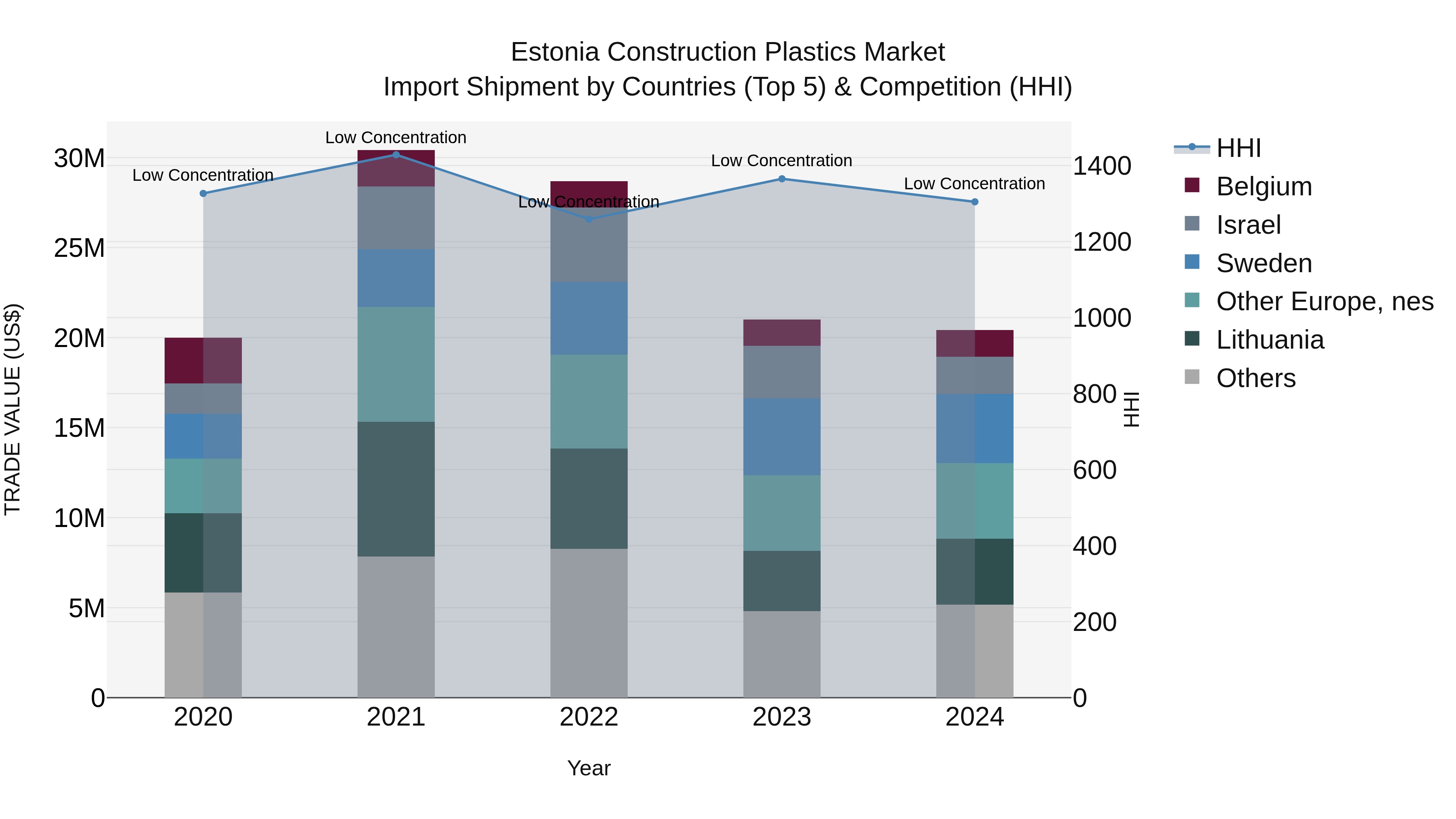
Estonia`s construction plastics import market in 2024 continued to see diversified sources with top exporters being Other Europe, nes, Sweden, Lithuania, Israel, and Belgium. The market displayed low concentration with the Herfindahl-Hirschman Index (HHI) remaining at a low level. Despite a modest compound annual growth rate (CAGR) of 0.51% from 2020 to 2024, there was a slight decline in growth rate of -2.82% from 2023 to 2024. This indicates a stable but slightly declining trend in the import shipments of construction plastics to Estonia.
Estonia Construction Plastics Market Overview
The construction plastics market in Estonia is growing as demand for lightweight, durable, and cost-effective materials increases. Plastics are used in a wide range of applications, from insulation and piping to roofing and windows. As the construction industry continues to innovate, the demand for construction plastics in Estonia is expected to expand.
Drivers of the market
The construction plastics market in Estonia is growing as plastics are increasingly used in building applications such as piping, insulation, windows, and flooring. Plastics offer advantages like durability, flexibility, and resistance to corrosion, making them ideal for construction projects in both residential and commercial sectors. The market is also influenced by the shift toward sustainable, recyclable plastics that meet the increasing demand for green construction materials.
Challenges of the market
The construction plastics market faces criticism over environmental concerns related to plastic waste and recycling. Regulatory pressures to adopt sustainable practices further complicate market operations. High costs of advanced plastic materials also limit widespread adoption.
Government Policy of the market
The government encourages the development and use of recyclable construction plastics. Policies aim to reduce waste and promote sustainability in the construction sector.
Key Highlights of the Report:
- Estonia Construction Plastics Market Outlook
- Market Size of Estonia Construction Plastics Market, 2024
- Forecast of Estonia Construction Plastics Market, 2031
- Historical Data and Forecast of Estonia Construction Plastics Revenues & Volume for the Period 2021-2031
- Estonia Construction Plastics Market Trend Evolution
- Estonia Construction Plastics Market Drivers and Challenges
- Estonia Construction Plastics Price Trends
- Estonia Construction Plastics Porter`s Five Forces
- Estonia Construction Plastics Industry Life Cycle
- Historical Data and Forecast of Estonia Construction Plastics Market Revenues & Volume By Type for the Period 2021-2031
- Historical Data and Forecast of Estonia Construction Plastics Market Revenues & Volume By Pvc for the Period 2021-2031
- Historical Data and Forecast of Estonia Construction Plastics Market Revenues & Volume By Polyurethane for the Period 2021-2031
- Historical Data and Forecast of Estonia Construction Plastics Market Revenues & Volume By Polypropylene for the Period 2021-2031
- Historical Data and Forecast of Estonia Construction Plastics Market Revenues & Volume By Polyethylene for the Period 2021-2031
- Historical Data and Forecast of Estonia Construction Plastics Market Revenues & Volume By Application for the Period 2021-2031
- Historical Data and Forecast of Estonia Construction Plastics Market Revenues & Volume By Window for the Period 2021-2031
- Historical Data and Forecast of Estonia Construction Plastics Market Revenues & Volume By Roofing for the Period 2021-2031
- Historical Data and Forecast of Estonia Construction Plastics Market Revenues & Volume By Flooring for the Period 2021-2031
- Historical Data and Forecast of Estonia Construction Plastics Market Revenues & Volume By Insulation for the Period 2021-2031
- Historical Data and Forecast of Estonia Construction Plastics Market Revenues & Volume By Piping for the Period 2021-2031
- Estonia Construction Plastics Import Export Trade Statistics
- Market Opportunity Assessment By Type
- Market Opportunity Assessment By Application
- Estonia Construction Plastics Top Companies Market Share
- Estonia Construction Plastics Competitive Benchmarking By Technical and Operational Parameters
- Estonia Construction Plastics Company Profiles
- Estonia Construction Plastics Key Strategic Recommendations






































