Estonia Football Market Top 5 Importing Countries and Market Competition (HHI) Analysis
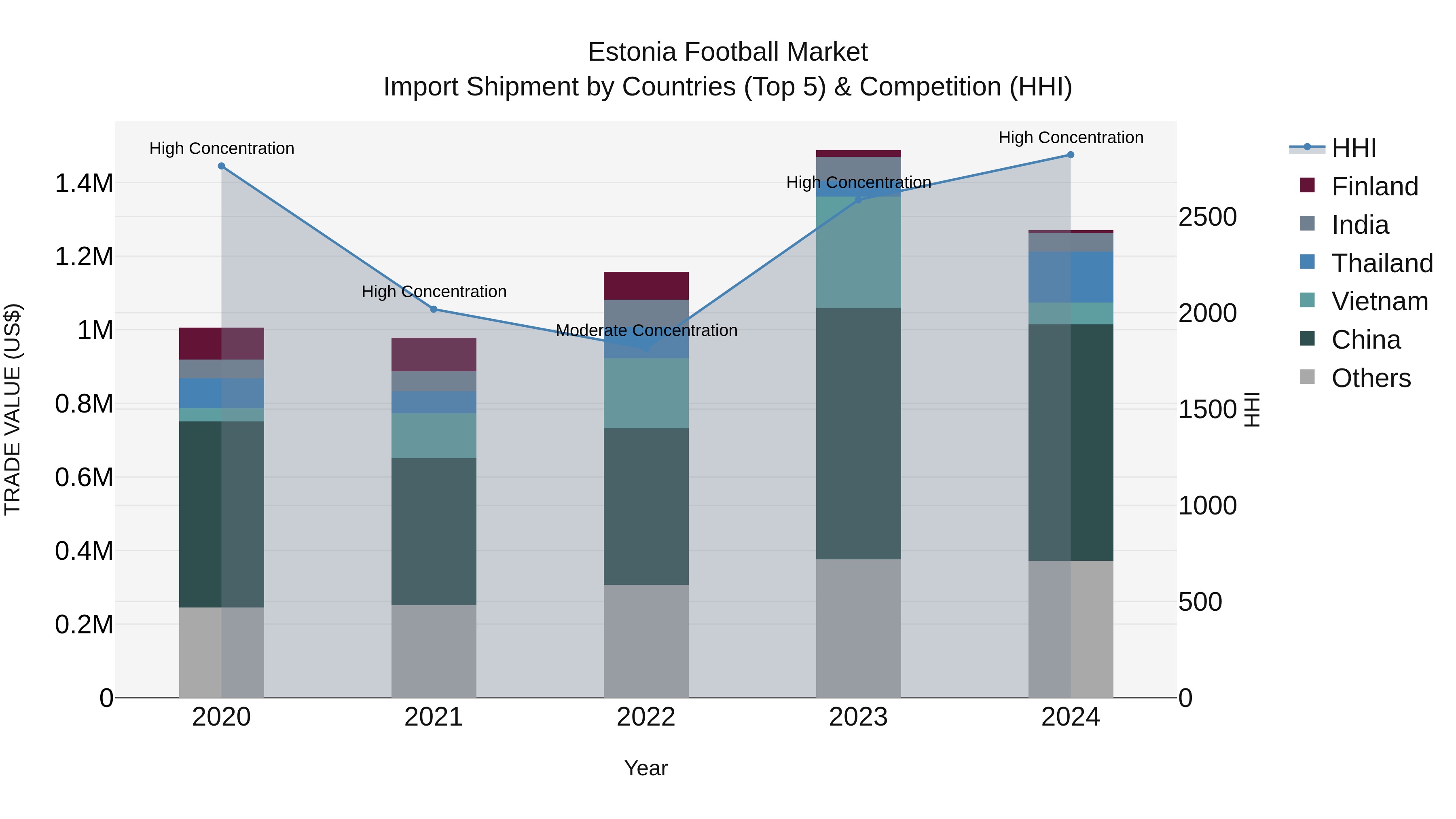
The Estonia football import market continued to be dominated by imports from China, Thailand, Malaysia, Pakistan, and Vietnam in 2024, showcasing a high level of concentration with a high Herfindahl-Hirschman Index (HHI). Despite a healthy compound annual growth rate (CAGR) of 6.0% from 2020 to 2024, there was a notable decline in the growth rate from 2023 to 2024 at -14.64%. This suggests a potential shift or slowdown in the market dynamics, which may require further analysis to understand the underlying factors impacting the import shipments in the football industry in Estonia.
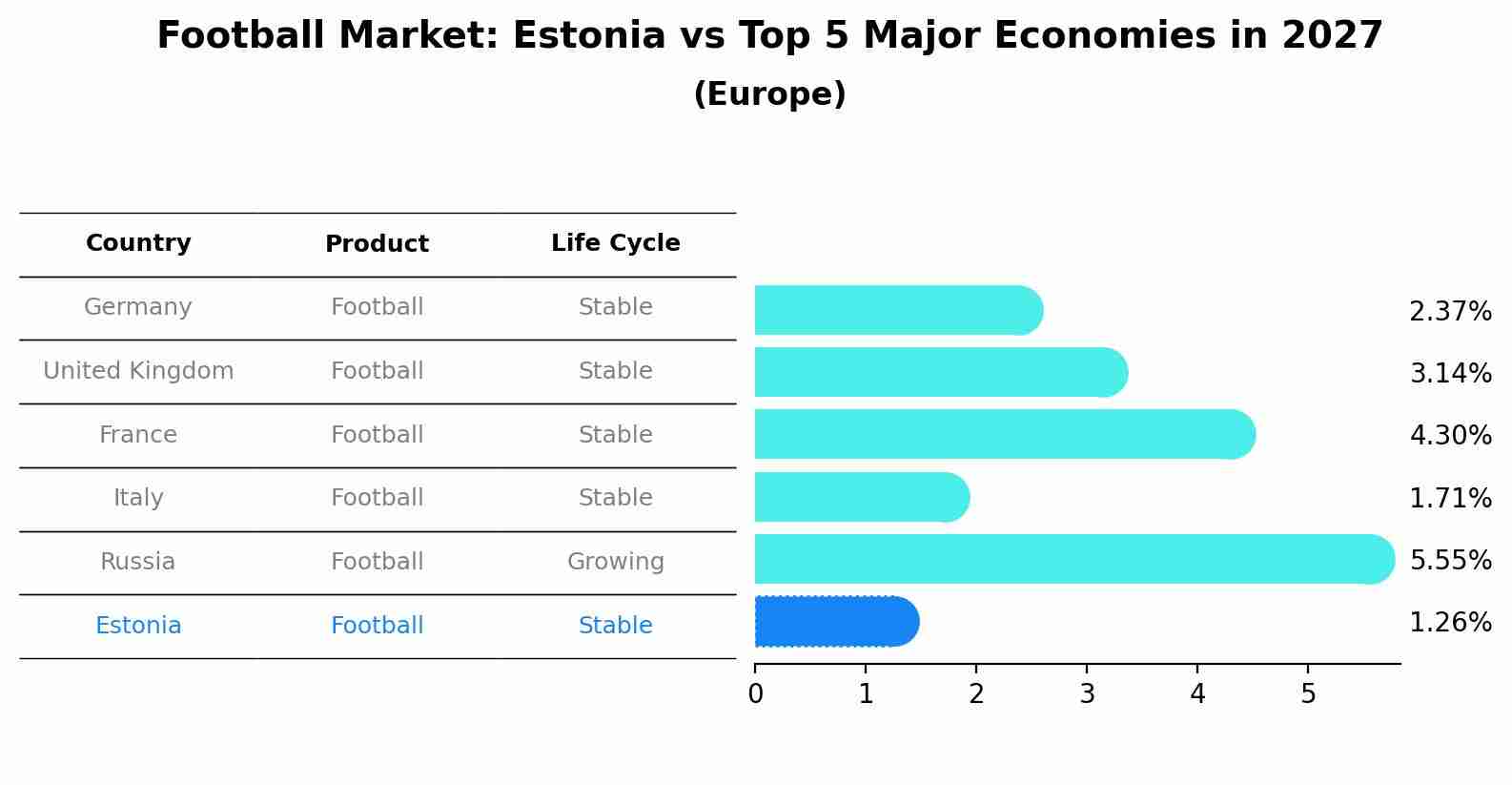
Football Market: Estonia vs Top 5 Major Economies in 2027 (Europe)
By 2027, the Football market in Estonia is anticipated to reach a growth rate of 1.26%, as part of an increasingly competitive Europe region, where Germany remains at the forefront, supported by United Kingdom, France, Italy and Russia, driving innovations and market adoption across sectors.
Key Highlights of the Report:
- Estonia Football Market Outlook
- Market Size of Estonia Football Market, 2025
- Forecast of Estonia Football Market, 2032
- Historical Data and Forecast of Estonia Football Revenues & Volume for the Period 2022 - 2032F
- Estonia Football Market Trend Evolution
- Estonia Football Market Drivers and Challenges
- Estonia Football Price Trends
- Estonia Football Porter`s Five Forces
- Estonia Football Industry Life Cycle
- Historical Data and Forecast of Estonia Football Market Revenues & Volume By Type for the Period 2022 - 2032F
- Historical Data and Forecast of Estonia Football Market Revenues & Volume By Training Ball for the Period 2022 - 2032F
- Historical Data and Forecast of Estonia Football Market Revenues & Volume By Match Ball for the Period 2022 - 2032F
- Historical Data and Forecast of Estonia Football Market Revenues & Volume By Others for the Period 2022 - 2032F
- Historical Data and Forecast of Estonia Football Market Revenues & Volume By Manufacturing Process for the Period 2022 - 2032F
- Historical Data and Forecast of Estonia Football Market Revenues & Volume By Hand Stitched for the Period 2022 - 2032F
- Historical Data and Forecast of Estonia Football Market Revenues & Volume By Machine Stitched for the Period 2022 - 2032F
- Historical Data and Forecast of Estonia Football Market Revenues & Volume By Thermally Bonded for the Period 2022 - 2032F
- Historical Data and Forecast of Estonia Football Market Revenues & Volume By Distribution Channel for the Period 2022 - 2032F
- Historical Data and Forecast of Estonia Football Market Revenues & Volume By Online for the Period 2022 - 2032F
- Historical Data and Forecast of Estonia Football Market Revenues & Volume By Offline for the Period 2022 - 2032F
- Estonia Football Import Export Trade Statistics
- Market Opportunity Assessment By Type
- Market Opportunity Assessment By Manufacturing Process
- Market Opportunity Assessment By Distribution Channel
- Estonia Football Top Companies Market Share
- Estonia Football Competitive Benchmarking By Technical and Operational Parameters
- Estonia Football Company Profiles
- Estonia Football Key Strategic Recommendations






































