Estonia Industrial Evaporators Market Top 5 Importing Countries and Market Competition (HHI) Analysis
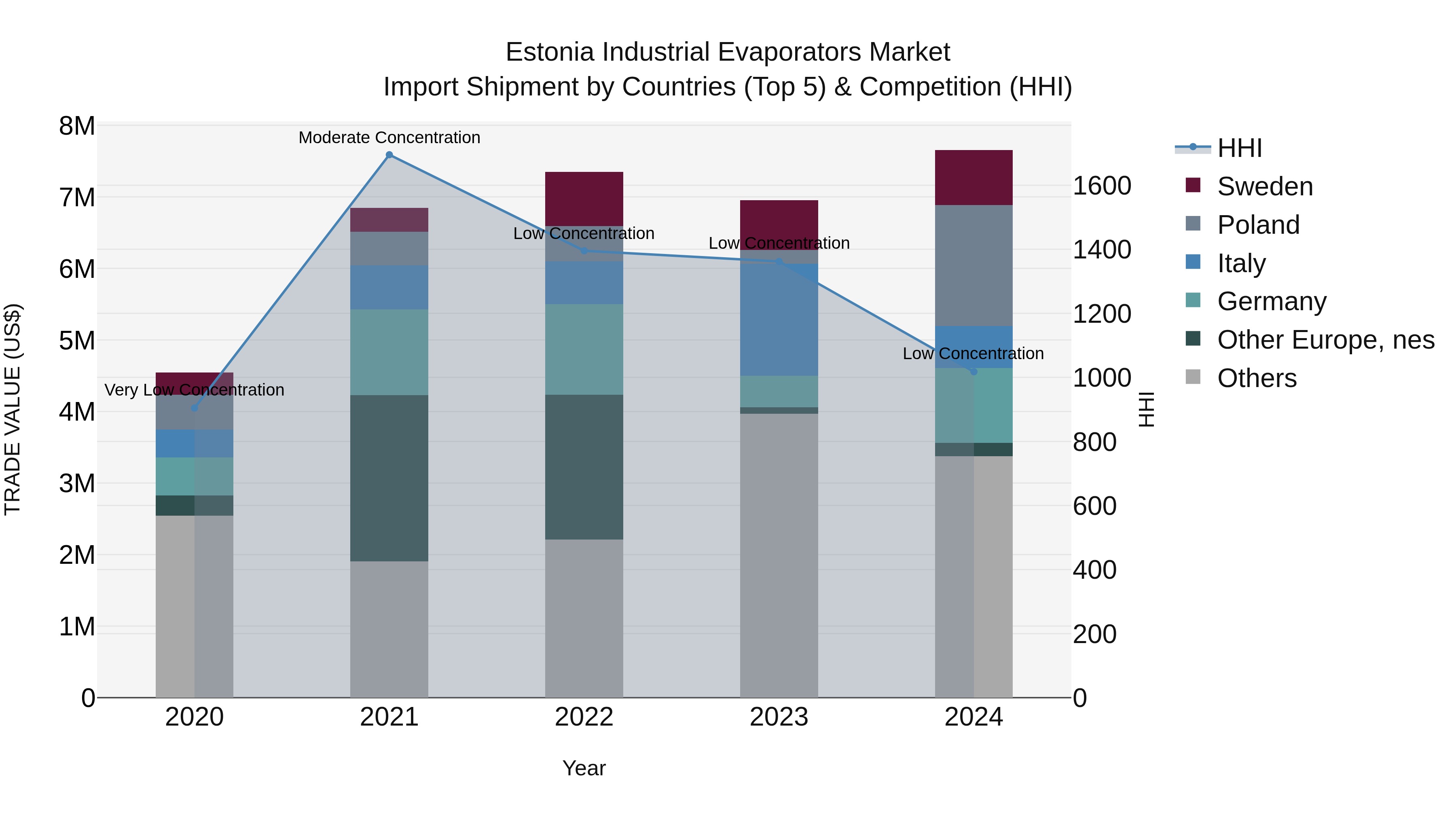
Estonia`s industrial evaporator import market in 2024 saw significant growth with a CAGR of 13.92% from 2020-24. Top exporting countries like Poland, Germany, Sweden, Finland, and Italy contributed to this expansion. Despite the increasing imports, market concentration, as measured by the HHI, remained low in 2024. The growth rate from 2023-24 of 10.02% indicates a positive trend in the industry, suggesting continued opportunities for international suppliers in the Estonian market.
Estonia Industrial Evaporators Market Overview
The industrial evaporators market in Estonia is expanding due to the growing demand for heat transfer solutions in various industries. Evaporators are used to concentrate liquids, remove solvents, and facilitate the recovery of valuable components in industries like food processing, pharmaceuticals, and chemicals. The need for energy-efficient and reliable evaporators is increasing as industries aim to reduce operational costs and enhance process efficiency. Additionally, advancements in evaporator technology, such as multi-effect evaporation systems and innovations in heat recovery, are driving the markets growth in Estonia.
Drivers of the market
The industrial evaporators market in Estonia is driven by the need for efficient thermal processing in industries such as food and beverage, chemicals, and pharmaceuticals. Evaporators are essential in concentrating liquids, recycling heat, and reducing the volume of waste products. With growing industrial demand for energy-efficient solutions, Estonias industrial sector is increasingly adopting advanced evaporators that support sustainability goals and cost reductions. The need for better resource management and energy savings in Estonias diverse industrial landscape is a major driver of the market for industrial evaporators.
Challenges of the market
The industrial evaporators market in Estonia is influenced by challenges such as the rising demand for energy-efficient and cost-effective evaporation systems, particularly in industries like food processing, chemicals, and pharmaceuticals. The market is under pressure to develop evaporators that maximize energy efficiency, minimize water consumption, and comply with environmental regulations. Additionally, the complexity of designing and manufacturing highly customized evaporator systems, which can handle diverse operating conditions and materials, adds to the production cost and time constraints.
Government Policy of the market
Estonian government policies in the industrial evaporators market focus on supporting energy-efficient and environmentally friendly evaporative technologies. The government promotes the adoption of evaporators in industries such as chemical processing and water treatment while ensuring compliance with EU regulations on waste management, energy use, and emissions reduction.
Key Highlights of the Report:
- Estonia Industrial Evaporators Market Outlook
- Market Size of Estonia Industrial Evaporators Market, 2024
- Forecast of Estonia Industrial Evaporators Market, 2031
- Historical Data and Forecast of Estonia Industrial Evaporators Revenues & Volume for the Period 2021-2031
- Estonia Industrial Evaporators Market Trend Evolution
- Estonia Industrial Evaporators Market Drivers and Challenges
- Estonia Industrial Evaporators Price Trends
- Estonia Industrial Evaporators Porter`s Five Forces
- Estonia Industrial Evaporators Industry Life Cycle
- Historical Data and Forecast of Estonia Industrial Evaporators Market Revenues & Volume By Construction Type for the Period 2021-2031
- Historical Data and Forecast of Estonia Industrial Evaporators Market Revenues & Volume By Shell & Tube for the Period 2021-2031
- Historical Data and Forecast of Estonia Industrial Evaporators Market Revenues & Volume By Plate for the Period 2021-2031
- Historical Data and Forecast of Estonia Industrial Evaporators Market Revenues & Volume By End Use Industry for the Period 2021-2031
- Historical Data and Forecast of Estonia Industrial Evaporators Market Revenues & Volume By Food & Beverage for the Period 2021-2031
- Historical Data and Forecast of Estonia Industrial Evaporators Market Revenues & Volume By Pharmaceutical for the Period 2021-2031
- Historical Data and Forecast of Estonia Industrial Evaporators Market Revenues & Volume By Chemical & Petrochemical for the Period 2021-2031
- Historical Data and Forecast of Estonia Industrial Evaporators Market Revenues & Volume By Automotive for the Period 2021-2031
- Historical Data and Forecast of Estonia Industrial Evaporators Market Revenues & Volume By Functionality for the Period 2021-2031
- Historical Data and Forecast of Estonia Industrial Evaporators Market Revenues & Volume By Falling Film for the Period 2021-2031
- Historical Data and Forecast of Estonia Industrial Evaporators Market Revenues & Volume By Rising Film for the Period 2021-2031
- Estonia Industrial Evaporators Import Export Trade Statistics
- Market Opportunity Assessment By Construction Type
- Market Opportunity Assessment By End Use Industry
- Market Opportunity Assessment By Functionality
- Estonia Industrial Evaporators Top Companies Market Share
- Estonia Industrial Evaporators Competitive Benchmarking By Technical and Operational Parameters
- Estonia Industrial Evaporators Company Profiles
- Estonia Industrial Evaporators Key Strategic Recommendations






































