Estonia Industrial Rubber Products Market Top 5 Importing Countries and Market Competition (HHI) Analysis
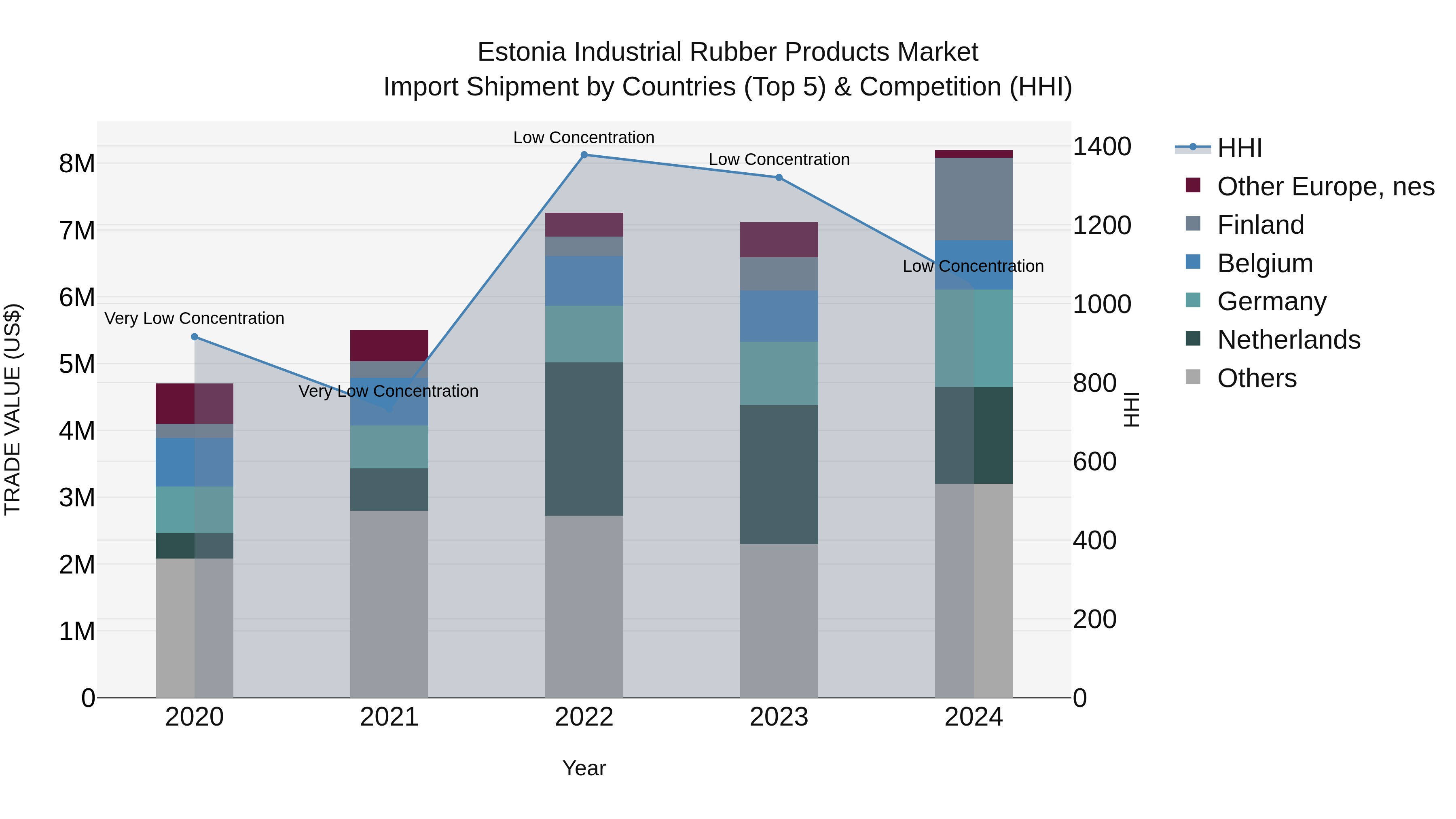
Estonia`s industrial rubber products import market in 2024 continued to thrive, with Germany, Netherlands, Finland, Belgium, and Poland emerging as top exporters. The market remained competitive and diversified, with a low Herfindahl-Hirschman Index (HHI) indicating a healthy level of concentration. The impressive Compound Annual Growth Rate (CAGR) of 14.88% from 2020 to 2024 signifies sustained growth and opportunities for stakeholders. Additionally, the growth rate of 15.14% from 2023 to 2024 indicates a strong upward trajectory for the market, making it an attractive sector for investment and expansion.
Estonia Industrial Rubber Products Market Overview
The industrial rubber market in Estonia caters to industries such as automotive, construction, and manufacturing, where rubber is used in various products like seals, gaskets, belts, and hoses. With the growth of the automotive and industrial sectors, there is rising demand for high-performance rubber materials that are durable, heat-resistant, and capable of handling demanding applications.
Drivers of the market
The market for industrial rubber products in Estonia is growing as industries seek reliable, durable, and versatile materials for manufacturing a wide range of components. Rubber products, such as seals, hoses, belts, and gaskets, are essential for industrial applications, helping to reduce friction, wear, and leakage in equipment. With Estonias growing industrial sector, including automotive and manufacturing industries, the demand for industrial rubber products continues to rise. Moreover, the increasing focus on quality control and cost efficiency further accelerates market growth as businesses strive to improve productivity and minimize downtime.
Challenges of the market
The industrial rubber products market faces similar challenges to the broader industrial rubber market but with the added complexity of meeting specialized requirements across a diverse range of industries. Manufacturers are under pressure to develop rubber seals, gaskets, hoses, and belts that are not only durable and high-performing but also capable of meeting strict safety and environmental standards. The high cost of advanced rubber compounds and production processes, along with increasing competition from synthetic and alternative materials, further complicates market dynamics. Additionally, the demand for more sustainable products is pushing manufacturers to invest in research and development, which raises costs and extends product development timelines.
Government Policy of the market
Estonian policies in the industrial rubber products market support the production of high-quality, durable rubber products that meet safety and environmental standards. The government promotes innovation in the use of sustainable materials and processes that reduce the environmental impact of rubber manufacturing, aligning with EU directives on waste management and recycling.
Key Highlights of the Report:
- Estonia Industrial Rubber Products Market Outlook
- Market Size of Estonia Industrial Rubber Products Market, 2024
- Forecast of Estonia Industrial Rubber Products Market, 2031
- Historical Data and Forecast of Estonia Industrial Rubber Products Revenues & Volume for the Period 2021-2031
- Estonia Industrial Rubber Products Market Trend Evolution
- Estonia Industrial Rubber Products Market Drivers and Challenges
- Estonia Industrial Rubber Products Price Trends
- Estonia Industrial Rubber Products Porter`s Five Forces
- Estonia Industrial Rubber Products Industry Life Cycle
- Historical Data and Forecast of Estonia Industrial Rubber Products Market Revenues & Volume By Rubber Type for the Period 2021-2031
- Historical Data and Forecast of Estonia Industrial Rubber Products Market Revenues & Volume By Natural Rubber for the Period 2021-2031
- Historical Data and Forecast of Estonia Industrial Rubber Products Market Revenues & Volume By Styrene Butadiene Rubber for the Period 2021-2031
- Historical Data and Forecast of Estonia Industrial Rubber Products Market Revenues & Volume By Polybutadiene for the Period 2021-2031
- Historical Data and Forecast of Estonia Industrial Rubber Products Market Revenues & Volume By Ethylene-propylene for the Period 2021-2031
- Historical Data and Forecast of Estonia Industrial Rubber Products Market Revenues & Volume By Nitrile Butadiene Rubber for the Period 2021-2031
- Historical Data and Forecast of Estonia Industrial Rubber Products Market Revenues & Volume By Others for the Period 2021-2031
- Historical Data and Forecast of Estonia Industrial Rubber Products Market Revenues & Volume By Process for the Period 2021-2031
- Historical Data and Forecast of Estonia Industrial Rubber Products Market Revenues & Volume By Molded for the Period 2021-2031
- Historical Data and Forecast of Estonia Industrial Rubber Products Market Revenues & Volume By Extruded for the Period 2021-2031
- Historical Data and Forecast of Estonia Industrial Rubber Products Market Revenues & Volume By Fabricated for the Period 2021-2031
- Historical Data and Forecast of Estonia Industrial Rubber Products Market Revenues & Volume By Latex-Based for the Period 2021-2031
- Historical Data and Forecast of Estonia Industrial Rubber Products Market Revenues & Volume By Others for the Period 2021-2031
- Historical Data and Forecast of Estonia Industrial Rubber Products Market Revenues & Volume By Product for the Period 2021-2031
- Historical Data and Forecast of Estonia Industrial Rubber Products Market Revenues & Volume By Mechanical Rubber Products for the Period 2021-2031
- Historical Data and Forecast of Estonia Industrial Rubber Products Market Revenues & Volume By Rubber Hoses for the Period 2021-2031
- Historical Data and Forecast of Estonia Industrial Rubber Products Market Revenues & Volume By Rubber Belts for the Period 2021-2031
- Historical Data and Forecast of Estonia Industrial Rubber Products Market Revenues & Volume By Rubber Roofing for the Period 2021-2031
- Historical Data and Forecast of Estonia Industrial Rubber Products Market Revenues & Volume By Others for the Period 2021-2031
- Historical Data and Forecast of Estonia Industrial Rubber Products Market Revenues & Volume By End-use for the Period 2021-2031
- Historical Data and Forecast of Estonia Industrial Rubber Products Market Revenues & Volume By Construction & Infrastructure for the Period 2021-2031
- Historical Data and Forecast of Estonia Industrial Rubber Products Market Revenues & Volume By Automotive for the Period 2021-2031
- Historical Data and Forecast of Estonia Industrial Rubber Products Market Revenues & Volume By Aerospace for the Period 2021-2031
- Historical Data and Forecast of Estonia Industrial Rubber Products Market Revenues & Volume By Energy for the Period 2021-2031
- Historical Data and Forecast of Estonia Industrial Rubber Products Market Revenues & Volume By Others for the Period 2021-2031
- Estonia Industrial Rubber Products Import Export Trade Statistics
- Market Opportunity Assessment By Rubber Type
- Market Opportunity Assessment By Process
- Market Opportunity Assessment By Product
- Market Opportunity Assessment By End-use
- Estonia Industrial Rubber Products Top Companies Market Share
- Estonia Industrial Rubber Products Competitive Benchmarking By Technical and Operational Parameters
- Estonia Industrial Rubber Products Company Profiles
- Estonia Industrial Rubber Products Key Strategic Recommendations






































