Estonia Magnesium Sulfate Market Top 5 Importing Countries and Market Competition (HHI) Analysis
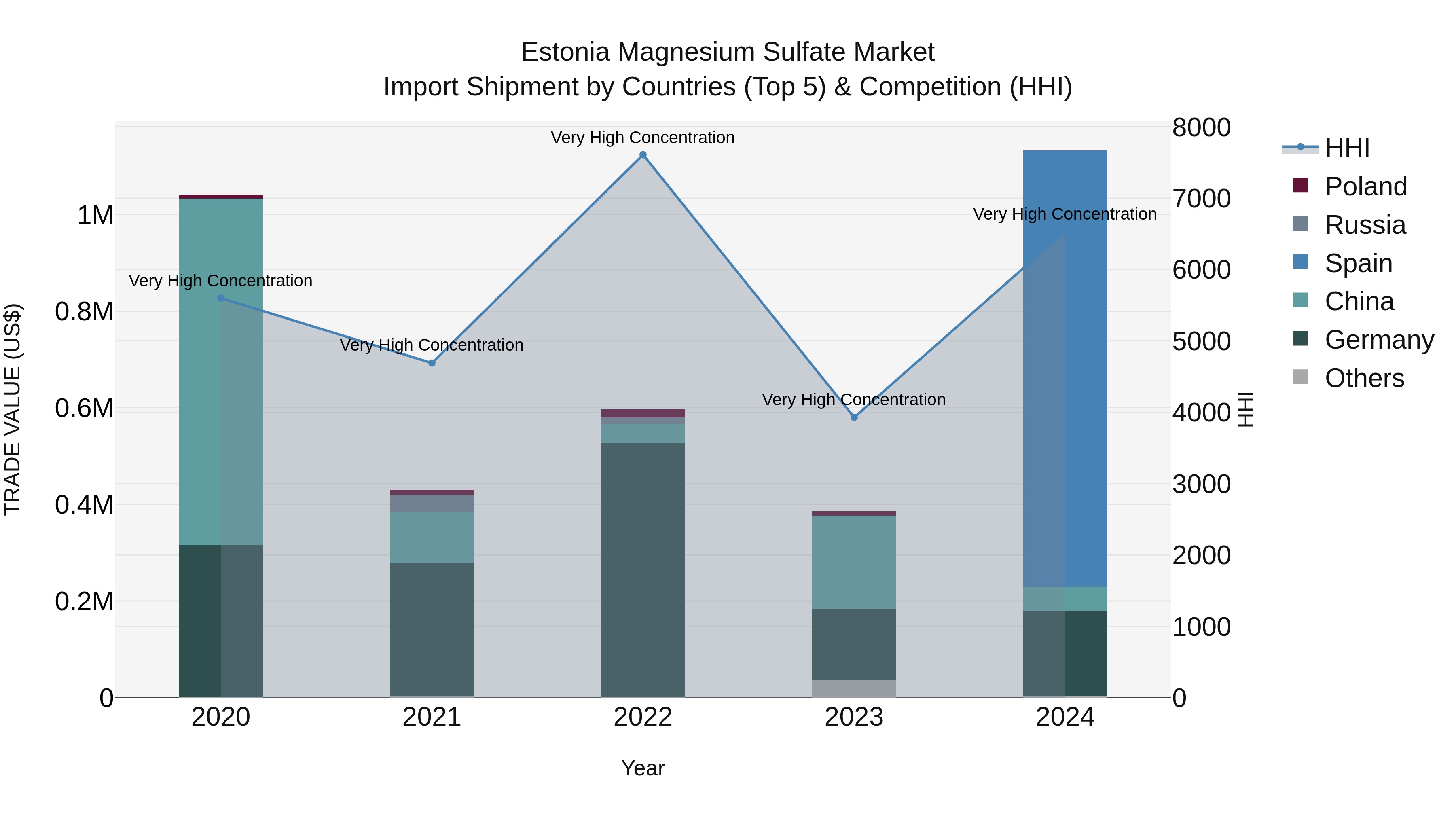
Estonia`s magnesium sulfate import market in 2024 continued to be dominated by top exporters such as Spain, Germany, China, Netherlands, and Poland, indicating strong trade relationships. The Herfindahl-Hirschman Index (HHI) remained at high concentration levels, suggesting limited competition among suppliers. The compound annual growth rate (CAGR) for the period 2020-2024 stood at 2.14%, reflecting steady growth. Notably, the growth rate from 2023 to 2024 surged impressively by 193.43%, indicating a notable expansion in import volumes within a short timeframe. This data highlights the significance of magnesium sulfate imports for Estonia`s market dynamics.
Estonia Magnesium Sulfate Market Overview
The magnesium sulfate market in Estonia is expanding, supported by its use in agriculture, pharmaceuticals, and industrial applications. Magnesium sulfate is commonly used as a fertilizer, as well as in the production of textiles, detergents, and personal care products. The growing agricultural sector in Estonia, along with increasing demand for magnesium sulfate in health and wellness products, is driving the market.
Drivers of the market
The Estonia magnesium sulfate market is driven by its use in a range of applications, including agriculture, pharmaceuticals, and food processing. In agriculture, magnesium sulfate is used as a fertilizer to address magnesium deficiency in soils, while in pharmaceuticals, it serves as a laxative and a treatment for various health conditions. The increasing demand for sustainable farming practices and the growing global population, which drives food production needs, contribute to the demand for magnesium sulfate. Additionally, the expanding healthcare sector and the growing use of magnesium sulfate in dietary supplements further support market growth.
Challenges of the market
The Estonia Magnesium Sulfate Market faces challenges related to supply chain disruptions and competition from synthetic alternatives. Magnesium sulfate, used in agriculture, pharmaceuticals, and industrial processes, is derived from naturally occurring minerals. However, disruptions in the availability of these sources can lead to supply shortages. Additionally, the increasing use of synthetic alternatives in agriculture and industrial applications presents a challenge to the growth of the magnesium sulfate market.
Government Policy of the market
The Estonian government encourages the use of magnesium sulfate in agriculture and pharmaceuticals by supporting local production and export initiatives. Policies ensure alignment with EU environmental and safety regulations.
Key Highlights of the Report:
- Estonia Magnesium Sulfate Market Outlook
- Market Size of Estonia Magnesium Sulfate Market, 2024
- Forecast of Estonia Magnesium Sulfate Market, 2031
- Historical Data and Forecast of Estonia Magnesium Sulfate Revenues & Volume for the Period 2021-2031
- Estonia Magnesium Sulfate Market Trend Evolution
- Estonia Magnesium Sulfate Market Drivers and Challenges
- Estonia Magnesium Sulfate Price Trends
- Estonia Magnesium Sulfate Porter`s Five Forces
- Estonia Magnesium Sulfate Industry Life Cycle
- Historical Data and Forecast of Estonia Magnesium Sulfate Market Revenues & Volume By Form for the Period 2021-2031
- Historical Data and Forecast of Estonia Magnesium Sulfate Market Revenues & Volume By Crystal for the Period 2021-2031
- Historical Data and Forecast of Estonia Magnesium Sulfate Market Revenues & Volume By Powder for the Period 2021-2031
- Historical Data and Forecast of Estonia Magnesium Sulfate Market Revenues & Volume By Granules for the Period 2021-2031
- Historical Data and Forecast of Estonia Magnesium Sulfate Market Revenues & Volume By Types for the Period 2021-2031
- Historical Data and Forecast of Estonia Magnesium Sulfate Market Revenues & Volume By Heptahydrate for the Period 2021-2031
- Historical Data and Forecast of Estonia Magnesium Sulfate Market Revenues & Volume By Anhydrous for the Period 2021-2031
- Historical Data and Forecast of Estonia Magnesium Sulfate Market Revenues & Volume By Monohydrate for the Period 2021-2031
- Historical Data and Forecast of Estonia Magnesium Sulfate Market Revenues & Volume By Others for the Period 2021-2031
- Historical Data and Forecast of Estonia Magnesium Sulfate Market Revenues & Volume By Applications for the Period 2021-2031
- Historical Data and Forecast of Estonia Magnesium Sulfate Market Revenues & Volume By Fertilizer for the Period 2021-2031
- Historical Data and Forecast of Estonia Magnesium Sulfate Market Revenues & Volume By Medical for the Period 2021-2031
- Historical Data and Forecast of Estonia Magnesium Sulfate Market Revenues & Volume By Food Additive for the Period 2021-2031
- Historical Data and Forecast of Estonia Magnesium Sulfate Market Revenues & Volume By Industrial for the Period 2021-2031
- Historical Data and Forecast of Estonia Magnesium Sulfate Market Revenues & Volume By Chemical for the Period 2021-2031
- Historical Data and Forecast of Estonia Magnesium Sulfate Market Revenues & Volume By Others for the Period 2021-2031
- Estonia Magnesium Sulfate Import Export Trade Statistics
- Market Opportunity Assessment By Form
- Market Opportunity Assessment By Types
- Market Opportunity Assessment By Applications
- Estonia Magnesium Sulfate Top Companies Market Share
- Estonia Magnesium Sulfate Competitive Benchmarking By Technical and Operational Parameters
- Estonia Magnesium Sulfate Company Profiles
- Estonia Magnesium Sulfate Key Strategic Recommendations






































