Estonia Portable Battery Market Top 5 Importing Countries and Market Competition (HHI) Analysis
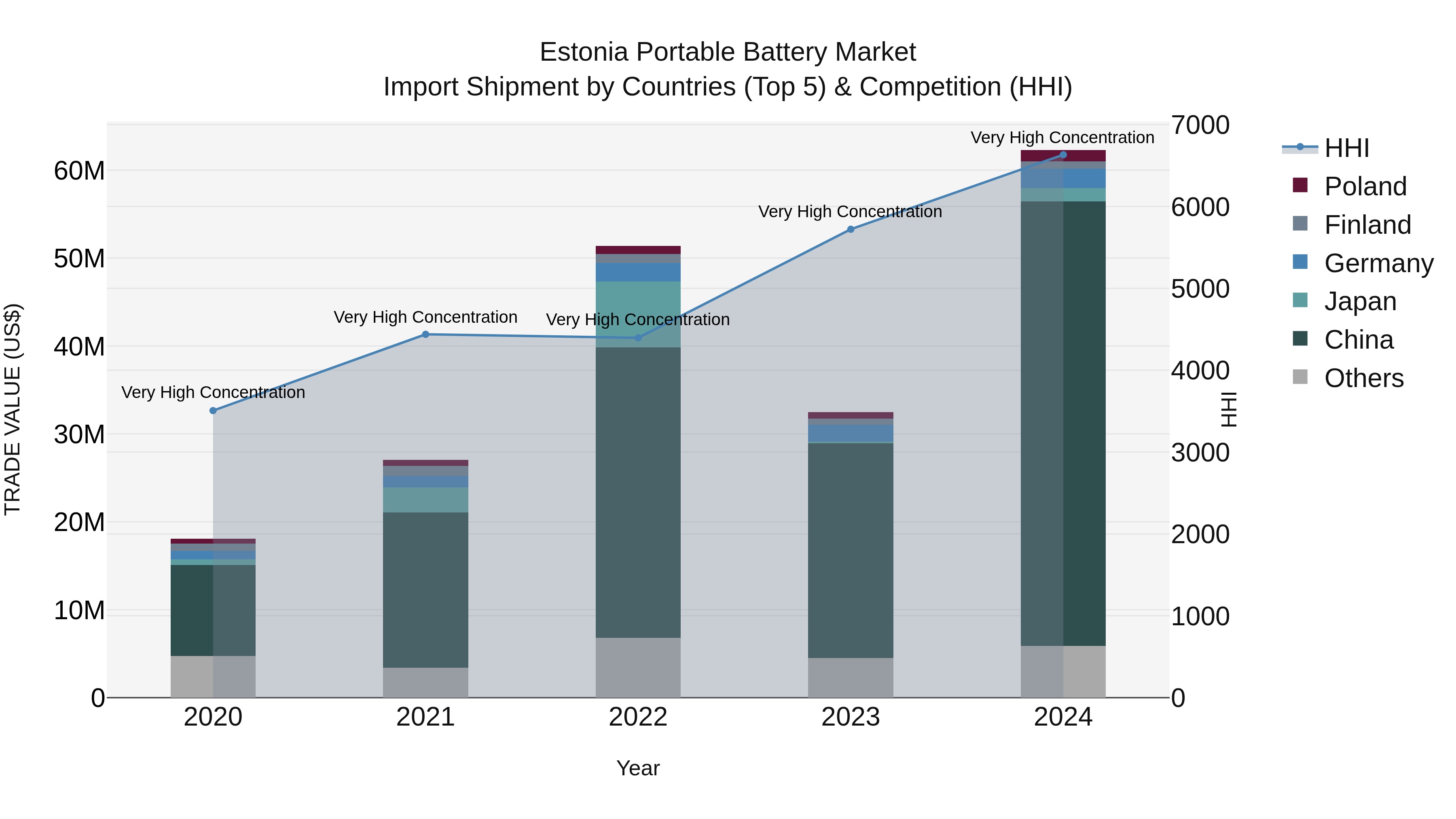
Estonia`s import of portable batteries in 2024 saw significant contributions from top exporting countries including China, Germany, Czechia, Japan, and Poland. The high Herfindahl-Hirschman Index (HHI) indicates a concentrated market. With a remarkable compound annual growth rate (CAGR) of 36.21% from 2020 to 2024, the industry is experiencing rapid expansion. The impressive growth rate of 91.75% from 2023 to 2024 highlights the increasing demand for portable batteries in Estonia, suggesting a promising market outlook for the industry in the coming years.
Estonia Portable Battery Market Overview
The portable battery market in Estonia is experiencing robust growth driven by the increasing use of portable electronics such as smartphones, laptops, and electric vehicles. As the demand for energy-efficient and long-lasting batteries continues to rise, the portable battery market is expected to expand. Additionally, the growing interest in renewable energy storage solutions is likely to drive further growth in the portable battery market in Estonia.
Drivers of the market
The portable battery market in Estonia is expanding with the increasing demand for mobile devices, electric vehicles, and renewable energy storage solutions. As consumer reliance on mobile technology and the adoption of electric vehicles rises, the demand for portable and rechargeable batteries continues to grow in Estonia.
Challenges of the market
The portable battery market in Estonia faces challenges related to technology development and the increasing demand for high-capacity, long-lasting batteries. As portable devices such as smartphones, laptops, and electric vehicles become more prevalent, the need for advanced batteries with higher energy densities is growing. However, the production of these batteries relies heavily on materials such as lithium, cobalt, and nickel, which are subject to supply chain risks and price fluctuations. Additionally, there is increasing pressure on battery manufacturers to address environmental concerns, particularly regarding the recycling and disposal of used batteries.
Government Policy of the market
The Estonian government encourages innovation in the portable battery market, focusing on sustainable energy solutions. Policies related to battery recycling and the reduction of hazardous materials ensure that manufacturers comply with EU environmental standards. The governments push for the adoption of electric vehicles and renewable energy systems boosts the demand for portable batteries. Additionally, Estonia supports research into battery technologies that offer improved efficiency, longer lifespan, and reduced environmental impact.
Key Highlights of the Report:
- Estonia Portable Battery Market Outlook
- Market Size of Estonia Portable Battery Market, 2024
- Forecast of Estonia Portable Battery Market, 2031
- Historical Data and Forecast of Estonia Portable Battery Revenues & Volume for the Period 2021-2031
- Estonia Portable Battery Market Trend Evolution
- Estonia Portable Battery Market Drivers and Challenges
- Estonia Portable Battery Price Trends
- Estonia Portable Battery Porter`s Five Forces
- Estonia Portable Battery Industry Life Cycle
- Historical Data and Forecast of Estonia Portable Battery Market Revenues & Volume By Type for the Period 2021-2031
- Historical Data and Forecast of Estonia Portable Battery Market Revenues & Volume By Lead Acid Battery for the Period 2021-2031
- Historical Data and Forecast of Estonia Portable Battery Market Revenues & Volume By Lithium-Ion Battery for the Period 2021-2031
- Historical Data and Forecast of Estonia Portable Battery Market Revenues & Volume By Nickel Cadmium Battery for the Period 2021-2031
- Historical Data and Forecast of Estonia Portable Battery Market Revenues & Volume By Nickel Metal Battery for the Period 2021-2031
- Historical Data and Forecast of Estonia Portable Battery Market Revenues & Volume By Others for the Period 2021-2031
- Historical Data and Forecast of Estonia Portable Battery Market Revenues & Volume By Capacity for the Period 2021-2031
- Historical Data and Forecast of Estonia Portable Battery Market Revenues & Volume By 0-2500 mAh for the Period 2021-2031
- Historical Data and Forecast of Estonia Portable Battery Market Revenues & Volume By 2500-5000 mAh for the Period 2021-2031
- Historical Data and Forecast of Estonia Portable Battery Market Revenues & Volume By 5000-10,400 mAh for the Period 2021-2031
- Historical Data and Forecast of Estonia Portable Battery Market Revenues & Volume By Above 10,400 mAh for the Period 2021-2031
- Historical Data and Forecast of Estonia Portable Battery Market Revenues & Volume By Application for the Period 2021-2031
- Historical Data and Forecast of Estonia Portable Battery Market Revenues & Volume By Mobile phones for the Period 2021-2031
- Historical Data and Forecast of Estonia Portable Battery Market Revenues & Volume By Wearable Accessories for the Period 2021-2031
- Historical Data and Forecast of Estonia Portable Battery Market Revenues & Volume By Others Electronic Devices for the Period 2021-2031
- Estonia Portable Battery Import Export Trade Statistics
- Market Opportunity Assessment By Type
- Market Opportunity Assessment By Capacity
- Market Opportunity Assessment By Application
- Estonia Portable Battery Top Companies Market Share
- Estonia Portable Battery Competitive Benchmarking By Technical and Operational Parameters
- Estonia Portable Battery Company Profiles
- Estonia Portable Battery Key Strategic Recommendations






































