Ethiopia Automotive Parts and Components Market Growth Rate Analysis (2021-2031)
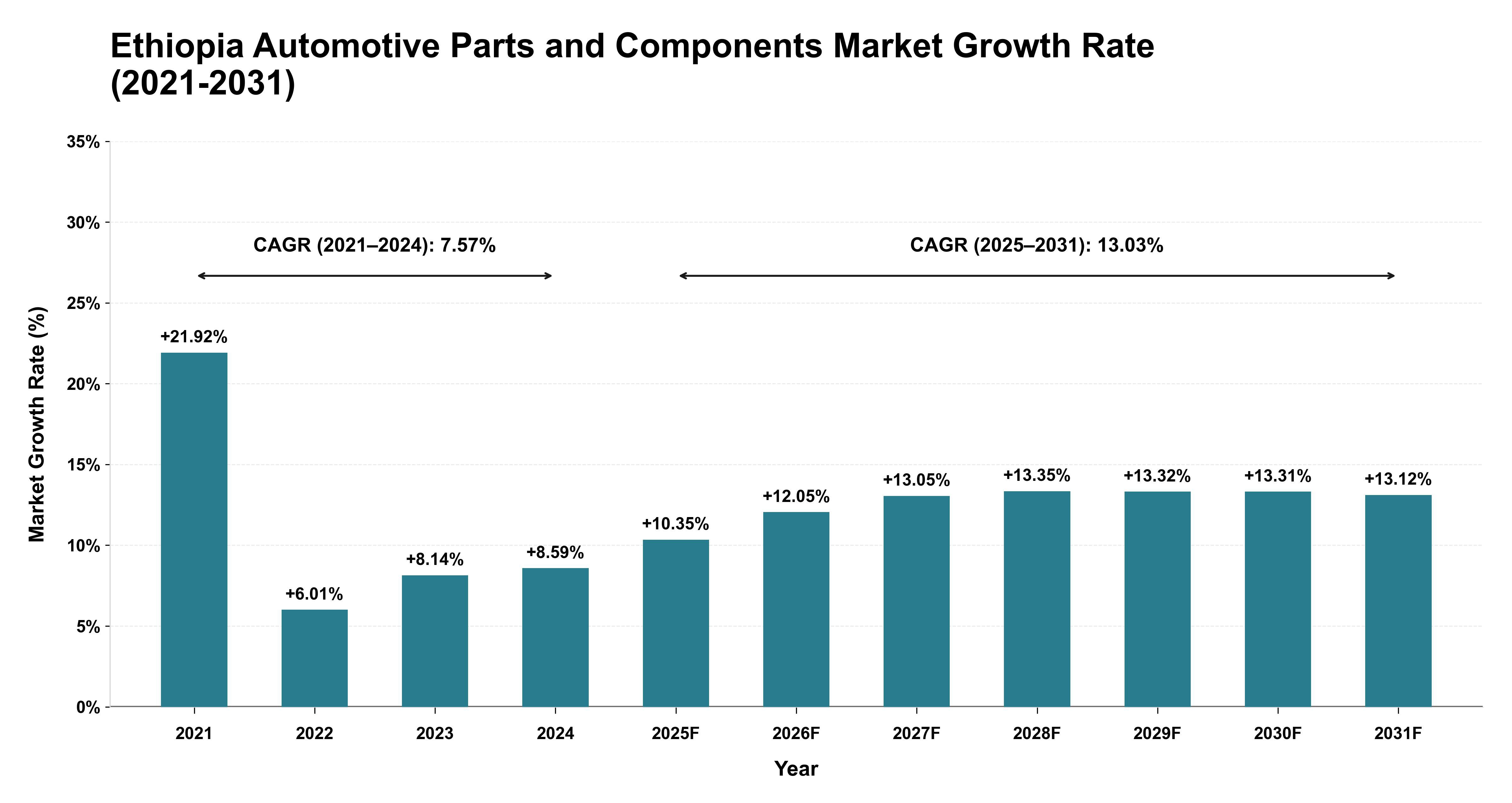
The Ethiopia Automotive Parts and Components Market exhibited a robust historical performance from 2021 to 2024, with a CAGR of 7.57%. This period saw significant growth, particularly in 2021 with a remarkable 21.92% increase, followed by a steady uptrend in subsequent years. The years 2022 to 2024 displayed single-digit but consistent growth rates, indicating market stabilization and maturation. Looking ahead to the forecast period from 2025 to 2031, the market is expected to accelerate its expansion with a projected CAGR of 13.03%. The growth trajectory for this segment is anticipated to sustain its upward momentum, with growth rates gradually increasing from 10.35% in 2025 to around 13.12% by the end of the forecast period in 2031. This outlook suggests a positive outlook for the Ethiopia Automotive Parts and Components Market, signaling continued market development and increasing demand for automotive products in the region.
Key Highlights of the Report:
- Ethiopia Automotive Parts and Components Market Outlook
- Market Size of Ethiopia Automotive Parts and Components Market, 2024
- Forecast of Ethiopia Automotive Parts and Components Market, 2031
- Historical Data and Forecast of Ethiopia Automotive Parts and Components Revenues & Volume for the Period 2021- 2031
- Ethiopia Automotive Parts and Components Market Trend Evolution
- Ethiopia Automotive Parts and Components Market Drivers and Challenges
- Ethiopia Automotive Parts and Components Price Trends
- Ethiopia Automotive Parts and Components Porter's Five Forces
- Ethiopia Automotive Parts and Components Industry Life Cycle
- Historical Data and Forecast of Ethiopia Automotive Parts and Components Market Revenues & Volume By Type for the Period 2021- 2031
- Historical Data and Forecast of Ethiopia Automotive Parts and Components Market Revenues & Volume By Driveline and Powertrain for the Period 2021- 2031
- Historical Data and Forecast of Ethiopia Automotive Parts and Components Market Revenues & Volume By Interiors and Exteriors for the Period 2021- 2031
- Historical Data and Forecast of Ethiopia Automotive Parts and Components Market Revenues & Volume By Electronics for the Period 2021- 2031
- Historical Data and Forecast of Ethiopia Automotive Parts and Components Market Revenues & Volume By Bodies and Chassis for the Period 2021- 2031
- Historical Data and Forecast of Ethiopia Automotive Parts and Components Market Revenues & Volume By Wheel and Tires for the Period 2021- 2031
- Historical Data and Forecast of Ethiopia Automotive Parts and Components Market Revenues & Volume By Other for the Period 2021- 2031
- Historical Data and Forecast of Ethiopia Automotive Parts and Components Market Revenues & Volume By Application for the Period 2021- 2031
- Historical Data and Forecast of Ethiopia Automotive Parts and Components Market Revenues & Volume By Original Equipment Manufacturers (OEMs) for the Period 2021- 2031
- Historical Data and Forecast of Ethiopia Automotive Parts and Components Market Revenues & Volume By Aftermarket for the Period 2021- 2031
- Ethiopia Automotive Parts and Components Import Export Trade Statistics
- Market Opportunity Assessment By Type
- Market Opportunity Assessment By Application
- Ethiopia Automotive Parts and Components Top Companies Market Share
- Ethiopia Automotive Parts and Components Competitive Benchmarking By Technical and Operational Parameters
- Ethiopia Automotive Parts and Components Company Profiles
- Ethiopia Automotive Parts and Components Key Strategic Recommendations






































