Topics Covered in Europe Military Vehicles Battery Market Report
Europe Military Vehicles Battery market report comprehensively covers the market by battery technologies, applications and countries. The Europe Military Vehicles Battery market report provides an unbiased and detailed analysis of the ongoing market trends, opportunities/ high growth areas, and market drivers, which would help stakeholders devise and align their market strategies according to the current and future market dynamics.
Europe Military Vehicles Battery Market Synopsis
Europe military vehicle battery market has seen significant developments in recent years, driven by increased defense spending and sustainability goals. The United Kingdom, for instance, is investing $74.9 billion, which constitutes 2.3% of its GDP, with plans to elevate this to 2.5% by 2030. France is also enhancing its defense budget under the Military Programming Act (2024-2030), targeting $457.7 billion. Notably, the United Kingdom aims to electrify its military fleet by 2035, having already achieved 27% ultra-low emissions standards across its vehicles. In parallel, the European Defense Agency has initiated projects such as ELUVAT, which focus on developing electrified powertrains to meet the energy demands of modern military operations. These initiatives collectively represent a transformative shift in military operations, driving the demand for high-performance battery solutions that align with broader EU goals of sustainability and carbon neutrality by 2050.
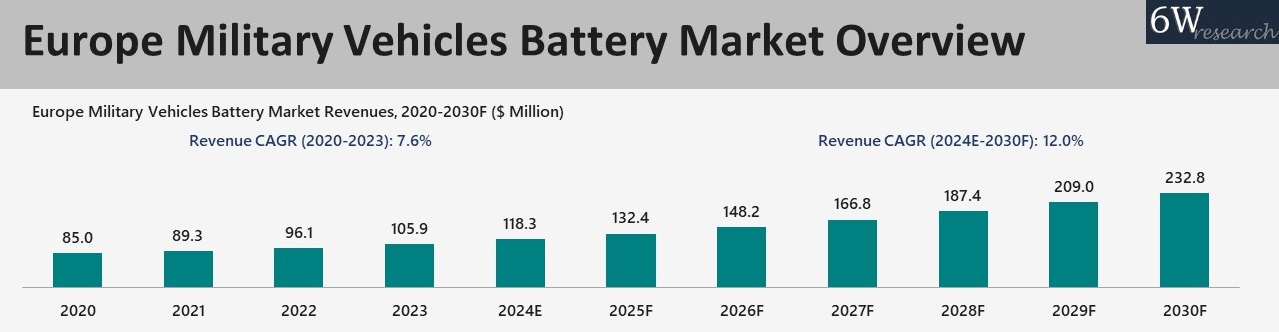
According to 6Wresearch, Europe Military Vehicles Battery Market revenue is projected to grow at a CAGR of 12.0% during 2024-30F. Initiatives, such as Poland's Technical Modernization Plan, aim to significantly boost military spending, increasing from $13 billion in 2020 to $31.6 billion by 2023, to modernize outdated equipment and enhance operational capabilities. Additionally, France's Defence and Energy Strategy is set to further catalyze investment in hybrid and electrified military vehicles, with a clear focus on reducing fossil fuel dependence. The expansion of unmanned systems—specifically UAVs, UGVs, and UUVs—is anticipated to drive the demand for high-performance batteries capable of sustaining prolonged operational hours and facilitating advanced functionalities. Additionally, the United Kingdom is making significant strides towards electrifying its military fleet by 2035, with 27% of its vehicles already adhering to ultra-low emissions standards. The country’s government plans to raise defense expenditure to 2.5% of GDP by 2030, further propelling investments in sustainable technologies.
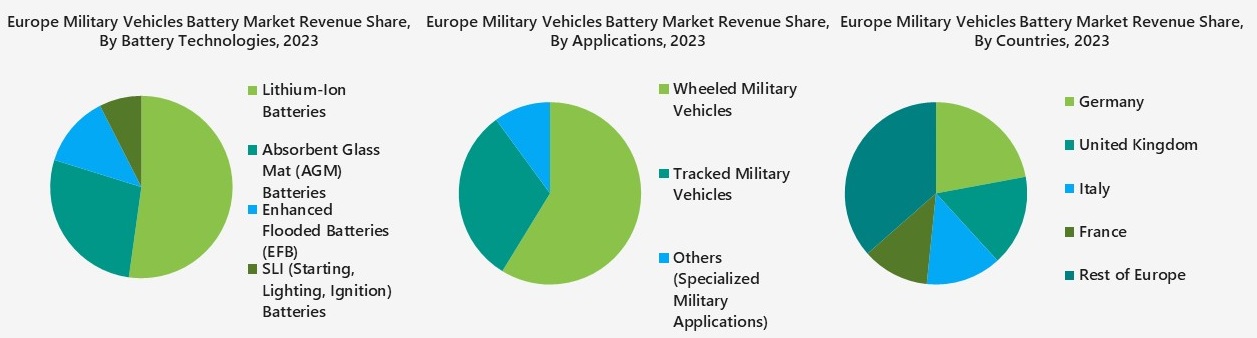
Market Segmentation by Applications
Wheeled military vehicles garnered the highest revenue share in the market in 2023 as they provide enhanced mobility, flexibility, and reduced maintenance costs, aligning with the operational needs of modern European armed forces​. For instance, under France's SCORPION programme, wheeled armoured vehicles such as the Jaguar EBRC and Griffon VBMR, are being introduced, with plans to deploy over 1,872 Griffon vehicles by 2030, further solidifying market growth.
Market Segmentation by Countries
In 2023, Germany secured the highest revenue share in the market owing to growing a focus on sustainable modernization and electrification of military fleets. The country has recently expanded its defense budget to strengthen its military capabilities in alignment with NATO commitments and carbon reduction goals. This is exemplified by the country’s allocation of over €100 billion as part of a modernization fund aimed at upgrading its military vehicles, with a particular focus on armoured and wheeled platforms such as the Lynx KF41 and Boxer vehicles​.
Market Segmentation by Battery Technologies
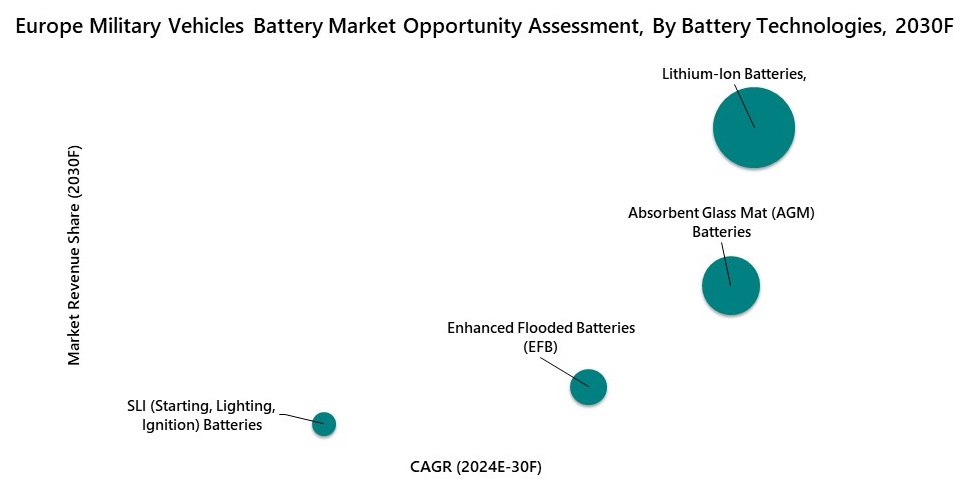
By 2030, lithium-ion (Li-ion) batteries are anticipated to hold the highest revenue share in the European military vehicle battery industry owing to rising electrification demand and technological advancements. Initiatives like the European Green Deal aim for a climate-neutral continent by 2050, with the BATT4EU initiative driving innovation in battery technologies to foster a sustainable and competitive battery value chain across sectors, including defense.
Key Attractiveness of the Report
- 10 Years Market Numbers.
- Historical Data Starting from 2020 to 2023.
- Base Year: 2023
- Forecast Data until 2030.
- Key Performance Indicators Impacting the Market.
- Major Upcoming Developments and Projects.
Key Highlights of the Report:
- Europe Military Vehicles Battery Market Overview
- Europe Military Vehicles Battery Market Outlook
- Europe Military Vehicles Battery Market Forecast
- Historical Data and Forecast of Europe Military Vehicles Battery Market Revenues, for the Period 2020-2030F
- Historical Data and Forecast of Europe Military Vehicles Battery Market Revenues, By Battery Technologies, for the Period 2020-2030F
- Historical Data and Forecast of Europe Military Vehicles Battery Market Revenues, By Applications, for the Period 2020-2030F
- Historical Data and Forecast of Europe Military Vehicles Battery Market Revenues, By Countries, for the Period 2020-2030F
- Porter’s Five Force Analysis
- Drivers and Restraints
- Europe Military Vehicles Battery Market Trends
- Europe Military Vehicles Battery Market Ecosystem
- Europe Military Vehicles Battery Market Opportunity Assessment
- Europe Military Vehicles Battery Market Competitive Benchmarking
- Company Profiles
- Key Strategic Recommendations
Market Scope and Segmentation
Thereportprovides a detailed analysis of the following market segments:
By Battery Technologies
- SLI (Starting, Lighting, Ignition) Batteries
- Enhanced Flooded Batteries (EFB)
- Absorbent Glass Mat (AGM) Batteries
- Lithium-Ion Batteries
By Applications
- Wheeled Military Vehicles
- Tracked Military Vehicles
- Others (Specialized Military Applications)






































