Fiji Adhesives Market Growth Rate Analysis (2021 - 2031)
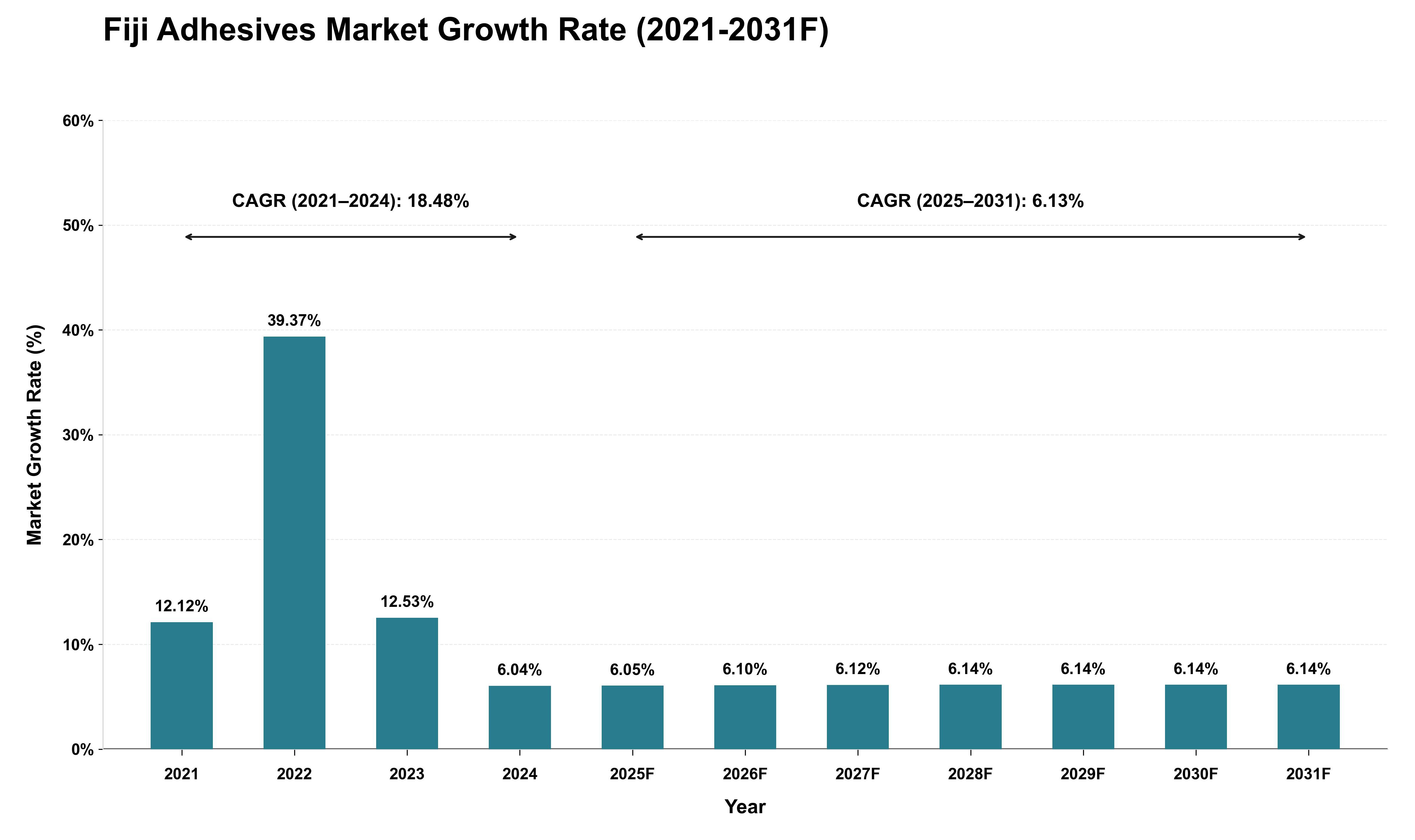
The Fiji adhesives market experienced a robust historical CAGR of 18.48% from 2021 to 2024, driven by a surge in construction and manufacturing activities post-pandemic, particularly in 2022, which saw an extraordinary growth rate of 39.37%. This spike can be attributed to global supply chain disruptions that heightened demand for reliable adhesive solutions amid rising commodity prices and increased import reliance. As the market transitioned into a more stable phase by 2024, growth rates normalized to 6.04%, reflecting adjustments in capacity and competitive dynamics as firms optimized production capabilities. Looking ahead to the forecast period (2025-2031), the CAGR is projected at 6.13%, indicating sustained but moderated growth as the market adapts to evolving consumer preferences and technological advancements in adhesive formulations, while also navigating potential fluctuations in global trade policies and economic cycles that could impact import dynamics.
Key Highlights of the Report:
- Fiji Adhesives Market Outlook
- Market Size of Fiji Adhesives Market, 2024
- Forecast of Fiji Adhesives Market, 2031
- Historical Data and Forecast of Fiji Adhesives Revenues & Volume for the Period 2021-2031
- Fiji Adhesives Market Trend Evolution
- Fiji Adhesives Market Drivers and Challenges
- Fiji Adhesives Price Trends
- Fiji Adhesives Porter`s Five Forces
- Fiji Adhesives Industry Life Cycle
- Historical Data and Forecast of Fiji Adhesives Market Revenues & Volume By Types for the Period 2021-2031
- Historical Data and Forecast of Fiji Adhesives Market Revenues & Volume By Acrylicfor the Period 2021-2031
- Historical Data and Forecast of Fiji Adhesives Market Revenues & Volume By Epoxy for the Period 2021-2031
- Historical Data and Forecast of Fiji Adhesives Market Revenues & Volume By Polyvinyl Acetate (PVA) for the Period 2021-2031
- Historical Data and Forecast of Fiji Adhesives Market Revenues & Volume By Polyurethane (PU) for the Period 2021-2031
- Historical Data and Forecast of Fiji Adhesives Market Revenues & Volume By Styrenic Block for the Period 2021-2031
- Historical Data and Forecast of Fiji Adhesives Market Revenues & Volume By Ethyl Vinyl Acetate (EVA) for the Period 2021-2031
- Historical Data and Forecast of Fiji Adhesives Market Revenues & Volume By Silicone & Others for the Period 2021-2031
- Historical Data and Forecast of Fiji Adhesives Market Revenues & Volume By Technology for the Period 2021-2031
- Historical Data and Forecast of Fiji Adhesives Market Revenues & Volume By Water-based for the Period 2021-2031
- Historical Data and Forecast of Fiji Adhesives Market Revenues & Volume By Solvent-based for the Period 2021-2031
- Historical Data and Forecast of Fiji Adhesives Market Revenues & Volume By Hot Melt for the Period 2021-2031
- Historical Data and Forecast of Fiji Adhesives Market Revenues & Volume By Pressure Sensitive for the Period 2021-2031
- Historical Data and Forecast of Fiji Adhesives Market Revenues & Volume By Reactive and Others for the Period 2021-2031
- Fiji Adhesives Import Export Trade Statistics
- Market Opportunity Assessment By Types
- Market Opportunity Assessment By Technology
- Fiji Adhesives Top Companies Market Share
- Fiji Adhesives Competitive Benchmarking By Technical and Operational Parameters
- Fiji Adhesives Company Profiles
- Fiji Adhesives Key Strategic Recommendations






































