Fiji Electric Motor Market Growth Rate Analysis (2025 - 2031)
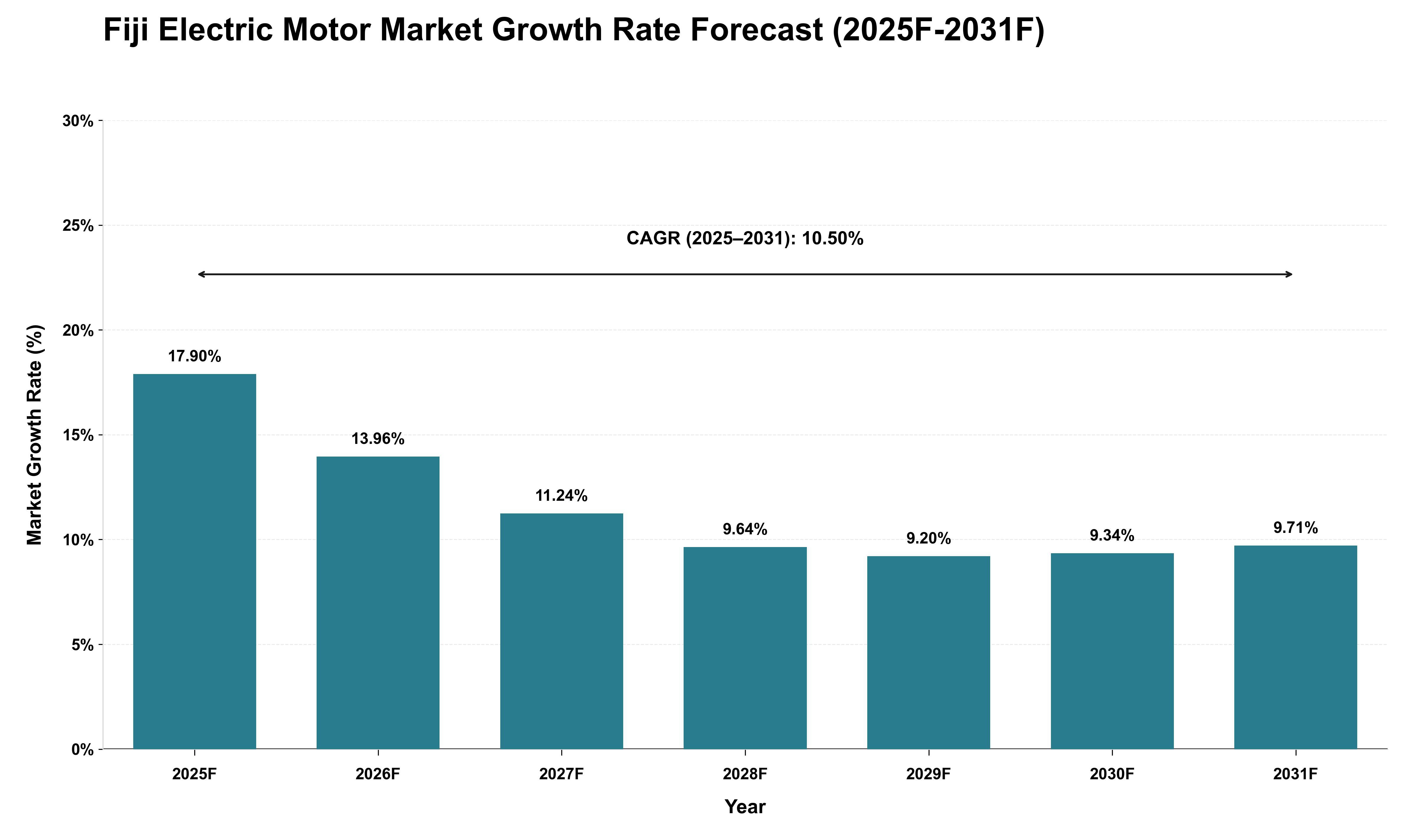
The Fiji electric motor market is projected to experience a robust compound annual growth rate of 10.50% from 2025 to 2031, driven by increasing demand for energy-efficient technologies and sustainable practices across various sectors. The initial surge of 17.90% in 2025 will likely be fueled by heightened investments in renewable energy infrastructure and electrification initiatives, which will create a strong pull for electric motors. As the forecast progresses, annual growth rates are expected to gradually decline, reflecting typical cyclical trends where initial spikes stabilize as supply chains adapt and import dependencies on raw materials such as copper and rare earth elements become more pronounced. Fluctuations in global commodity prices will play a critical role in shaping production costs, influencing pricing strategies and ultimately impacting market dynamics throughout this period.
Key Highlights of the Report:
- Fiji Electric Motor Market Outlook
- Market Size of Fiji Electric Motor Market, 2024
- Forecast of Fiji Electric Motor Market, 2031
- Historical Data and Forecast of Fiji Electric Motor Revenues & Volume for the Period 2021-2031
- Fiji Electric Motor Market Trend Evolution
- Fiji Electric Motor Market Drivers and Challenges
- Fiji Electric Motor Price Trends
- Fiji Electric Motor Porter`s Five Forces
- Fiji Electric Motor Industry Life Cycle
- Historical Data and Forecast of Fiji Electric Motor Market Revenues & Volume By Motor Type for the Period 2021-2031
- Historical Data and Forecast of Fiji Electric Motor Market Revenues & Volume By Alternate Current (AC) Motor for the Period 2021-2031
- Historical Data and Forecast of Fiji Electric Motor Market Revenues & Volume By Direct Current (DC) Motor for the Period 2021-2031
- Historical Data and Forecast of Fiji Electric Motor Market Revenues & Volume By Hermetic Motor for the Period 2021-2031
- Historical Data and Forecast of Fiji Electric Motor Market Revenues & Volume By Output Power for the Period 2021-2031
- Historical Data and Forecast of Fiji Electric Motor Market Revenues & Volume By Voltage Range for the Period 2021-2031
- Historical Data and Forecast of Fiji Electric Motor Market Revenues & Volume By 9 V & Below for the Period 2021-2031
- Historical Data and Forecast of Fiji Electric Motor Market Revenues & Volume By 10-20 V for the Period 2021-2031
- Historical Data and Forecast of Fiji Electric Motor Market Revenues & Volume By 21-60 V for the Period 2021-2031
- Historical Data and Forecast of Fiji Electric Motor Market Revenues & Volume By 60 V & Above for the Period 2021-2031
- Historical Data and Forecast of Fiji Electric Motor Market Revenues & Volume By Application for the Period 2021-2031
- Historical Data and Forecast of Fiji Electric Motor Market Revenues & Volume By Industrial machinery for the Period 2021-2031
- Historical Data and Forecast of Fiji Electric Motor Market Revenues & Volume By Motor vehicles for the Period 2021-2031
- Historical Data and Forecast of Fiji Electric Motor Market Revenues & Volume By Heating, ventilating, and cooling (HVAC) equipment for the Period 2021-2031
- Historical Data and Forecast of Fiji Electric Motor Market Revenues & Volume By Aerospace & transportation for the Period 2021-2031
- Historical Data and Forecast of Fiji Electric Motor Market Revenues & Volume By Household appliances for the Period 2021-2031
- Historical Data and Forecast of Fiji Electric Motor Market Revenues & Volume By Other for the Period 2021-2031
- Historical Data and Forecast of Fiji Electric Motor Market Revenues & Volume By Speed (RPM) for the Period 2021-2031
- Historical Data and Forecast of Fiji Electric Motor Market Revenues & Volume By Low-Speed Electric Motors (Less Than 1,000 RPM) for the Period 2021-2031
- Historical Data and Forecast of Fiji Electric Motor Market Revenues & Volume By Medium-Speed Electric Motors (1,001-25,000 RPM) for the Period 2021-2031
- Historical Data and Forecast of Fiji Electric Motor Market Revenues & Volume By High-Speed Electric Motors (25,001-75,000 RPM) for the Period 2021-2031
- Historical Data and Forecast of Fiji Electric Motor Market Revenues & Volume By Ultrahigh-Speed Electric Motors (Greater Than 75,001 RPM) for the Period 2021-2031
- Fiji Electric Motor Import Export Trade Statistics
- Market Opportunity Assessment By Motor Type
- Market Opportunity Assessment By Output Power
- Market Opportunity Assessment By Voltage Range
- Market Opportunity Assessment By Application
- Market Opportunity Assessment By Speed (RPM)
- Fiji Electric Motor Top Companies Market Share
- Fiji Electric Motor Competitive Benchmarking By Technical and Operational Parameters
- Fiji Electric Motor Company Profiles
- Fiji Electric Motor Key Strategic Recommendations






































