Finland Artificial Turf Market Size (2020-2030)
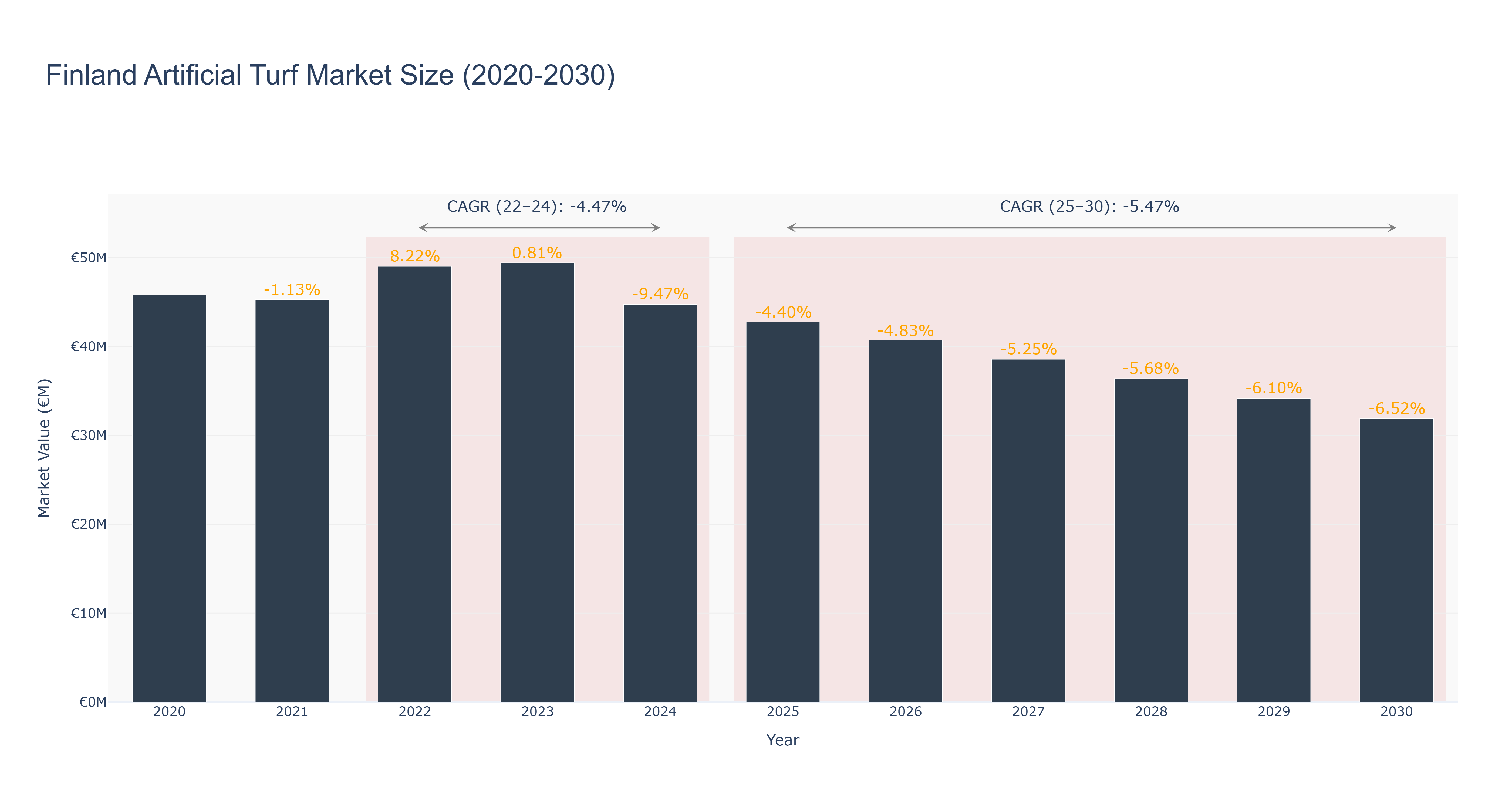
The Finland Artificial Turf Market has experienced fluctuations in recent years. The peak market size of €49.40 million was recorded in 2023. From 2020 to 2024, the market size decreased steadily, reaching €44.72 million in 2024. The forecasted trend from 2025 to 2030 shows a continued decline, with an estimated market size of €31.92 million in 2030. The CAGR for the periods 2022-24 and 2025-30 are -4.47% and -5.47% respectively. The market downturn can be attributed to factors such as changing consumer preferences, economic conditions, and technological advancements in alternative products. Looking ahead, Finland is set to invest in sustainable artificial turf solutions to align with environmental regulations and enhance product durability, ensuring a competitive edge in the market. Industry drivers for the Finland Artificial Turf Market include increasing emphasis on sports infrastructure development, rising demand for low-maintenance landscaping solutions, and the growing popularity of artificial turf in residential and commercial applications.
Finland Artificial Turf Market: Production & Trade Performance (2019-2025)
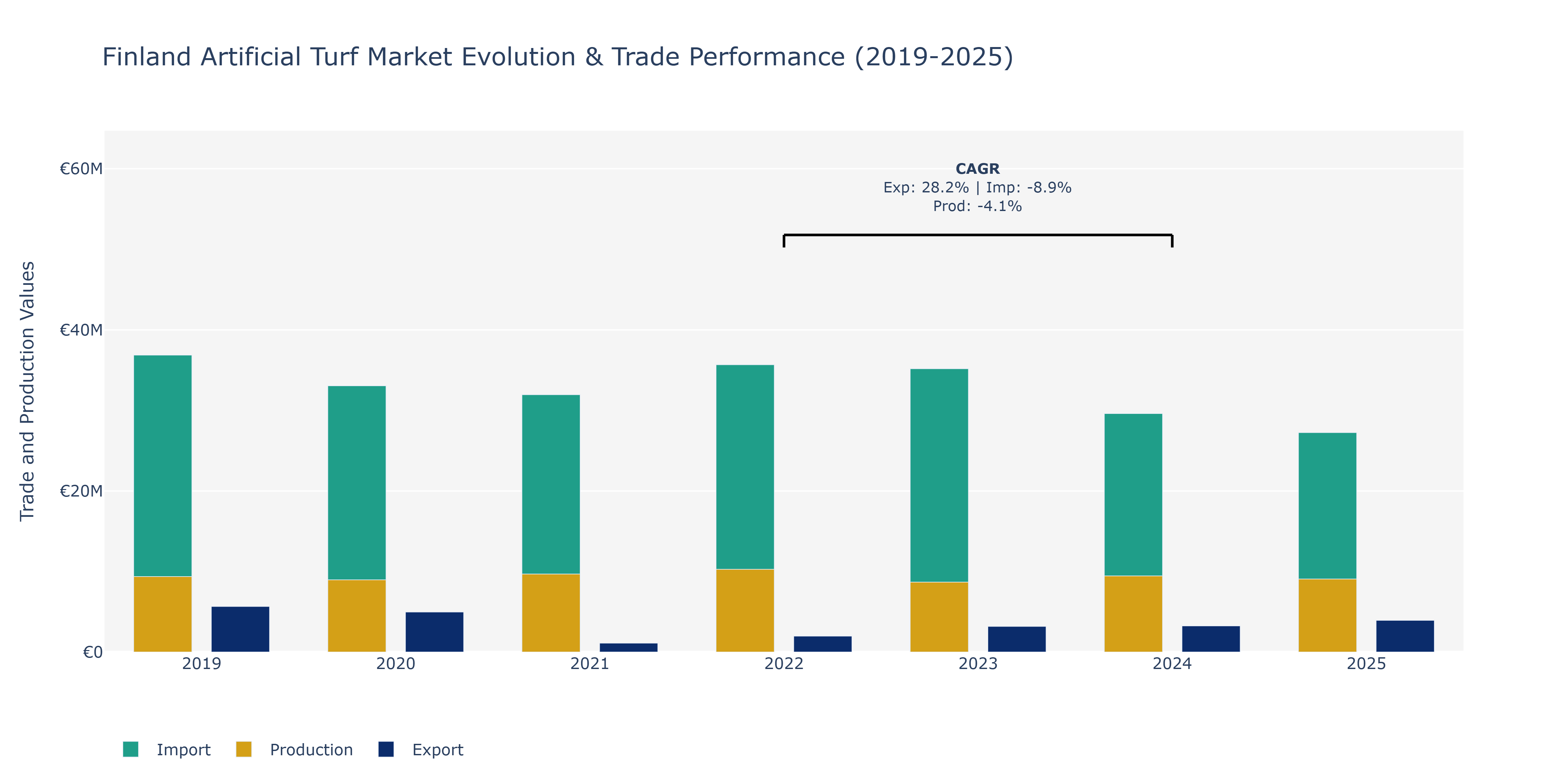
Between 2019 and 2025, Finland's Artificial Turf Market displayed notable fluctuations in Exports, Imports, and Production. Exports saw a gradual increase over the years, peaking at €3.93 million in 2025 from €5.66 million in 2019. Conversely, Imports experienced a consistent decline from €36.86 million in 2019 to €27.25 million in 2025. Production value varied, reaching a peak of €10.27 million in 2022 before dropping to €9.07 million in 2025. These trends could be attributed to several factors such as evolving consumer preferences towards sustainable and low-maintenance landscaping solutions, government initiatives promoting the use of artificial turf in sports facilities, and advancements in technology leading to improved product quality and durability. The declining imports could be influenced by a shift towards domestic production to meet the growing demand for artificial turf in various applications, aligning with Finland's sustainability goals and reducing dependency on foreign suppliers.
Key Highlights of the Report:
- Finland Artificial Turf Market Outlook
- Market Size of Finland Artificial Turf Market, 2024
- Forecast of Finland Artificial Turf Market, 2031
- Historical Data and Forecast of Finland Artificial Turf Revenues & Volume for the Period 2021- 2031
- Finland Artificial Turf Market Trend Evolution
- Finland Artificial Turf Market Drivers and Challenges
- Finland Artificial Turf Price Trends
- Finland Artificial Turf Porter's Five Forces
- Finland Artificial Turf Industry Life Cycle
- Historical Data and Forecast of Finland Artificial Turf Market Revenues & Volume By Material for the Period 2021- 2031
- Historical Data and Forecast of Finland Artificial Turf Market Revenues & Volume By Polyethylene for the Period 2021- 2031
- Historical Data and Forecast of Finland Artificial Turf Market Revenues & Volume By Polypropylene for the Period 2021- 2031
- Historical Data and Forecast of Finland Artificial Turf Market Revenues & Volume By Nylon for the Period 2021- 2031
- Historical Data and Forecast of Finland Artificial Turf Market Revenues & Volume By Application for the Period 2021- 2031
- Historical Data and Forecast of Finland Artificial Turf Market Revenues & Volume By Residential for the Period 2021- 2031
- Historical Data and Forecast of Finland Artificial Turf Market Revenues & Volume By Commercial for the Period 2021- 2031
- Historical Data and Forecast of Finland Artificial Turf Market Revenues & Volume By Sports for the Period 2021- 2031
- Finland Artificial Turf Import Export Trade Statistics
- Market Opportunity Assessment By Material
- Market Opportunity Assessment By Application
- Finland Artificial Turf Top Companies Market Share
- Finland Artificial Turf Competitive Benchmarking By Technical and Operational Parameters
- Finland Artificial Turf Company Profiles
- Finland Artificial Turf Key Strategic Recommendations






































