Finland Cranes Market Size Growth Rate
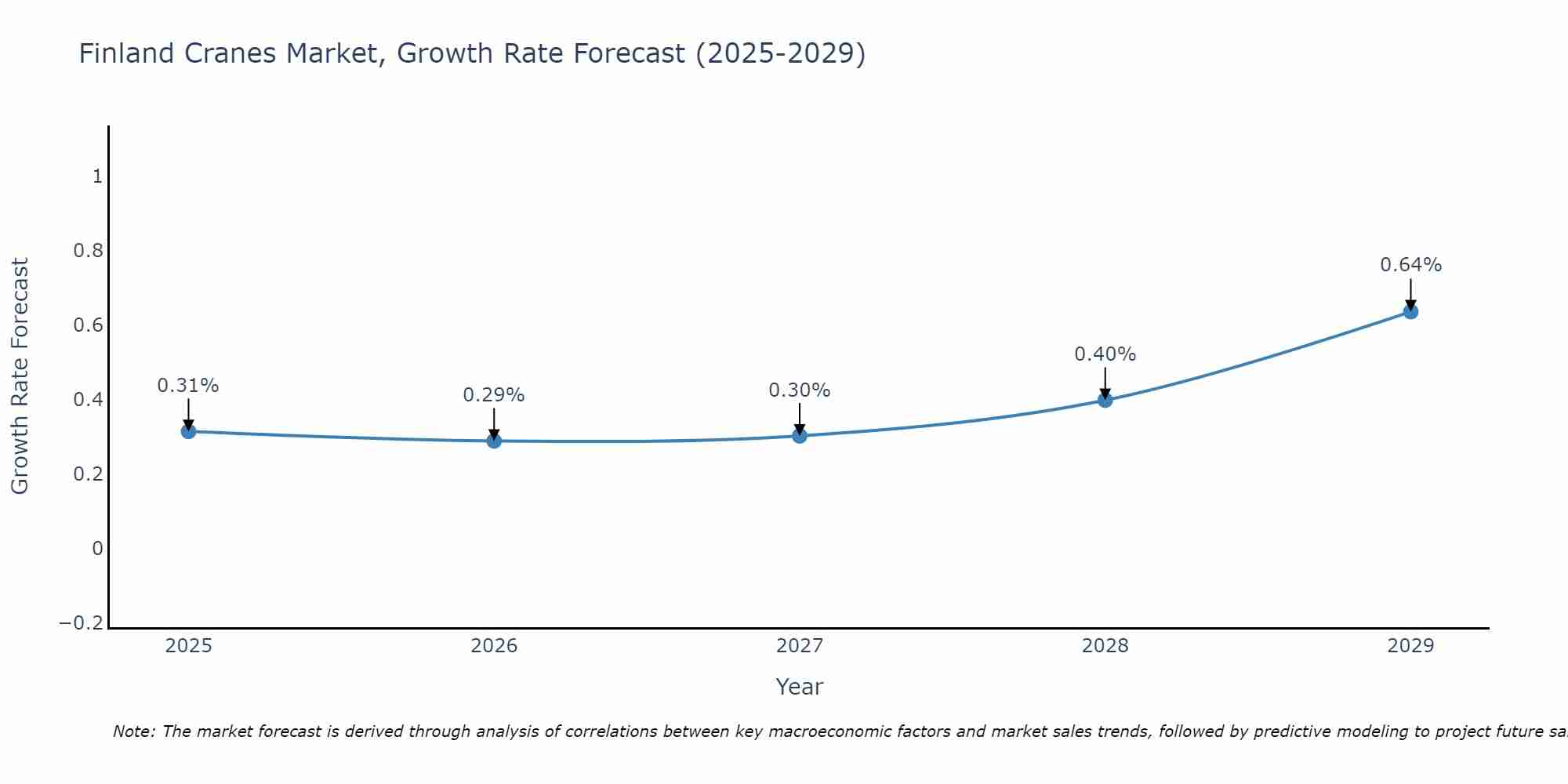
The Finland Cranes Market is projected to witness mixed growth rate patterns during 2025 to 2029. From 0.31% in 2025, the growth rate steadily ascends to 0.64% in 2029.
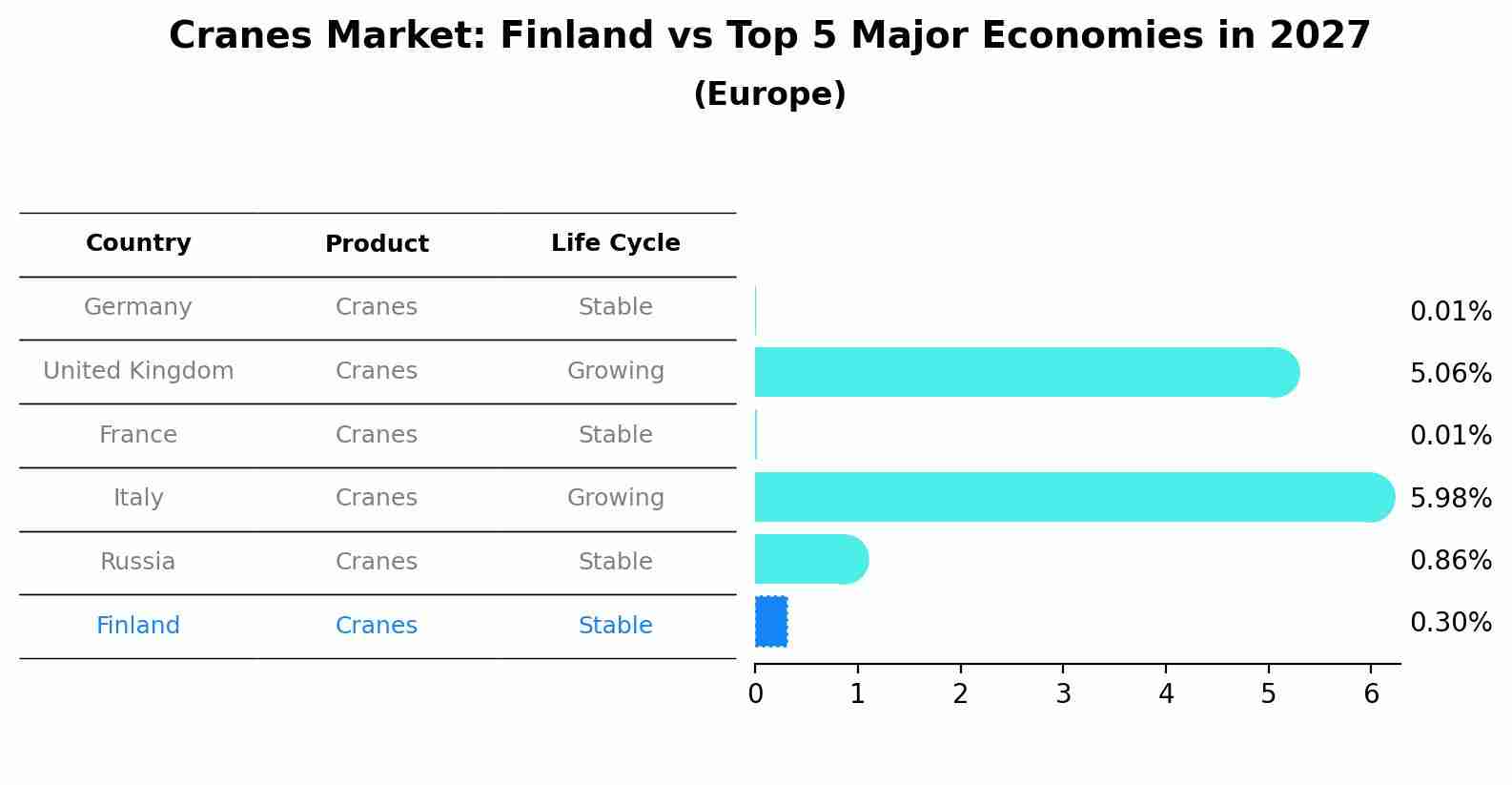
Cranes Market: Finland vs Top 5 Major Economies in 2027 (Europe)
By 2027, the Cranes market in Finland is anticipated to reach a growth rate of 0.30%, as part of an increasingly competitive Europe region, where Germany remains at the forefront, supported by United Kingdom, France, Italy and Russia, driving innovations and market adoption across sectors.
Finland Cranes Market Overview
The Cranes Market in Finland is experiencing growth as industries such as construction, shipping, and logistics require advanced lifting equipment. Innovations in crane technology, such as automation, energy efficiency, and better safety features, are contributing to the market`s development, with an increasing focus on reducing operational costs and improving productivity.
Drivers of the market
The Cranes Market in Finland is experiencing growth as industries in construction, manufacturing, and logistics require efficient lifting and handling equipment. As infrastructure development projects expand and material handling demands rise, the need for specialized cranes, including mobile and tower cranes, is pushing market growth.
Challenges of the market
The crane market in Finland faces challenges related to high equipment costs and the demand for highly specialized cranes for diverse industrial applications. Additionally, regulatory restrictions on emissions and safety standards add complexity to manufacturing and operating cranes in the market.
Government Policy of the market
The Finnish governments policy for the cranes market is centered around fostering innovation in the design and functionality of cranes used in various sectors, including construction, mining, and logistics. Regulations focus on minimizing environmental impact through energy-efficient technologies and promoting the use of cranes in sustainable construction projects. Finland encourages the adoption of automation and digitalization to improve crane performance and safety.
Key Highlights of the Report:
- Finland Cranes Market Outlook
- Market Size of Finland Cranes Market, 2024
- Forecast of Finland Cranes Market, 2031
- Historical Data and Forecast of Finland Cranes Revenues & Volume for the Period 2021-2031
- Finland Cranes Market Trend Evolution
- Finland Cranes Market Drivers and Challenges
- Finland Cranes Price Trends
- Finland Cranes Porter`s Five Forces
- Finland Cranes Industry Life Cycle
- Historical Data and Forecast of Finland Cranes Market Revenues & Volume By Product Type for the Period 2021-2031
- Historical Data and Forecast of Finland Cranes Market Revenues & Volume By Mobile for the Period 2021-2031
- Historical Data and Forecast of Finland Cranes Market Revenues & Volume By Fixed for the Period 2021-2031
- Historical Data and Forecast of Finland Cranes Market Revenues & Volume By Marine for the Period 2021-2031
- Historical Data and Forecast of Finland Cranes Market Revenues & Volume By End-User for the Period 2021-2031
- Historical Data and Forecast of Finland Cranes Market Revenues & Volume By Construction for the Period 2021-2031
- Historical Data and Forecast of Finland Cranes Market Revenues & Volume By Mining for the Period 2021-2031
- Historical Data and Forecast of Finland Cranes Market Revenues & Volume By Industrial for the Period 2021-2031
- Historical Data and Forecast of Finland Cranes Market Revenues & Volume By Oil & Gas for the Period 2021-2031
- Historical Data and Forecast of Finland Cranes Market Revenues & Volume By Others for the Period 2021-2031
- Finland Cranes Import Export Trade Statistics
- Market Opportunity Assessment By Product Type
- Market Opportunity Assessment By End-User
- Finland Cranes Top Companies Market Share
- Finland Cranes Competitive Benchmarking By Technical and Operational Parameters
- Finland Cranes Company Profiles
- Finland Cranes Key Strategic Recommendations






































