Finland Diesel Engine Market Size (2020-2030)
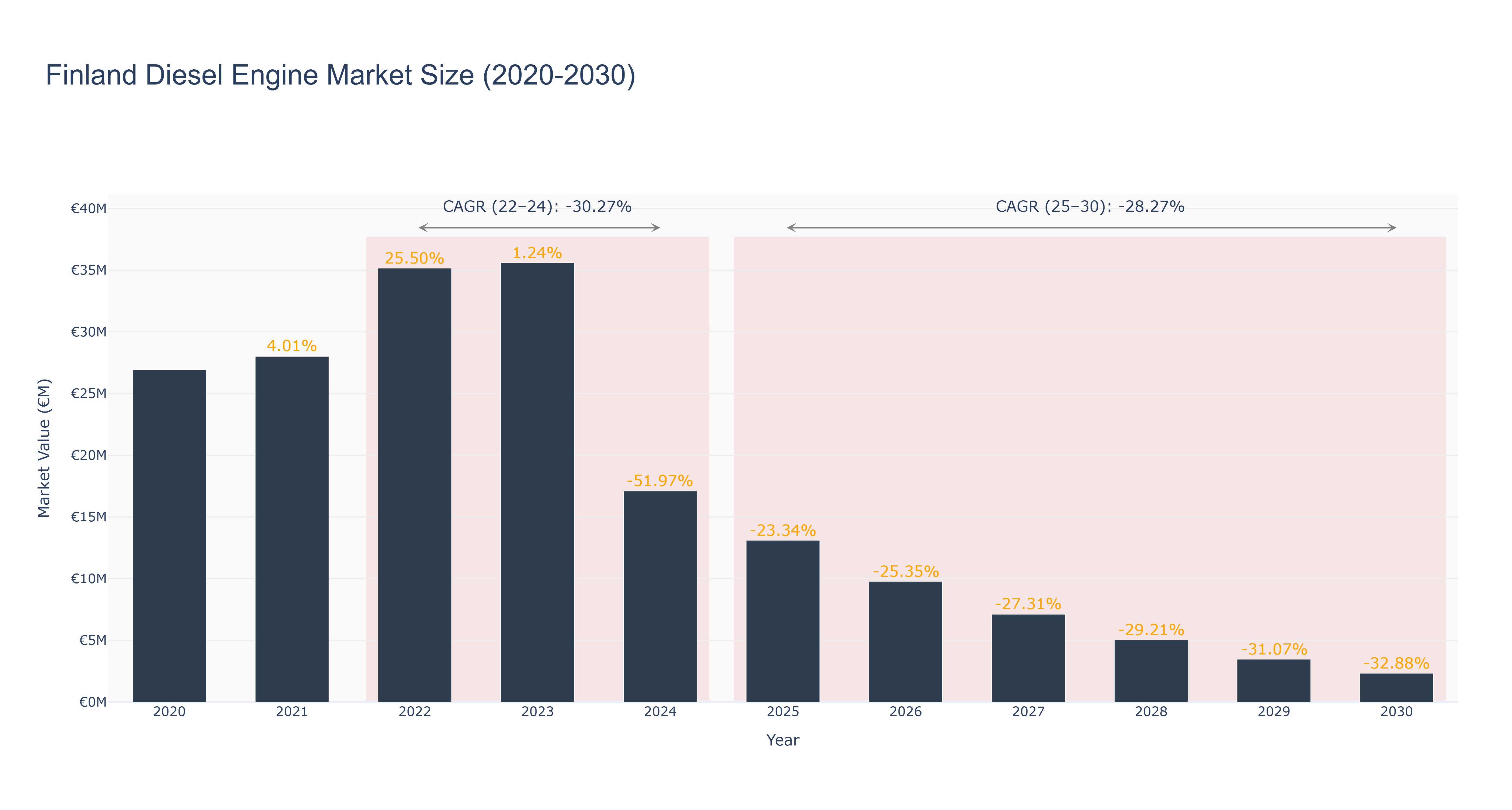
The Finland Diesel Engine Market witnessed a peak market size of €35.60 million in 2023, followed by a significant decline to €17.10 million in 2024. The market is forecasted to continue its downward trend, reaching €2.33 million in 2030. The CAGR for the period 2022-24 stands at -30.27%, while for 2025-30, it is projected at -28.27%. The market faced challenges due to a global shift towards sustainable energy sources, impacting the demand for diesel engines. However, recent developments in Finland indicate a growing focus on renewable energy projects, which may lead to potential opportunities for the market in the future. As of 2026, the market is expected to adapt to changing industry dynamics and explore innovative solutions to navigate the evolving landscape.
Finland Diesel Engine Market: Production & Trade Performance (2019-2025)
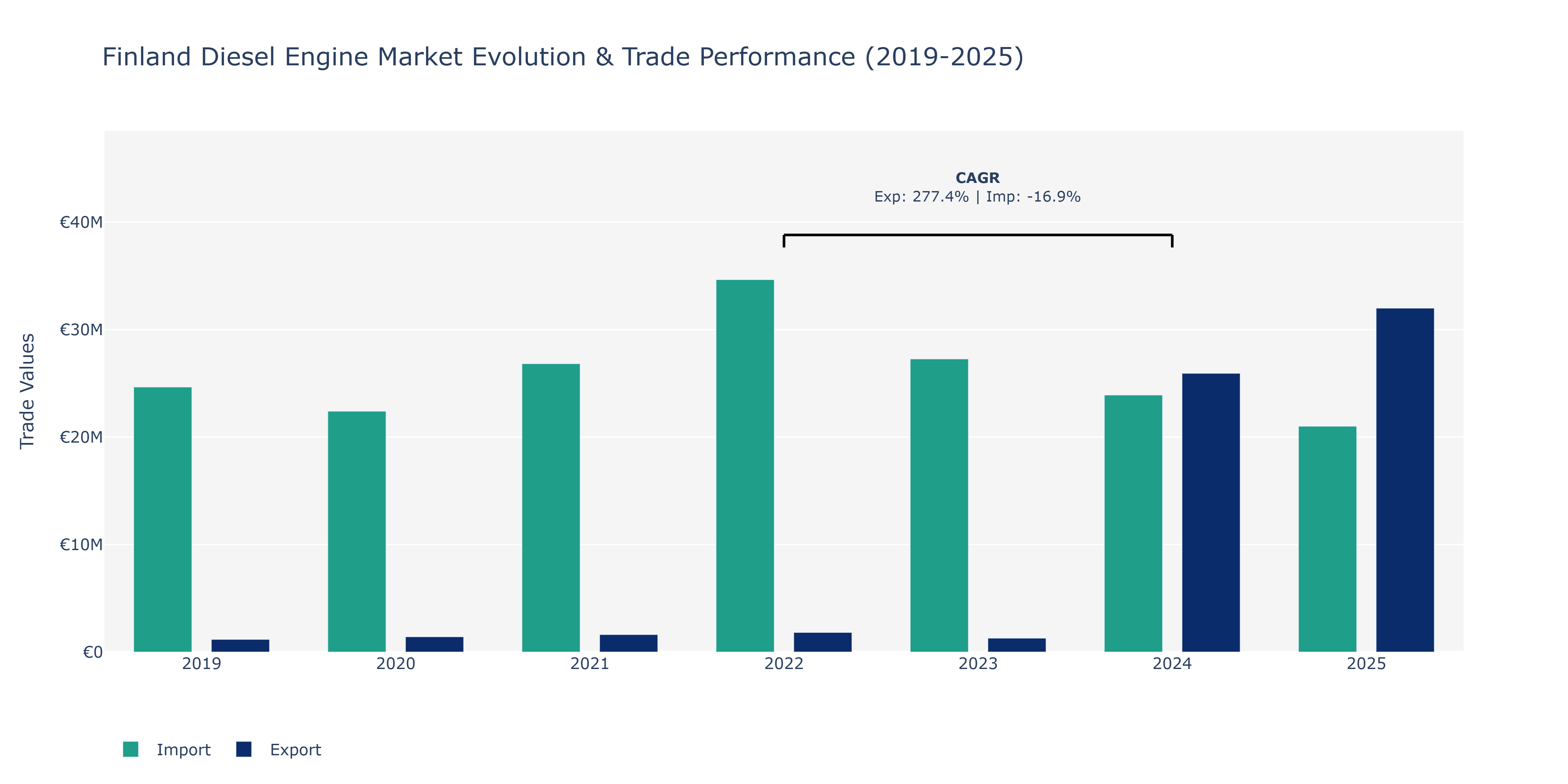
Between 2019 and 2025, Finland's Diesel Engine Market showcased distinctive trends in exports and imports. Exports surged from €1.18 million in 2019 to a peak of €31.99 million in 2025, indicating a significant upward trajectory driven by technological advancements and increased demand for Finnish diesel engine products globally. In contrast, imports fluctuated, reaching a high of €34.65 million in 2022 and then decreasing to €21.01 million in 2025, reflecting a temporary decline potentially influenced by market saturation or shifts in supply chain dynamics. The substantial growth in exports can be attributed to Finland's reputation for producing high-quality diesel engines and the country's focus on innovation and sustainability in the automotive sector, aligning with global trends towards cleaner energy sources. Meanwhile, the volatility in imports might stem from fluctuating global economic conditions impacting demand for imported diesel engines in Finland. Further analysis could explore how Finland's strategic partnerships and trade agreements have influenced these market dynamics over the years.
Finland Diesel Engine Market Overview
The diesel engine market in Finland is growing due to the demand for powerful and fuel-efficient engines in sectors like transportation, industrial machinery, and agriculture. Diesel engines are preferred for their durability, efficiency, and ability to handle heavy-duty applications. With the Finnish government focusing on reducing carbon emissions, the market is also seeing a shift towards more sustainable, cleaner diesel technologies that comply with stringent environmental regulations.
Drivers of the market
The Finland Diesel Engine market is driven by the countrys focus on energy efficiency and high-performance machinery across various sectors, including transportation, industrial, and power generation. Diesel engines are favored for their high fuel efficiency, durability, and ability to generate more power with less fuel consumption compared to gasoline engines. With Finlands strong industrial base and the need for reliable, cost-effective power generation, the demand for diesel engines in sectors such as agriculture, construction, and logistics is growing. Moreover, technological advancements in engine design, along with stringent environmental standards requiring low-emission diesel engines, are also key drivers of the market.
Challenges of the market
The diesel engine market in Finland is driven by demand from industries such as transportation, construction, and agriculture. Diesel engines are known for their power, efficiency, and durability, making them popular in heavy-duty applications. However, the market is facing growing pressure due to the increasing shift towards electric and alternative fuel vehicles, as well as stricter emissions regulations.
Government Policy of the market
Finlands policies focus on transitioning the diesel engine market towards cleaner technologies. The government provides financial incentives for developing energy-efficient and low-emission diesel engines, aligning with European Union emission standards.
Key Highlights of the Report:
- Finland Diesel Engine Market Outlook
- Market Size of Finland Diesel Engine Market, 2024
- Forecast of Finland Diesel Engine Market, 2031
- Historical Data and Forecast of Finland Diesel Engine Revenues & Volume for the Period 2021-2031
- Finland Diesel Engine Market Trend Evolution
- Finland Diesel Engine Market Drivers and Challenges
- Finland Diesel Engine Price Trends
- Finland Diesel Engine Porter`s Five Forces
- Finland Diesel Engine Industry Life Cycle
- Historical Data and Forecast of Finland Diesel Engine Market Revenues & Volume By Power Rating for the Period 2021-2031
- Historical Data and Forecast of Finland Diesel Engine Market Revenues & Volume By 0.5 MW 1 MW for the Period 2021-2031
- Historical Data and Forecast of Finland Diesel Engine Market Revenues & Volume By Up to 0.5 MW for the Period 2021-2031
- Historical Data and Forecast of Finland Diesel Engine Market Revenues & Volume By 2 MW 5 MW for the Period 2021-2031
- Historical Data and Forecast of Finland Diesel Engine Market Revenues & Volume By 1 MW 2 MW for the Period 2021-2031
- Historical Data and Forecast of Finland Diesel Engine Market Revenues & Volume By Above 5 MW for the Period 2021-2031
- Historical Data and Forecast of Finland Diesel Engine Market Revenues & Volume By for the Period 2021-2031
- Historical Data and Forecast of Finland Diesel Engine Market Revenues & Volume By End User for the Period 2021-2031
- Historical Data and Forecast of Finland Diesel Engine Market Revenues & Volume By Automotive for the Period 2021-2031
- Historical Data and Forecast of Finland Diesel Engine Market Revenues & Volume By Non-Automotive for the Period 2021-2031
- Finland Diesel Engine Import Export Trade Statistics
- Market Opportunity Assessment By Power Rating
- Market Opportunity Assessment By End User
- Finland Diesel Engine Top Companies Market Share
- Finland Diesel Engine Competitive Benchmarking By Technical and Operational Parameters
- Finland Diesel Engine Company Profiles
- Finland Diesel Engine Key Strategic Recommendations






































