Finland Electric Motor Market Size Growth Rate
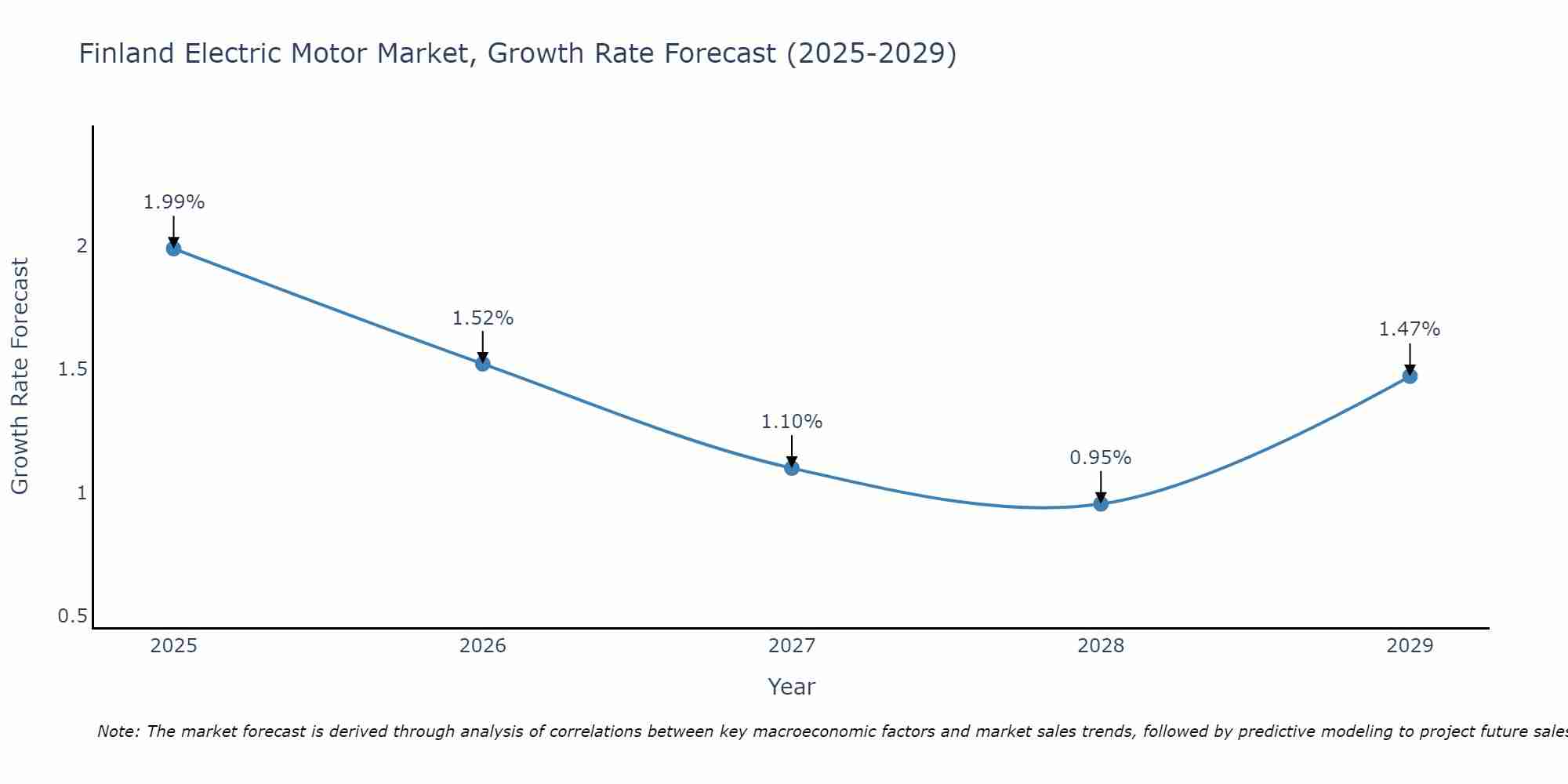
The Finland Electric Motor Market is projected to witness mixed growth rate patterns during 2025 to 2029. Starting high at 1.99% in 2025, the market steadily declines to 1.47% by 2029.
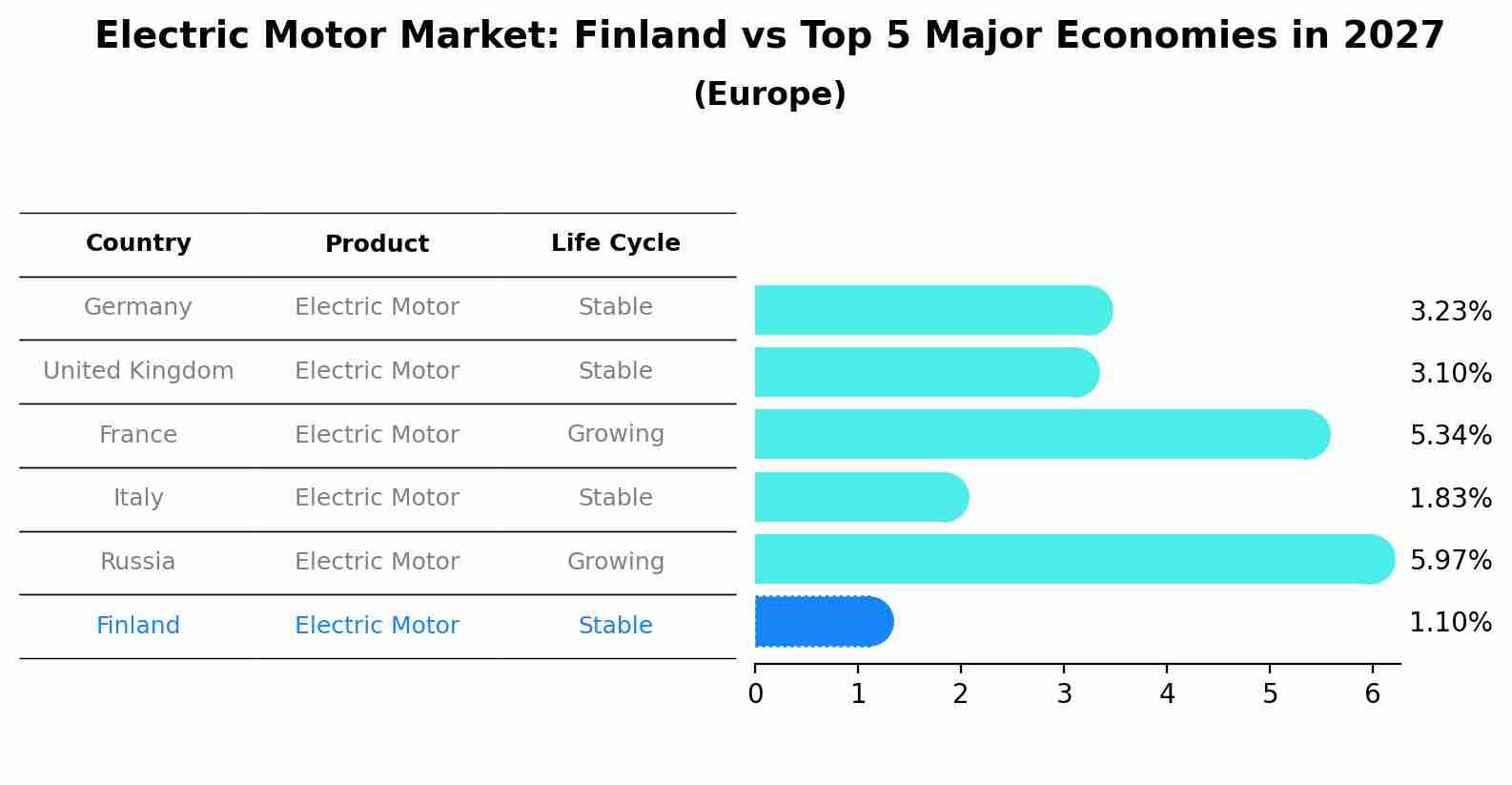
Electric Motor Market: Finland vs Top 5 Major Economies in 2027 (Europe)
By 2027, Finland's Electric Motor market is forecasted to achieve a stable growth rate of 1.10%, with Germany leading the Europe region, followed by United Kingdom, France, Italy and Russia.
Key Highlights of the Report:
- Finland Electric Motor Market Outlook
- Market Size of Finland Electric Motor Market, 2024
- Forecast of Finland Electric Motor Market, 2031
- Historical Data and Forecast of Finland Electric Motor Revenues & Volume for the Period 2021-2031
- Finland Electric Motor Market Trend Evolution
- Finland Electric Motor Market Drivers and Challenges
- Finland Electric Motor Price Trends
- Finland Electric Motor Porter`s Five Forces
- Finland Electric Motor Industry Life Cycle
- Historical Data and Forecast of Finland Electric Motor Market Revenues & Volume By Motor Type for the Period 2021-2031
- Historical Data and Forecast of Finland Electric Motor Market Revenues & Volume By Alternate Current (AC) Motor for the Period 2021-2031
- Historical Data and Forecast of Finland Electric Motor Market Revenues & Volume By Direct Current (DC) Motor for the Period 2021-2031
- Historical Data and Forecast of Finland Electric Motor Market Revenues & Volume By Hermetic Motor for the Period 2021-2031
- Historical Data and Forecast of Finland Electric Motor Market Revenues & Volume By Output Power for the Period 2021-2031
- Historical Data and Forecast of Finland Electric Motor Market Revenues & Volume By Voltage Range for the Period 2021-2031
- Historical Data and Forecast of Finland Electric Motor Market Revenues & Volume By 9 V & Below for the Period 2021-2031
- Historical Data and Forecast of Finland Electric Motor Market Revenues & Volume By 10-20 V for the Period 2021-2031
- Historical Data and Forecast of Finland Electric Motor Market Revenues & Volume By 21-60 V for the Period 2021-2031
- Historical Data and Forecast of Finland Electric Motor Market Revenues & Volume By 60 V & Above for the Period 2021-2031
- Historical Data and Forecast of Finland Electric Motor Market Revenues & Volume By Application for the Period 2021-2031
- Historical Data and Forecast of Finland Electric Motor Market Revenues & Volume By Industrial machinery for the Period 2021-2031
- Historical Data and Forecast of Finland Electric Motor Market Revenues & Volume By Motor vehicles for the Period 2021-2031
- Historical Data and Forecast of Finland Electric Motor Market Revenues & Volume By Heating, ventilating, and cooling (HVAC) equipment for the Period 2021-2031
- Historical Data and Forecast of Finland Electric Motor Market Revenues & Volume By Aerospace & transportation for the Period 2021-2031
- Historical Data and Forecast of Finland Electric Motor Market Revenues & Volume By Household appliances for the Period 2021-2031
- Historical Data and Forecast of Finland Electric Motor Market Revenues & Volume By Other for the Period 2021-2031
- Historical Data and Forecast of Finland Electric Motor Market Revenues & Volume By Speed (RPM) for the Period 2021-2031
- Historical Data and Forecast of Finland Electric Motor Market Revenues & Volume By Low-Speed Electric Motors (Less Than 1,000 RPM) for the Period 2021-2031
- Historical Data and Forecast of Finland Electric Motor Market Revenues & Volume By Medium-Speed Electric Motors (1,001-25,000 RPM) for the Period 2021-2031
- Historical Data and Forecast of Finland Electric Motor Market Revenues & Volume By High-Speed Electric Motors (25,001-75,000 RPM) for the Period 2021-2031
- Historical Data and Forecast of Finland Electric Motor Market Revenues & Volume By Ultrahigh-Speed Electric Motors (Greater Than 75,001 RPM) for the Period 2021-2031
- Finland Electric Motor Import Export Trade Statistics
- Market Opportunity Assessment By Motor Type
- Market Opportunity Assessment By Output Power
- Market Opportunity Assessment By Voltage Range
- Market Opportunity Assessment By Application
- Market Opportunity Assessment By Speed (RPM)
- Finland Electric Motor Top Companies Market Share
- Finland Electric Motor Competitive Benchmarking By Technical and Operational Parameters
- Finland Electric Motor Company Profiles
- Finland Electric Motor Key Strategic Recommendations






































