Finland Household Cleaning Products Market Top 5 Importing Countries and Market Competition (HHI) Analysis
In 2024, Finland continued to see a steady increase in household cleaning products import shipments with a Compound Annual Growth Rate (CAGR) of 1.77% from 2020 to 2024. Despite a slight decline in growth rate from 2023 to 2024 (-8.99%), the market remains stable. The top exporting countries to Finland include Sweden, Germany, Belgium, Denmark, and Metropolitan France. With a low Herfindahl-Hirschman Index (HHI) indicating low market concentration, there is a diverse range of suppliers contributing to the Finnish household cleaning products market.
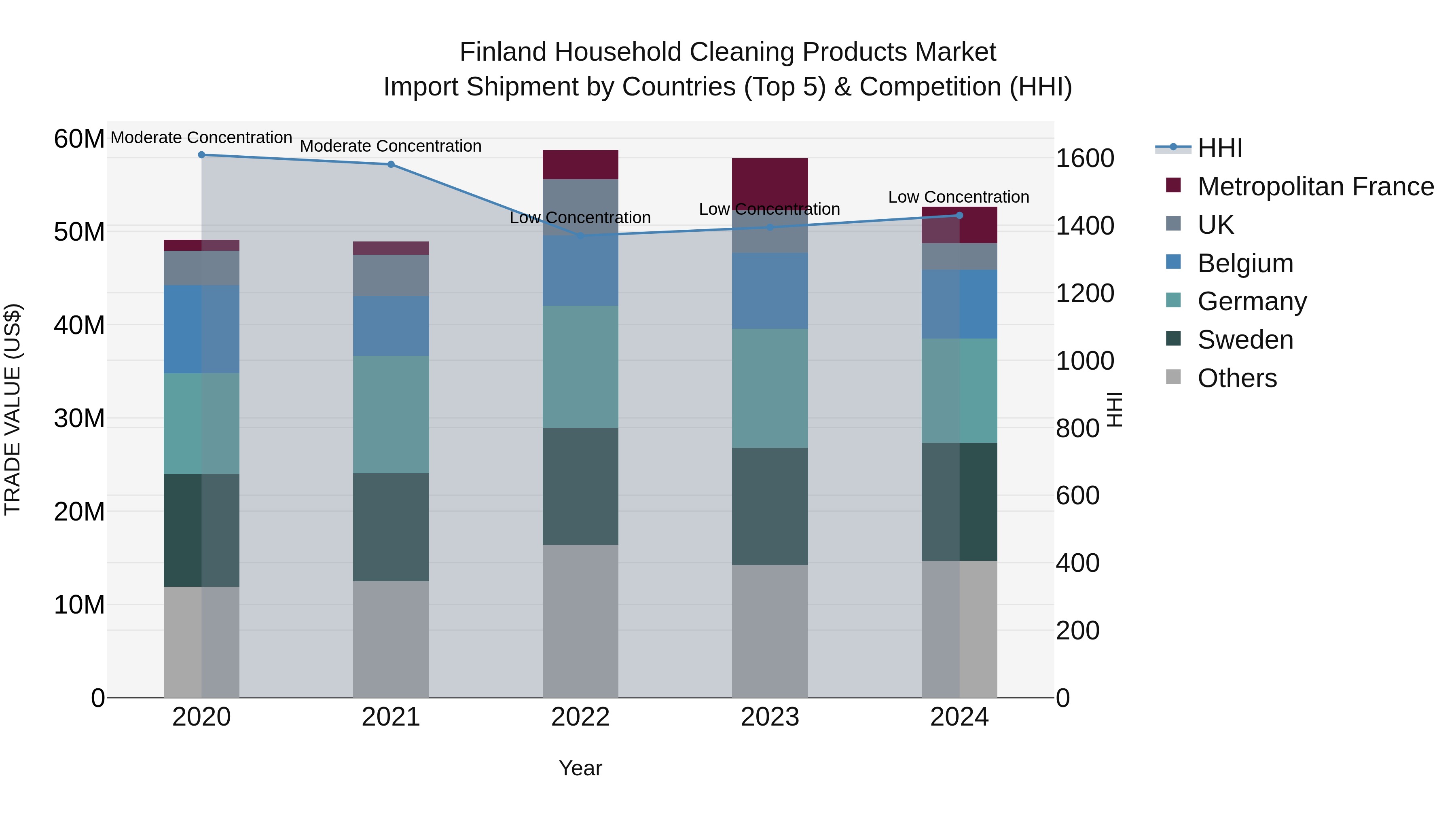
Finland Household Cleaning Products Market Overview
The household cleaning products market in Finland is expanding as consumers become more conscious about cleanliness, hygiene, and environmental impact. Finnish consumers are increasingly opting for eco-friendly and sustainable cleaning products that minimize chemical usage and reduce environmental harm. The demand for natural cleaning solutions, including plant-based and biodegradable products, is growing, reflecting broader trends toward sustainability. As more households focus on maintaining a clean and healthy environment, the market for household cleaning products in Finland is expected to continue thriving, with innovations in non-toxic and effective cleaning solutions playing a significant role.
Drivers of the market
The household cleaning products market in Finland is growing, driven by consumer preferences for eco-friendly and effective cleaning solutions. The demand for products such as all-purpose cleaners, disinfectants, and specialized products (e.g., for kitchen and bathroom use) is rising. Sustainability and the shift towards natural and biodegradable ingredients are significant trends in this market.
Challenges of the market
The household cleaning products market in Finland faces challenges stemming from the growing demand for eco-friendly and sustainable products. Consumers are becoming more conscious of the environmental impact of traditional cleaning chemicals, leading to an increase in demand for natural and biodegradable alternatives. However, manufacturers face difficulties in sourcing sustainable raw materials and ensuring that products are both effective and environmentally friendly. Additionally, competition from private-label brands and price sensitivity in the market can impact profit margins.
Government Policy of the market
Finlands policies in the household cleaning products market promote the use of biodegradable and non-toxic ingredients. Regulations ensure product safety and environmental compliance, while subsidies encourage local manufacturers to develop sustainable cleaning solutions.
Key Highlights of the Report:
- Finland Household Cleaning Products Market Outlook
- Market Size of Finland Household Cleaning Products Market, 2024
- Forecast of Finland Household Cleaning Products Market, 2031
- Historical Data and Forecast of Finland Household Cleaning Products Revenues & Volume for the Period 2021-2031
- Finland Household Cleaning Products Market Trend Evolution
- Finland Household Cleaning Products Market Drivers and Challenges
- Finland Household Cleaning Products Price Trends
- Finland Household Cleaning Products Porter`s Five Forces
- Finland Household Cleaning Products Industry Life Cycle
- Historical Data and Forecast of Finland Household Cleaning Products Market Revenues & Volume By Product Type for the Period 2021-2031
- Historical Data and Forecast of Finland Household Cleaning Products Market Revenues & Volume By Laundry Detergents for the Period 2021-2031
- Historical Data and Forecast of Finland Household Cleaning Products Market Revenues & Volume By Surface Cleaners for the Period 2021-2031
- Historical Data and Forecast of Finland Household Cleaning Products Market Revenues & Volume By Dishwashing Products for the Period 2021-2031
- Historical Data and Forecast of Finland Household Cleaning Products Market Revenues & Volume By Toilet Cleaners for the Period 2021-2031
- Historical Data and Forecast of Finland Household Cleaning Products Market Revenues & Volume By Others for the Period 2021-2031
- Finland Household Cleaning Products Import Export Trade Statistics
- Market Opportunity Assessment By Product Type
- Finland Household Cleaning Products Top Companies Market Share
- Finland Household Cleaning Products Competitive Benchmarking By Technical and Operational Parameters
- Finland Household Cleaning Products Company Profiles
- Finland Household Cleaning Products Key Strategic Recommendations






































