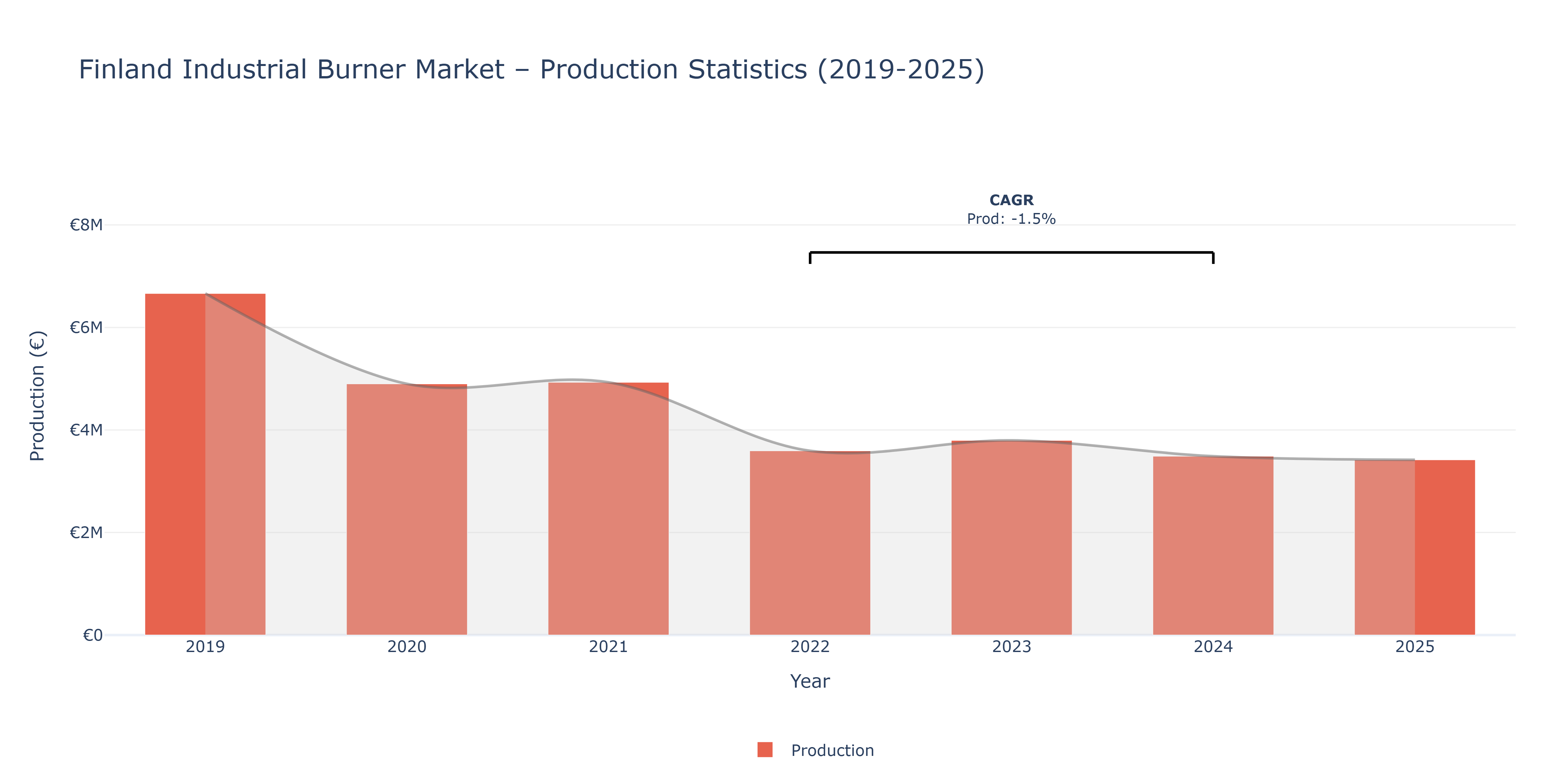
Finland Industrial Burner - Market Production Statistics (2019-2025)
In the Finland Industrial Burner Market, production exhibited a declining trend from 2019 to 2025. The production figures decreased from €6.66 million in 2019 to €3.42 million in 2025. The market experienced fluctuations, with peaks in 2019 and a slight increase in 2021 compared to 2020. The decline in production can be attributed to various factors such as economic slowdown, changes in industrial demand, and technological advancements impacting production efficiency. The Compound Annual Growth Rate (CAGR) for production between 2022 and 2024 was calculated at -1.49%, indicating a modest decline in production levels over the period. This downward trend suggests a challenging market environment, necessitating strategic adaptations to navigate the changing landscape and potentially explore new growth opportunities.
Finland Industrial Burner Market Overview
The industrial burner market in Finland is expanding as industries seek more efficient and environmentally friendly combustion solutions for heating, drying, and power generation. Industrial burners are used in various applications, including industrial furnaces, boilers, and ovens, to provide precise control over fuel combustion. With Finlands commitment to sustainability, there is an increasing demand for low-emission burners that comply with environmental regulations. The growing industrial base and the need for energy-efficient solutions are expected to drive the market for industrial burners in Finland in the coming years.
Drivers of the market
The industrial burner market in Finland is driven by the need for energy-efficient combustion solutions in various industries, including oil and gas, manufacturing, and chemical processing. As companies seek to reduce fuel consumption and minimize emissions, there is an increasing adoption of high-efficiency burners. Technological advancements in burner design, such as variable speed controls and integrated monitoring systems, also contribute to the growth of this market. Additionally, stricter environmental standards for industrial processes encourage the demand for cleaner and more efficient combustion technologies.
Challenges of the market
The industrial burner market in Finland faces challenges due to increasing pressure to meet stricter environmental regulations concerning emissions and energy efficiency. Manufacturers are required to develop burners that reduce energy consumption and lower emissions, which can increase production costs. Additionally, competition from alternative heating technologies and the growing adoption of renewable energy solutions presents challenges for the burner market.
Government Policy of the market
Industrial burners in Finland must comply with strict emission standards set by the government. Policies promote the adoption of low-NOx and energy-efficient burners, with subsidies available for eco-friendly upgrades.
Key Highlights of the Report:
- Finland Industrial Burner Market Outlook
- Market Size of Finland Industrial Burner Market, 2024
- Forecast of Finland Industrial Burner Market, 2031
- Historical Data and Forecast of Finland Industrial Burner Revenues & Volume for the Period 2021-2031
- Finland Industrial Burner Market Trend Evolution
- Finland Industrial Burner Market Drivers and Challenges
- Finland Industrial Burner Price Trends
- Finland Industrial Burner Porter`s Five Forces
- Finland Industrial Burner Industry Life Cycle
- Historical Data and Forecast of Finland Industrial Burner Market Revenues & Volume By Type for the Period 2021-2031
- Historical Data and Forecast of Finland Industrial Burner Market Revenues & Volume By Cold Chamber Die Casting Machine for the Period 2021-2031
- Historical Data and Forecast of Finland Industrial Burner Market Revenues & Volume By Hot Chamber Die Casting Machine for the Period 2021-2031
- Historical Data and Forecast of Finland Industrial Burner Market Revenues & Volume By Gravity Die Casting Machine for the Period 2021-2031
- Historical Data and Forecast of Finland Industrial Burner Market Revenues & Volume By Material for the Period 2021-2031
- Historical Data and Forecast of Finland Industrial Burner Market Revenues & Volume By Aluminum for the Period 2021-2031
- Historical Data and Forecast of Finland Industrial Burner Market Revenues & Volume By Zinc for the Period 2021-2031
- Historical Data and Forecast of Finland Industrial Burner Market Revenues & Volume By Magnesium for the Period 2021-2031
- Historical Data and Forecast of Finland Industrial Burner Market Revenues & Volume By End User for the Period 2021-2031
- Historical Data and Forecast of Finland Industrial Burner Market Revenues & Volume By Transportation for the Period 2021-2031
- Historical Data and Forecast of Finland Industrial Burner Market Revenues & Volume By Mechanical & Manufacturing Equipment for the Period 2021-2031
- Historical Data and Forecast of Finland Industrial Burner Market Revenues & Volume By Building & Construction for the Period 2021-2031
- Finland Industrial Burner Import Export Trade Statistics
- Market Opportunity Assessment By Type
- Market Opportunity Assessment By Material
- Market Opportunity Assessment By End User
- Finland Industrial Burner Top Companies Market Share
- Finland Industrial Burner Competitive Benchmarking By Technical and Operational Parameters
- Finland Industrial Burner Company Profiles
- Finland Industrial Burner Key Strategic Recommendations






































