Finland Injection Molding Machine Market Size (2020-2030)
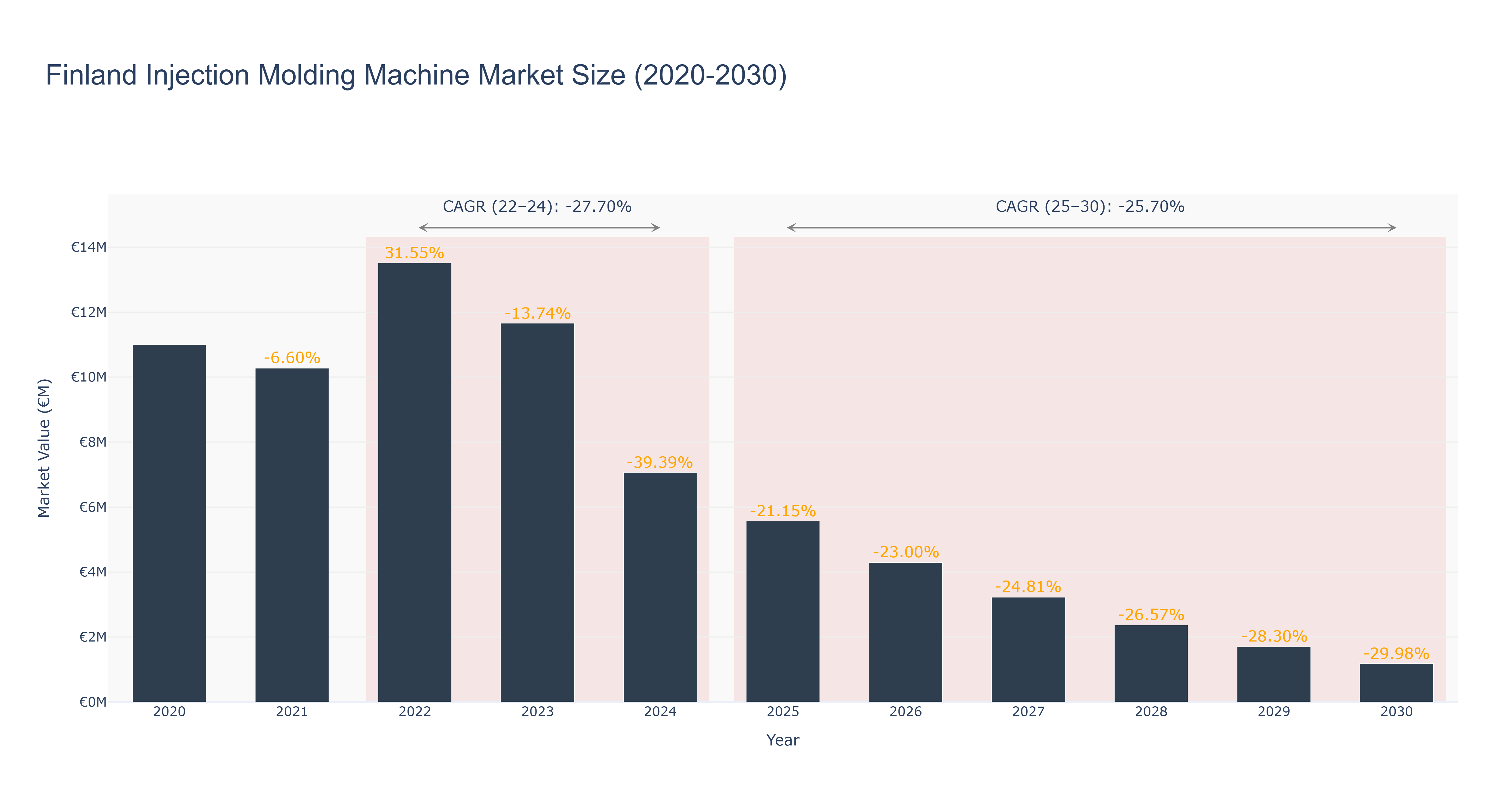
The Finland Injection Molding Machine Market experienced notable volatility in the actual data from 2020 to 2024, peaking at €11.00 million in 2020 before declining to €7.07 million by 2024, reflecting a significant Compound Annual Growth Rate (CAGR) of -27.70% during the period. A sharp recovery was observed in 2022, where the market size soared to €13.52 million, driven primarily by increased demand in the automotive and consumer goods sectors. However, subsequent years witnessed substantial declines due to global supply chain disruptions and reduced industrial activity, resulting in a projected market size decrease to €1.19 million by 2030, with a forecasted CAGR of -25.70%. The market's future outlook remains challenging, influenced by ongoing technological advancements and competition from alternative manufacturing processes, which may inhibit growth despite potential opportunities in sustainable production technologies.
Finland Injection Molding Machine Market: Production & Trade Performance (2019-2025)
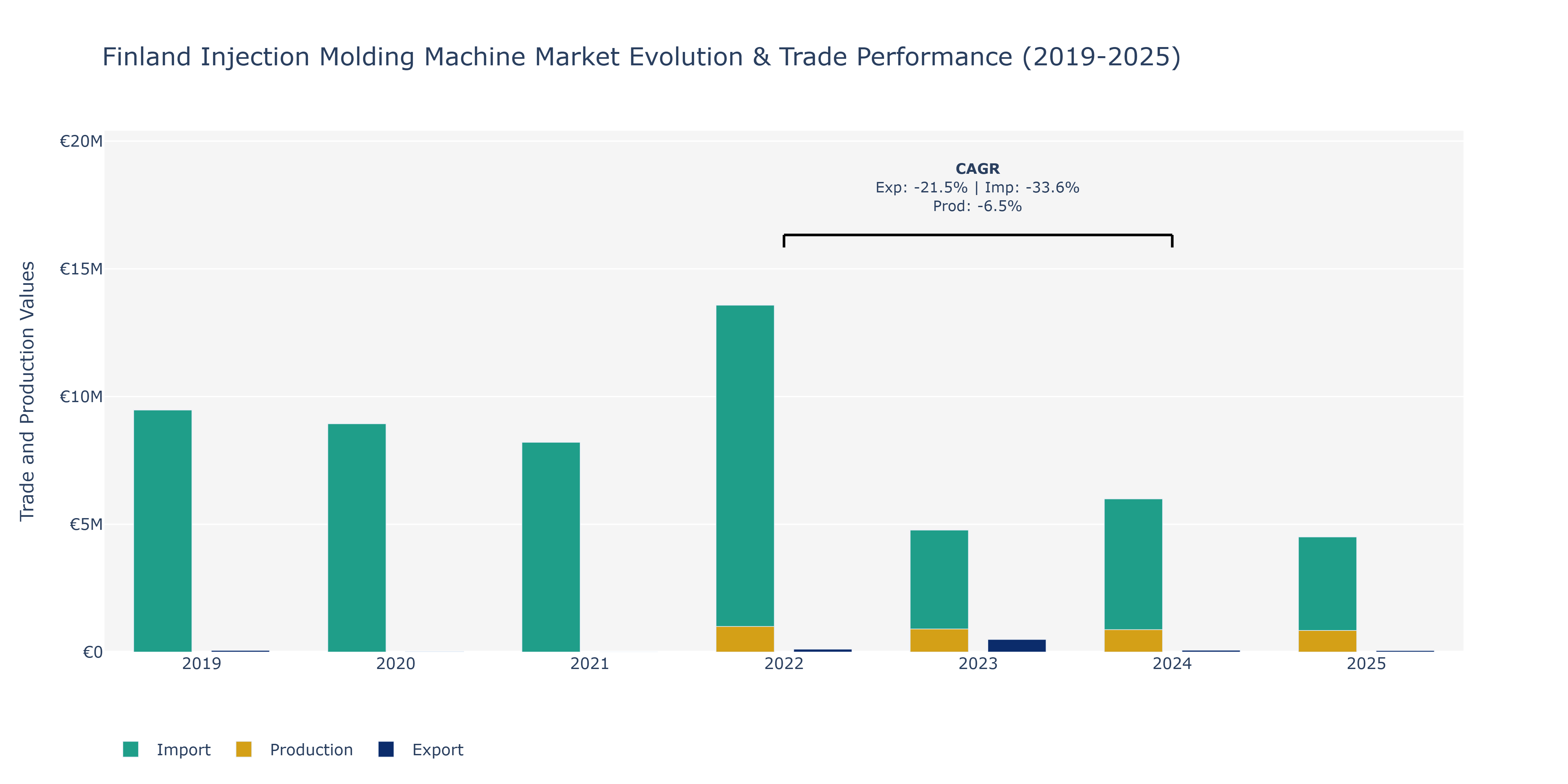
In the Finland Injection Molding Machine Market, from 2019 to 2025, exports experienced fluctuations. In 2019, exports were at €63.04 thousand, declining sharply to €23.44 thousand in 2020, before significantly increasing to €493.74 thousand in 2023, and then decreasing to €58.38 thousand in 2025. Imports followed a similar pattern, starting at €9.47 million in 2019, decreasing annually to €4.5 million in 2025. Production value also fluctuated, starting at €1 billion in 2022 and declining to €843.65 million in 2025. These changes can be attributed to various factors such as global economic conditions, technological advancements impacting demand patterns, and shifts in consumer preferences towards sustainable manufacturing processes. Given the declining trend in imports and production, local manufacturers may be facing challenges to compete with international players, necessitating strategic adaptations to enhance competitiveness and meet evolving market demands.
Finland Injection Molding Machine Market Overview
The injection molding machine market in Finland is growing due to the increasing demand for automated, high-precision machines used in manufacturing plastic parts. These machines are used in a variety of industries, including automotive, electronics, and medical devices, to produce components with high durability and tight tolerances.
Drivers of the market
The injection molding machine market in Finland is growing due to the rising demand for efficient, high-speed, and energy-efficient machinery across various manufacturing sectors. Injection molding machines are essential for producing complex plastic components, and their use is expanding in industries such as automotive, electronics, and packaging. The growing focus on automation and Industry 4.0 technologies is contributing to the adoption of advanced molding machines that offer higher precision, faster cycles, and reduced energy consumption. Additionally, Finlands strong industrial base and innovation in production technologies are supporting the demand for state-of-the-art injection molding machines.
Challenges of the market
In Finland, the injection molding machine market faces significant challenges driven by the need for greater automation and efficiency in production processes. The growing demand for faster and more energy-efficient machines requires constant innovation and investment in new technologies. Additionally, the fluctuation in the cost of raw materials, such as steel and electronic components, can affect the profitability of manufacturers. Companies must also contend with international competition, particularly from low-cost regions, which puts pressure on pricing strategies.
Government Policy of the market
Finnish policies focus on modernizing manufacturing facilities by supporting the adoption of advanced injection molding machines. Incentives such as tax breaks are offered for companies investing in energy-efficient and automated machinery. The government also funds training programs to upskill workers in the use of these technologies.
Key Highlights of the Report:
- Finland Injection Molding Machine Market Outlook
- Market Size of Finland Injection Molding Machine Market, 2024
- Forecast of Finland Injection Molding Machine Market, 2031
- Historical Data and Forecast of Finland Injection Molding Machine Revenues & Volume for the Period 2021-2031
- Finland Injection Molding Machine Market Trend Evolution
- Finland Injection Molding Machine Market Drivers and Challenges
- Finland Injection Molding Machine Price Trends
- Finland Injection Molding Machine Porter`s Five Forces
- Finland Injection Molding Machine Industry Life Cycle
- Historical Data and Forecast of Finland Injection Molding Machine Market Revenues & Volume By Material for the Period 2021-2031
- Historical Data and Forecast of Finland Injection Molding Machine Market Revenues & Volume By Plastic for the Period 2021-2031
- Historical Data and Forecast of Finland Injection Molding Machine Market Revenues & Volume By Metal for the Period 2021-2031
- Historical Data and Forecast of Finland Injection Molding Machine Market Revenues & Volume By Others for the Period 2021-2031
- Historical Data and Forecast of Finland Injection Molding Machine Market Revenues & Volume By Technology for the Period 2021-2031
- Historical Data and Forecast of Finland Injection Molding Machine Market Revenues & Volume By Hydraulic for the Period 2021-2031
- Historical Data and Forecast of Finland Injection Molding Machine Market Revenues & Volume By Electric for the Period 2021-2031
- Historical Data and Forecast of Finland Injection Molding Machine Market Revenues & Volume By Hybrid for the Period 2021-2031
- Historical Data and Forecast of Finland Injection Molding Machine Market Revenues & Volume By End-use for the Period 2021-2031
- Historical Data and Forecast of Finland Injection Molding Machine Market Revenues & Volume By Automotive for the Period 2021-2031
- Historical Data and Forecast of Finland Injection Molding Machine Market Revenues & Volume By Consumer Goods for the Period 2021-2031
- Historical Data and Forecast of Finland Injection Molding Machine Market Revenues & Volume By Packaging for the Period 2021-2031
- Historical Data and Forecast of Finland Injection Molding Machine Market Revenues & Volume By Electronics for the Period 2021-2031
- Historical Data and Forecast of Finland Injection Molding Machine Market Revenues & Volume By Others for the Period 2021-2031
- Finland Injection Molding Machine Import Export Trade Statistics
- Market Opportunity Assessment By Material
- Market Opportunity Assessment By Technology
- Market Opportunity Assessment By End-use
- Finland Injection Molding Machine Top Companies Market Share
- Finland Injection Molding Machine Competitive Benchmarking By Technical and Operational Parameters
- Finland Injection Molding Machine Company Profiles
- Finland Injection Molding Machine Key Strategic Recommendations






































