Finland Iron Powder Market Size (2020-2030)
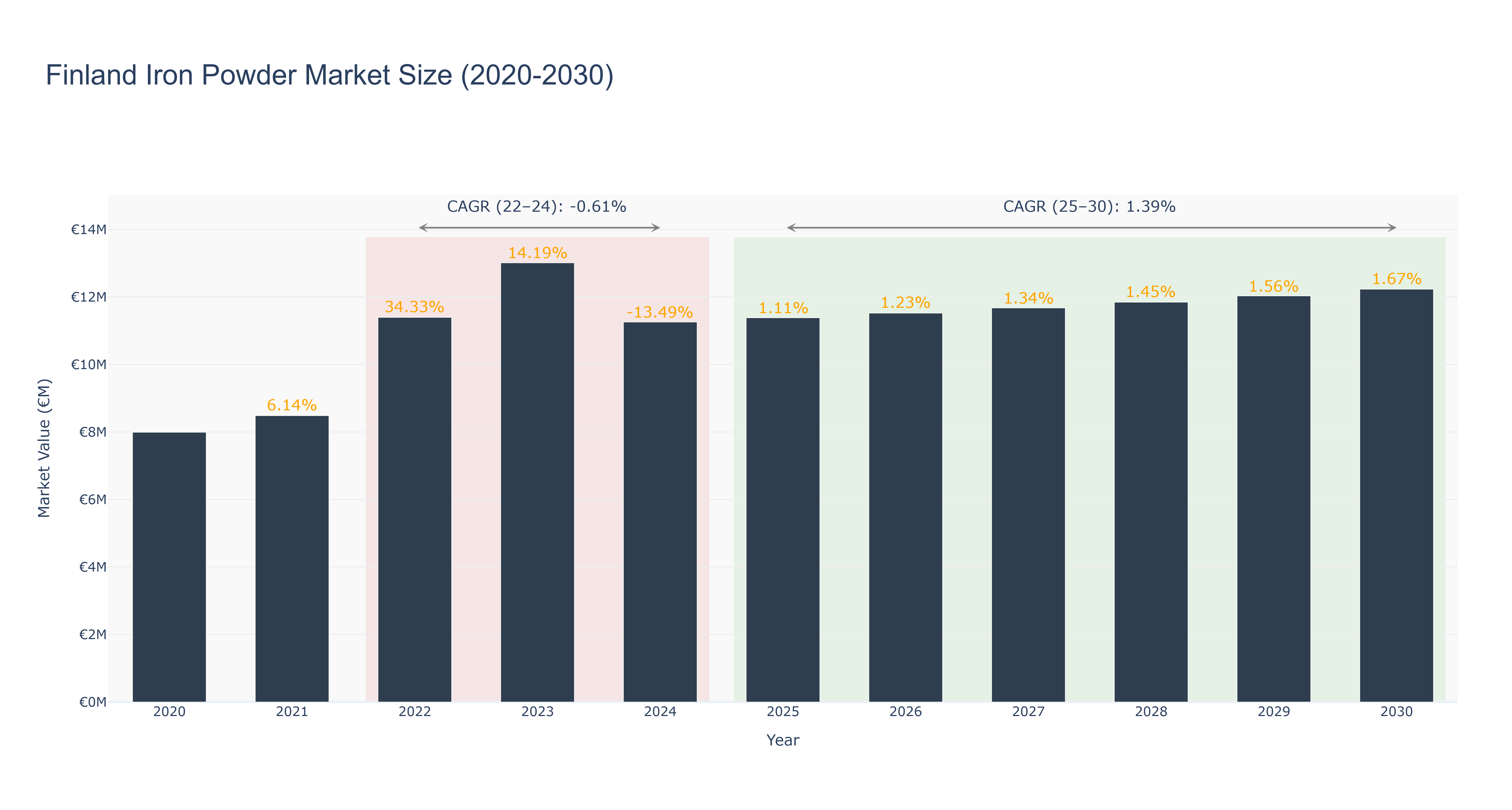
The Finland Iron Powder Market experienced a peak size of €13.01 million in 2023. From 2020 to 2024, the market size fluctuated, starting at €7.99 million in 2020, reaching a high of €13.01 million in 2023, and then dropping to €11.26 million in 2024. Forecasted growth from 2025 to 2030 shows a steady increase, with a CAGR of 1.39%. The market faced a decline in 2024 due to external factors impacting demand, while the subsequent growth can be attributed to increased industrial applications and technological advancements in iron powder production processes. Looking ahead, Finland is set to invest in sustainable manufacturing practices, including the use of iron powder in eco-friendly products, positioning the market for further growth and innovation in the coming years.
Finland Iron Powder Market: Production & Trade Performance (2019-2025)
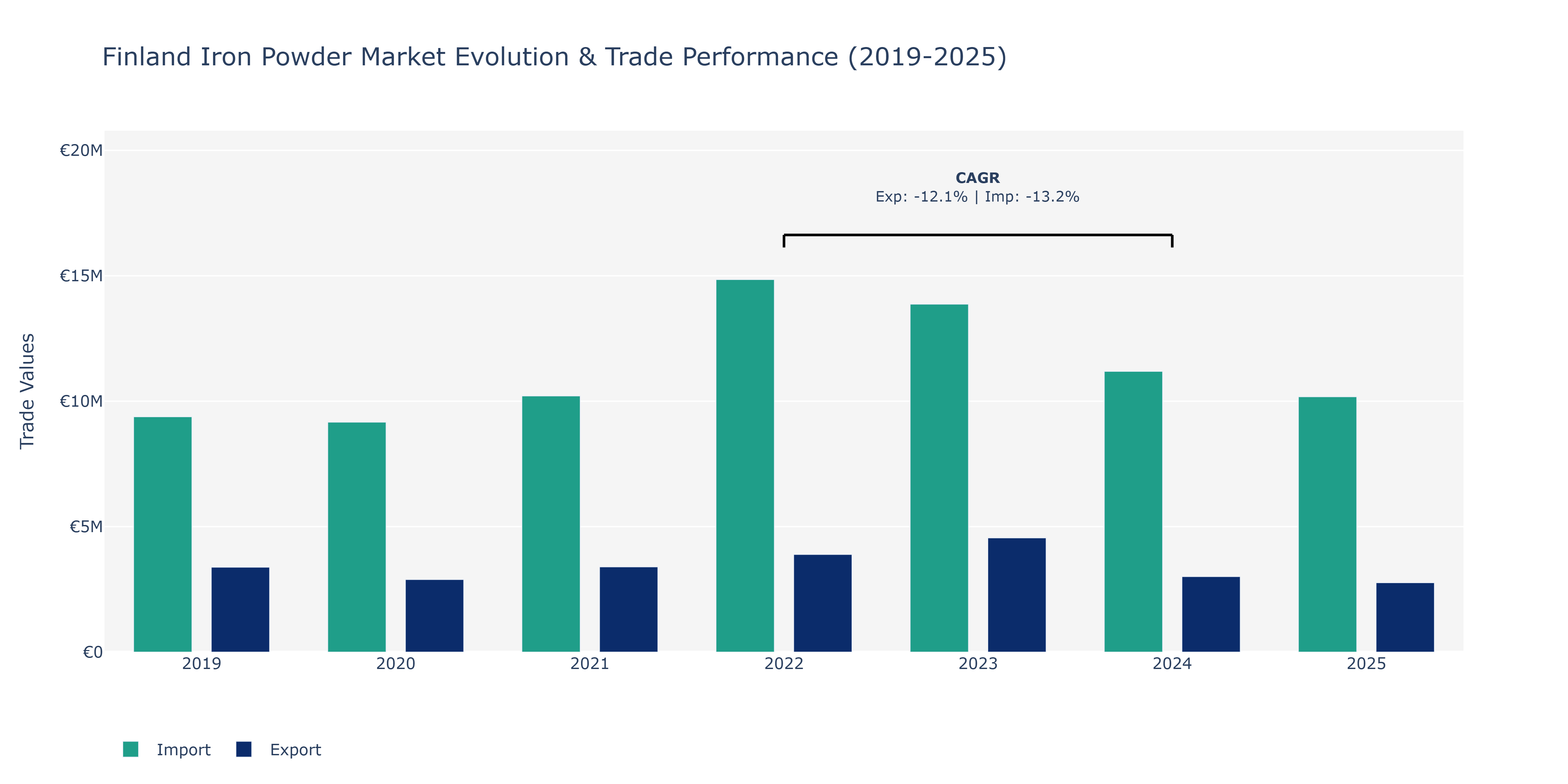
Between 2019 and 2025, Finland's Iron Powder Market saw fluctuations in both exports and imports. Exports started at €3.38 million, experienced a decline in 2020 to €2.89 million, before rising again in 2021 to €3.39 million, reaching a peak in 2023 at €4.55 million, and then declined to €2.76 million in 2025. Similarly, imports began at €9.38 million in 2019, decreased slightly in 2020 to €9.16 million, rose in 2021 to €10.21 million, peaked in 2022 at €14.85 million, and then decreased to €10.18 million in 2025. These fluctuations can be attributed to various factors, including global demand shifts, supply chain disruptions, and domestic production capacity. The decrease in exports and imports in 2025 might have been influenced by changing market dynamics or trade regulations impacting the iron powder sector. Further analysis into market demand fluctuations and trade policies could provide valuable insights into understanding these trends in Finland's Iron Powder Market.
Finland Iron Powder Market Overview
The iron powder market in Finland is expanding as iron powder is used in a variety of applications, including metallurgy, 3D printing, and manufacturing. Iron powder is essential in the production of sintered parts and is used in the automotive and machinery industries. Finlands advanced manufacturing capabilities and its focus on industrial innovation are driving the demand for iron powder. The market is expected to grow as the demand for high-quality, precise metal parts increases.
Drivers of the market
The iron powder market in Finland is growing as demand rises for iron powder in applications such as powder metallurgy, 3D printing, and welding. Iron powder is used to manufacture high-quality parts for automotive and industrial applications. Finlands strong industrial base, along with the increasing use of additive manufacturing technologies, is driving the demand for iron powder.
Challenges of the market
The iron powder market in Finland faces challenges in meeting the increasing demand for high-quality iron powders used in applications such as additive manufacturing and powder metallurgy. Companies must balance the production of high-performance powders with cost-efficiency, while addressing concerns about the environmental impact of powder production. The competition from alternative materials and the need for continuous innovation add complexity to the market.
Government Policy of the market
Finland promotes the development of advanced manufacturing processes for iron powder, particularly for additive manufacturing. Government policies include funding for research and ensuring compliance with environmental standards in production.
Key Highlights of the Report:
- Finland Iron Powder Market Outlook
- Market Size of Finland Iron Powder Market, 2024
- Forecast of Finland Iron Powder Market, 2031
- Historical Data and Forecast of Finland Iron Powder Revenues & Volume for the Period 2021-2031
- Finland Iron Powder Market Trend Evolution
- Finland Iron Powder Market Drivers and Challenges
- Finland Iron Powder Price Trends
- Finland Iron Powder Porter`s Five Forces
- Finland Iron Powder Industry Life Cycle
- Historical Data and Forecast of Finland Iron Powder Market Revenues & Volume By End Use for the Period 2021-2031
- Historical Data and Forecast of Finland Iron Powder Market Revenues & Volume By Aerospace & defense for the Period 2021-2031
- Historical Data and Forecast of Finland Iron Powder Market Revenues & Volume By Automotive for the Period 2021-2031
- Historical Data and Forecast of Finland Iron Powder Market Revenues & Volume By Oil & Gas for the Period 2021-2031
- Historical Data and Forecast of Finland Iron Powder Market Revenues & Volume By Medical for the Period 2021-2031
- Historical Data and Forecast of Finland Iron Powder Market Revenues & Volume By Others for the Period 2021-2031
- Historical Data and Forecast of Finland Iron Powder Market Revenues & Volume By Product Type for the Period 2021-2031
- Historical Data and Forecast of Finland Iron Powder Market Revenues & Volume By Unalloyed for the Period 2021-2031
- Historical Data and Forecast of Finland Iron Powder Market Revenues & Volume By Alloyed for the Period 2021-2031
- Historical Data and Forecast of Finland Iron Powder Market Revenues & Volume By Insulated Iron powder for the Period 2021-2031
- Historical Data and Forecast of Finland Iron Powder Market Revenues & Volume By Manufacturing Process for the Period 2021-2031
- Historical Data and Forecast of Finland Iron Powder Market Revenues & Volume By Physical for the Period 2021-2031
- Historical Data and Forecast of Finland Iron Powder Market Revenues & Volume By Atomization for the Period 2021-2031
- Historical Data and Forecast of Finland Iron Powder Market Revenues & Volume By Electro deposition for the Period 2021-2031
- Historical Data and Forecast of Finland Iron Powder Market Revenues & Volume By Chemical for the Period 2021-2031
- Historical Data and Forecast of Finland Iron Powder Market Revenues & Volume By Reduction for the Period 2021-2031
- Historical Data and Forecast of Finland Iron Powder Market Revenues & Volume By Decomposition for the Period 2021-2031
- Historical Data and Forecast of Finland Iron Powder Market Revenues & Volume By Mechanical for the Period 2021-2031
- Historical Data and Forecast of Finland Iron Powder Market Revenues & Volume By Pulverization for the Period 2021-2031
- Finland Iron Powder Import Export Trade Statistics
- Market Opportunity Assessment By End Use
- Market Opportunity Assessment By Product Type
- Market Opportunity Assessment By Manufacturing Process
- Finland Iron Powder Top Companies Market Share
- Finland Iron Powder Competitive Benchmarking By Technical and Operational Parameters
- Finland Iron Powder Company Profiles
- Finland Iron Powder Key Strategic Recommendations






































