Finland Lead Alloy Market Size (2020-2030)
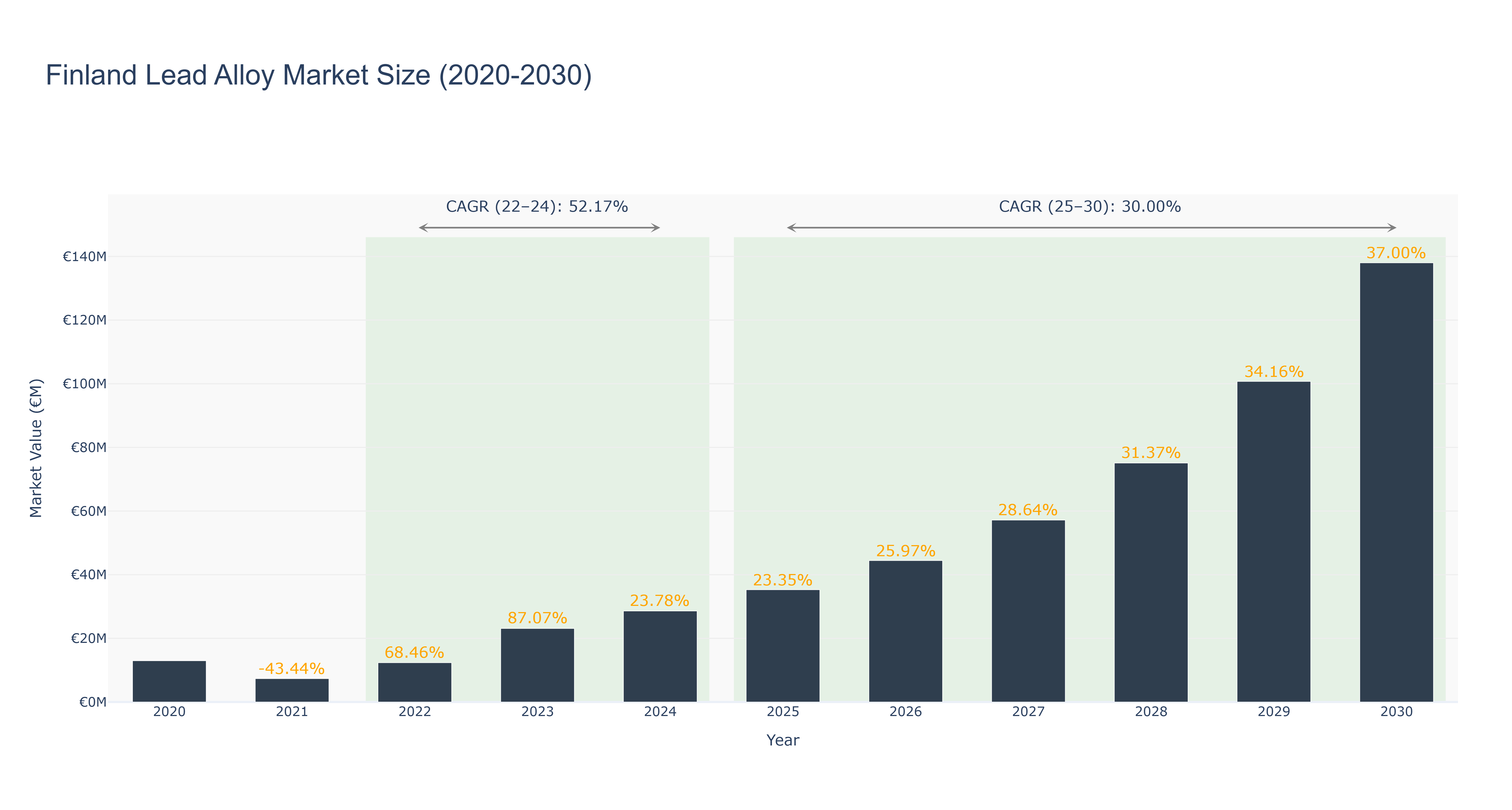
Finland Lead Alloy Market has shown significant growth over the years. The market peaked in 2030 with a market size of €137.99 million. From 2020 to 2024, the market size increased steadily, reaching €28.59 million in 2024. The forecasted market size from 2025 to 2030 shows a strong upward trend, with a CAGR of 30.0%. The CAGR from 2022 to 2024 was 52.17%, indicating a rapid growth phase during that period. The market's growth can be attributed to increasing demand for lead alloys in various industries, such as automotive and construction, driven by their unique properties. Looking ahead, Finland is set to invest in sustainable lead alloy production processes to align with environmental regulations and enhance competitiveness in the global market. Industry drivers include the rising demand for lead alloys in battery manufacturing and the construction sector. Future developments include the implementation of advanced recycling technologies to promote a circular economy in the lead alloy industry.
Finland Lead Alloy Market: Production & Trade Performance (2019-2025)
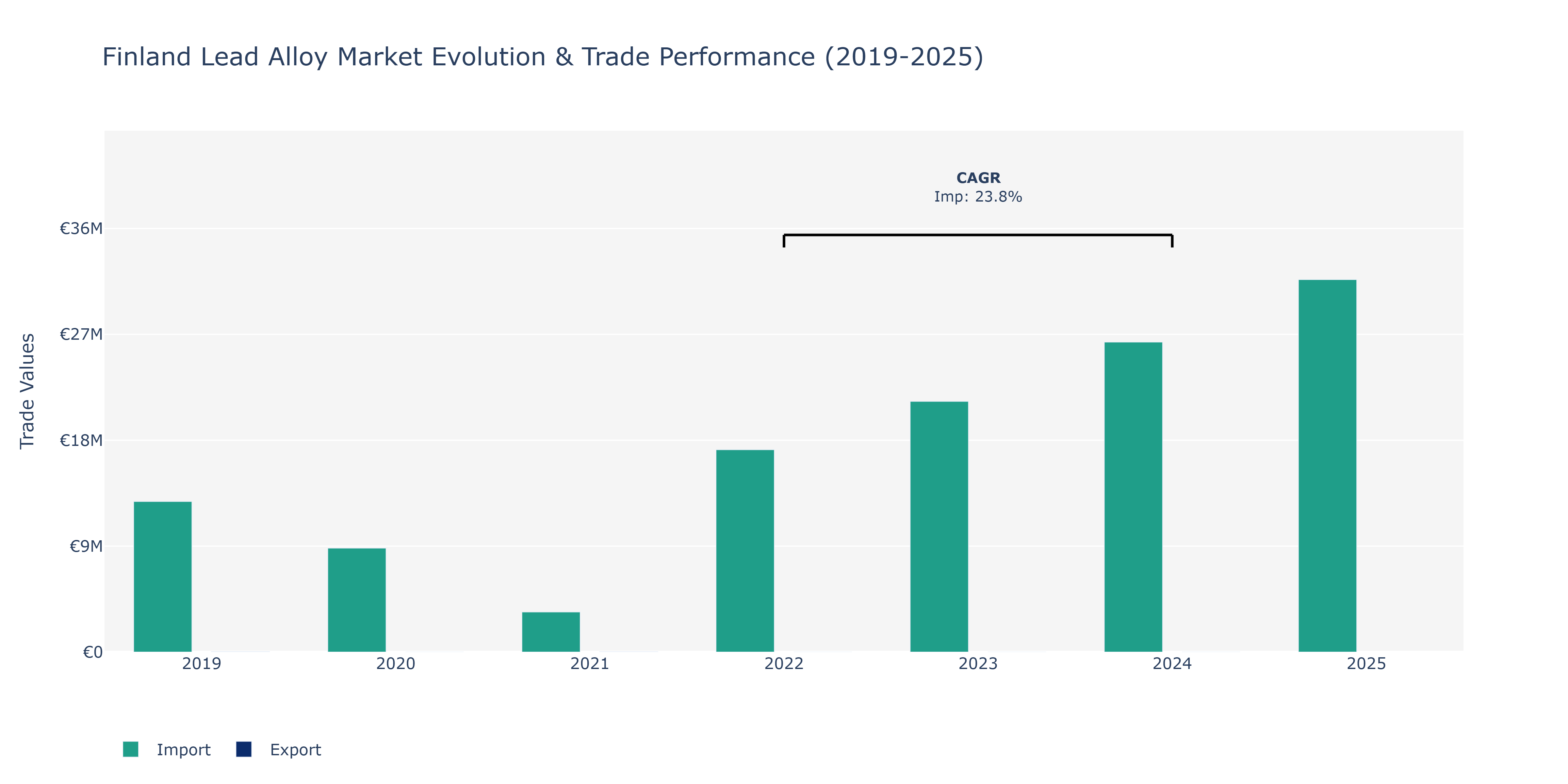
The Finland Lead Alloy Market witnessed a notable fluctuation in both Exports and Imports during the period under review. In 2019, Exports stood at €27.27 thousand, while Imports were substantially higher at €12.79 million. However, Exports experienced a decline in 2021, reaching €20.71 thousand, while Imports decreased to €3.4 million the same year. The subsequent years saw a sharp increase in Imports, reaching €31.65 million in 2025. This upward trend can be attributed to the growing demand for lead alloys in various industries such as automotive, construction, and electronics within Finland. The boost in Imports could also be influenced by global market dynamics and the need for a stable supply chain to support domestic manufacturing. Despite the fluctuations, the Finland Lead Alloy Market demonstrates resilience and adaptability to changing market conditions, emphasizing the importance of a strategic approach to trade dynamics in the industry.
Key Highlights of the Report:
- Finland Lead Alloy Market Outlook
- Market Size of Finland Lead Alloy Market, 2024
- Forecast of Finland Lead Alloy Market, 2031
- Historical Data and Forecast of Finland Lead Alloy Revenues & Volume for the Period 2021-2031
- Finland Lead Alloy Market Trend Evolution
- Finland Lead Alloy Market Drivers and Challenges
- Finland Lead Alloy Price Trends
- Finland Lead Alloy Porter`s Five Forces
- Finland Lead Alloy Industry Life Cycle
- Historical Data and Forecast of Finland Lead Alloy Market Revenues & Volume By Type for the Period 2021-2031
- Historical Data and Forecast of Finland Lead Alloy Market Revenues & Volume By Lead Antimony Alloys for the Period 2021-2031
- Historical Data and Forecast of Finland Lead Alloy Market Revenues & Volume By Lead Tin Alloys for the Period 2021-2031
- Historical Data and Forecast of Finland Lead Alloy Market Revenues & Volume By Lead Arsenic Alloys for the Period 2021-2031
- Historical Data and Forecast of Finland Lead Alloy Market Revenues & Volume By Lead Calcium Alloys for the Period 2021-2031
- Historical Data and Forecast of Finland Lead Alloy Market Revenues & Volume By Others for the Period 2021-2031
- Historical Data and Forecast of Finland Lead Alloy Market Revenues & Volume By Application for the Period 2021-2031
- Historical Data and Forecast of Finland Lead Alloy Market Revenues & Volume By Battery Grids for the Period 2021-2031
- Historical Data and Forecast of Finland Lead Alloy Market Revenues & Volume By Metals for the Period 2021-2031
- Historical Data and Forecast of Finland Lead Alloy Market Revenues & Volume By Cable Sheathing for the Period 2021-2031
- Historical Data and Forecast of Finland Lead Alloy Market Revenues & Volume By Lead Sheet for the Period 2021-2031
- Historical Data and Forecast of Finland Lead Alloy Market Revenues & Volume By Seamless Pipe for the Period 2021-2031
- Historical Data and Forecast of Finland Lead Alloy Market Revenues & Volume By Others for the Period 2021-2031
- Finland Lead Alloy Import Export Trade Statistics
- Market Opportunity Assessment By Type
- Market Opportunity Assessment By Application
- Finland Lead Alloy Top Companies Market Share
- Finland Lead Alloy Competitive Benchmarking By Technical and Operational Parameters
- Finland Lead Alloy Company Profiles
- Finland Lead Alloy Key Strategic Recommendations






































