France Acrylate Market Top 5 Importing Countries and Market Competition (HHI) Analysis
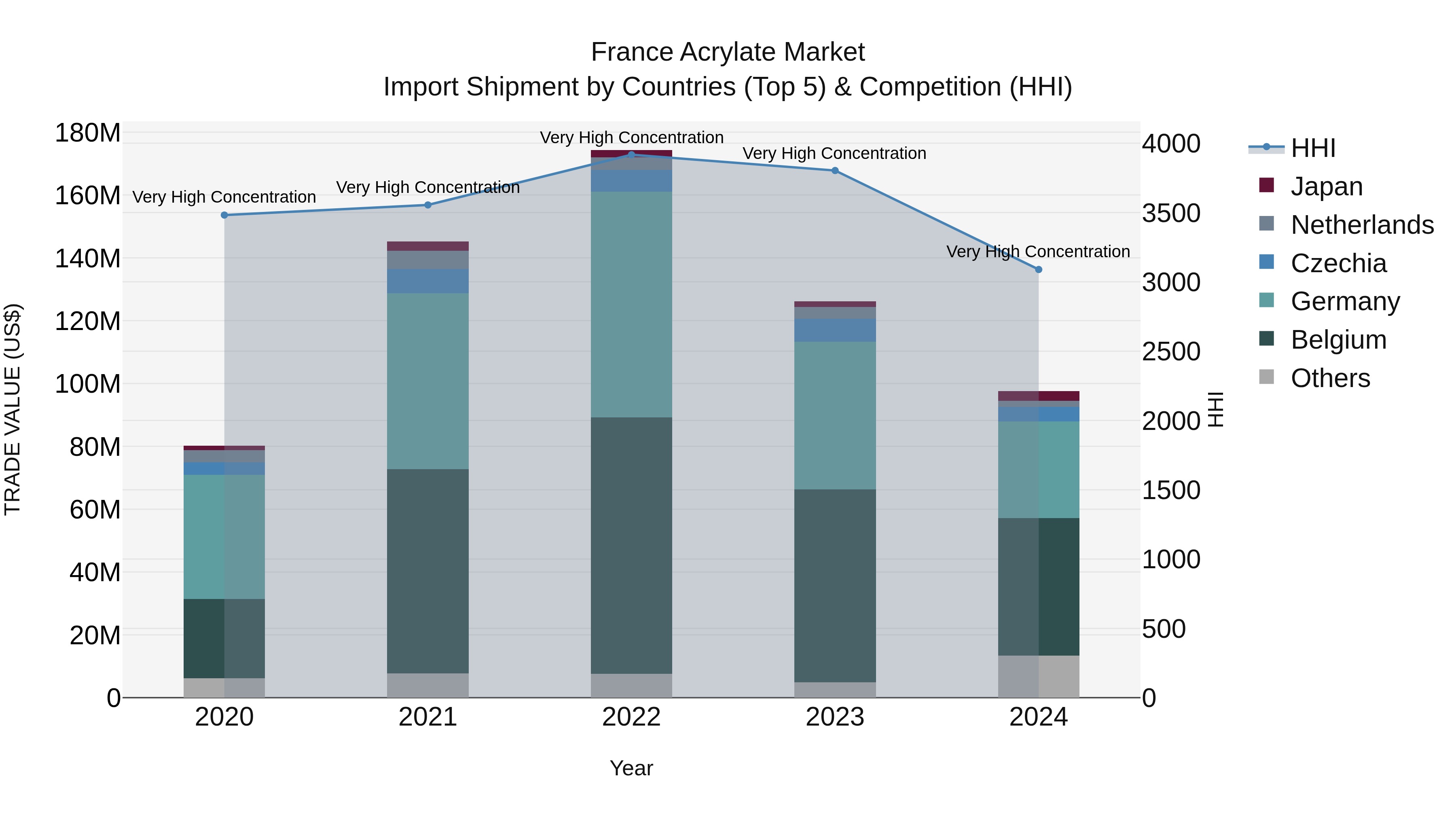
France`s acrylate import market in 2024 continued to be dominated by key exporting countries such as Belgium, Germany, China, Czechia, and Japan. The High Herfindahl-Hirschman Index (HHI) indicates a persistent high concentration within the market. Despite a healthy compound annual growth rate (CAGR) of 5.02% from 2020 to 2024, there was a notable decline in growth from 2023 to 2024, with a negative growth rate of -22.68%. This trend suggests a potential slowdown in the import demand for acrylate in France, signaling a need for further analysis and strategic planning for market participants.
France Acrylate Market Overview
The France Acrylate Market is experiencing steady growth due to the increasing demand from various end-use industries such as adhesives, paints and coatings, textiles, and construction. The market is driven by factors such as the growing construction industry, the increasing adoption of water-based adhesives and coatings, and the rising demand for eco-friendly products. Key players in the market are focusing on product innovation and expansion of their production capacities to meet the growing demand. However, challenges such as volatility in raw material prices and stringent regulations regarding the use of certain acrylate compounds may hinder market growth. Overall, the France Acrylate Market is expected to continue its growth trajectory, supported by the increasing demand for sustainable and high-performance materials across various industries.
France Acrylate Market Trends and Opportunities
The France Acrylate Market is experiencing growth due to increasing demand from end-use industries such as automotive, construction, and packaging. A key trend in the market is the shift towards sustainable and eco-friendly acrylate products, driven by regulatory pressure and consumer preferences for environmentally friendly options. Opportunities in the market lie in the development of bio-based acrylates and the expansion of applications in sectors like adhesives, textiles, and electronics. With a focus on innovation and product differentiation, companies in the France Acrylate Market can leverage these trends to capture market share and stay competitive in a rapidly evolving industry landscape.
France Acrylate Market Challenges
In the France Acrylate Market, some of the key challenges faced include increasing raw material costs, stringent regulations related to environmental protection and worker safety, and intense competition from established market players. Fluctuations in raw material prices can directly impact production costs and profit margins for acrylate manufacturers. Compliance with stringent environmental regulations often requires significant investments in technology and processes to reduce emissions and waste. Additionally, the market is highly competitive with a few dominant players, making it challenging for new entrants to gain a significant market share. Overall, navigating these challenges requires strategic planning, innovation, and a strong focus on sustainability and regulatory compliance in the France Acrylate Market.
France Acrylate Market Drivers
The France Acrylate Market is driven by several key factors, including the growing demand for acrylate-based products in industries such as paints and coatings, adhesives, and textiles. The increasing use of acrylates in construction and automotive sectors due to their properties such as high durability, adhesion, and weather resistance is also propelling market growth. Additionally, the rising awareness about eco-friendly and sustainable products is driving the demand for bio-based acrylates in France. Furthermore, technological advancements and innovations in the production processes of acrylates are contributing to market expansion by enhancing product quality and performance. Overall, the France Acrylate Market is expected to continue growing due to these drivers, with a focus on sustainability and performance driving innovation and market demand.
France Acrylate Market Government Policies
The France Acrylate Market is impacted by various government policies aimed at regulating the production, distribution, and usage of acrylate chemicals. These policies include environmental regulations to control emissions and waste disposal, safety standards to protect workers and consumers, and trade restrictions to ensure fair competition. Additionally, the French government has implemented measures to promote sustainability and innovation in the acrylate industry, such as incentives for research and development of eco-friendly alternatives. Overall, government policies in France are focused on balancing the economic benefits of the acrylate market with environmental and social responsibilities, aiming to create a sustainable and competitive industry for the future.
France Acrylate Market Future Outlook
The future outlook for the France Acrylate Market appears promising, driven by increasing demand in various end-use industries such as construction, automotive, and textiles. The market is expected to witness steady growth due to the rising adoption of acrylic-based products for their superior properties such as durability, weather resistance, and aesthetic appeal. Additionally, the focus on sustainable and eco-friendly solutions is likely to drive innovation in the market, leading to the development of bio-based acrylates. Market players are expected to invest in research and development activities to cater to evolving customer preferences and regulatory requirements, further contributing to market growth. However, challenges related to raw material availability and fluctuating prices may impact the market dynamics to some extent. Overall, the France Acrylate Market is poised for expansion in the coming years.
Key Highlights of the Report:
- France Acrylate Market Outlook
- Market Size of France Acrylate Market, 2024
- Forecast of France Acrylate Market, 2031
- Historical Data and Forecast of France Acrylate Revenues & Volume for the Period 2021 - 2031
- France Acrylate Market Trend Evolution
- France Acrylate Market Drivers and Challenges
- France Acrylate Price Trends
- France Acrylate Porter's Five Forces
- France Acrylate Industry Life Cycle
- Historical Data and Forecast of France Acrylate Market Revenues & Volume By Chemistry for the Period 2021 - 2031
- Historical Data and Forecast of France Acrylate Market Revenues & Volume By Butyl Acrylate for the Period 2021 - 2031
- Historical Data and Forecast of France Acrylate Market Revenues & Volume By Ethyl Acrylate for the Period 2021 - 2031
- Historical Data and Forecast of France Acrylate Market Revenues & Volume By Methyl Acrylate for the Period 2021 - 2031
- Historical Data and Forecast of France Acrylate Market Revenues & Volume By Application for the Period 2021 - 2031
- Historical Data and Forecast of France Acrylate Market Revenues & Volume By Paints & Coatings for the Period 2021 - 2031
- Historical Data and Forecast of France Acrylate Market Revenues & Volume By Adhesives for the Period 2021 - 2031
- Historical Data and Forecast of France Acrylate Market Revenues & Volume By Fabrics for the Period 2021 - 2031
- Historical Data and Forecast of France Acrylate Market Revenues & Volume By End Use Industry for the Period 2021 - 2031
- Historical Data and Forecast of France Acrylate Market Revenues & Volume By Packaging for the Period 2021 - 2031
- Historical Data and Forecast of France Acrylate Market Revenues & Volume By Consumer Goods for the Period 2021 - 2031
- Historical Data and Forecast of France Acrylate Market Revenues & Volume By Building & Construction for the Period 2021 - 2031
- Historical Data and Forecast of France Acrylate Market Revenues & Volume By Automotive for the Period 2021 - 2031
- France Acrylate Import Export Trade Statistics
- Market Opportunity Assessment By Chemistry
- Market Opportunity Assessment By Application
- Market Opportunity Assessment By End Use Industry
- France Acrylate Top Companies Market Share
- France Acrylate Competitive Benchmarking By Technical and Operational Parameters
- France Acrylate Company Profiles
- France Acrylate Key Strategic Recommendations






































