France Aircraft Seat Upholstery Market Size, Share & Growth Rate
The France Aircraft Seat Upholstery Market was estimated at USD 286 Million in 2025 and is projected to reach USD 366 Million by 2032, growing at a CAGR of 3.6% from 2026 to 2032. This growth trajectory is fueled by the resurgence of air travel demand post-pandemic and an increasing emphasis on passenger comfort. Innovations in materials and design are further enhancing the market dynamics, with airlines striving to elevate passenger experiences.
France Aircraft Seat Upholstery Market Year-wise Growth Rate and Key Drivers
This graph highlights how the France Aircraft Seat Upholstery Market has steadily grown over the years, supported by major growth factors.
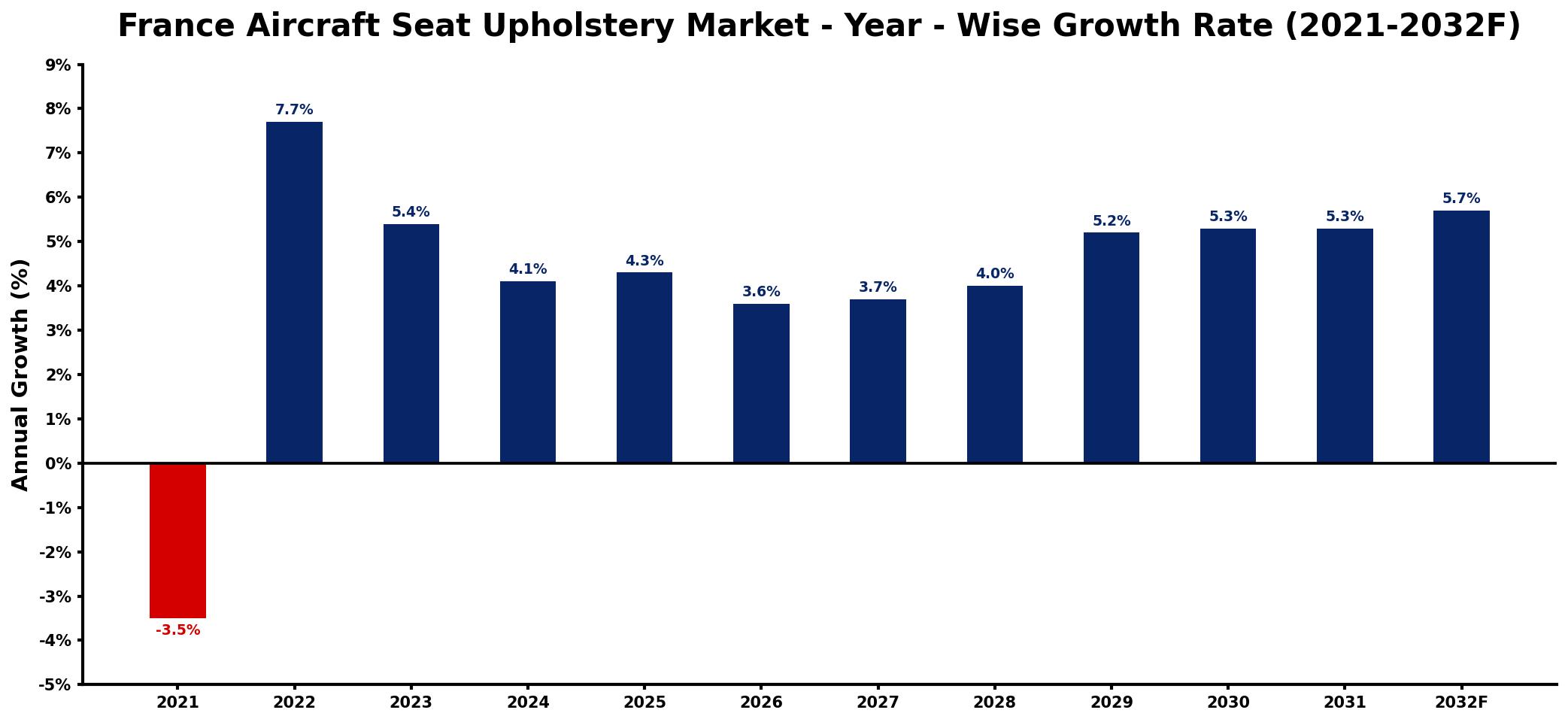
The table below presents the year‑wise growth rates along with the key drivers influencing the market
| Year | Growth Rate | Major Drivers |
| 2021 | -3.5% | decreased demand for travel services |
| 2022 | 7.7% | increased investments in aviation sector |
| 2023 | 5.4% | rising passenger travel frequency |
| 2024 | 4.1% | expansion of airline fleets globally |
| 2025 | 4.3% | growing focus on passenger comfort |
| 2026 | 3.6% | enhanced sustainability initiatives adopted |
| 2027 | 3.7% | innovation in material technologies |
| 2028 | 4.0% | increased competition among carriers |
| 2029 | 5.2% | growing influence of luxury travel |
| 2030 | 5.3% | emphasis on custom design solutions |
| 2031 | 5.3% | rising demand for eco-friendly materials |
| 2032 | 5.7% | increased collaboration with manufacturers |
Note: Market size estimations and growth projections presented in this report are based on 6Wresearch's proprietary forecasting methodology, utilizing the latest available industry data, government publications, and primary research inputs.
France Aircraft Seat Upholstery Market Synopsis
The France Aircraft Seat Upholstery Market is currently navigating through a period of steady growth, propelled by an uptick in both commercial and private flight activities. This momentum contrasts sharply with the recent challenges posed by the pandemic, which temporarily subdued demand and led to significant industry adjustments.
Looking forward, the market is heading towards enhanced customization and sustainability, addressing the evolving expectations of consumers and airlines alike. With increased competition, players are keenly investing in innovative upholstery solutions that not only meet regulatory standards but also resonate with the growing demand for eco-friendly products.
France Aircraft Seat Upholstery Market Key Takeaways
- The market is poised for growth driven by rising air travel demand and a focus on passenger comfort.
- Innovative materials and designs are increasingly being adopted to enhance durability and aesthetics.
- Sustainability is a key trend, with a shift towards lightweight and eco-friendly upholstery materials.
- Customization options are becoming essential for airlines looking to differentiate their brand and improve passenger experience.
- Regulatory compliance remains a crucial factor influencing material selection and design innovations.
Evaluation of Restraints in France Aircraft Seat Upholstery Market
While the France Aircraft Seat Upholstery Market shows promising growth potential, several constraints could limit its progress. One significant factor is the intense competition from global players, which creates pressure on local manufacturers to innovate continuously. Fluctuating raw material prices, especially for specialized textiles and eco-friendly options, can also affect production costs. Furthermore, compliance with stringent regulatory standards requires ongoing investment and adaptation, challenging manufacturers to maintain both quality and profitability in a dynamic marketplace.
France Aircraft Seat Upholstery Market Trends
Several key trends are shaping the France Aircraft Seat Upholstery Market. The industry is witnessing an increasing adoption of lightweight materials that not only enhance fuel efficiency but also simplify maintenance for airlines. Moreover, the incorporation of sustainable practices is on the rise, with suppliers exploring recycled fabrics and bio-based foams that meet environmental standards. Enhanced customization is also emerging as a critical differentiator, allowing airlines to create unique seating experiences that cater to their specific brand identities.
France Aircraft Seat Upholstery Market Opportunities
The France Aircraft Seat Upholstery Market offers numerous investment opportunities, especially in the development of innovative and sustainable upholstery solutions. Companies focusing on lightweight materials that comply with safety regulations stand to benefit significantly. Collaborations with airlines and aircraft manufacturers can create avenues for tailored products that meet specific requirements, enhancing customer satisfaction. Additionally, as airlines seek to refurbish older aircraft with modern and comfortable interiors, this segment represents a lucrative opportunity for growth.
Government Initiatives in the France Aircraft Seat Upholstery Market
Government initiatives in France regarding the aircraft upholstery market largely focus on maintaining high safety standards and promoting sustainability. Agencies such as the Directorate General of Civil Aviation (DGAC) and the European Aviation Safety Agency (EASA) enforce regulations that ensure fire safety, durability, and overall quality of materials used. Additionally, there is a growing governmental push towards eco-friendly practices, encouraging manufacturers to adopt sustainable processes and materials, thereby aligning with broader environmental goals.
Future Insights of the France Aircraft Seat Upholstery Market
The future of the France Aircraft Seat Upholstery Market is optimistic, driven by a projected increase in air travel and the expansion of airline fleets. Between 2026 and 2032, advancements in upholstery technology and materials are expected to influence market dynamics significantly. The continuing emphasis on comfort, coupled with a shift towards sustainable practices, will likely pave the way for innovative upholstery solutions. As airlines aim to provide better passenger experiences, the demand for high-quality, aesthetically pleasing upholstery will be paramount.
France Aircraft Seat Upholstery Market Latest Developments (2025 - 2026)
Recent developments within the France Aircraft Seat Upholstery Market indicate a strong focus on innovation and sustainability. Companies are actively exploring partnerships to integrate advanced materials into their upholstery offerings. Additionally, with the aviation sector on the path to recovery, there is a notable increase in refurbishment projects aimed at upgrading existing aircraft interiors, further stimulating demand in the upholstery segment.
France Aircraft Seat Upholstery Market - Key Attractiveness of the Report
- 10 Years of Market Numbers
- Historical Data Starting from 2022 to 2025
- Base Year: 2025
- Forecast Data until 2032
- Key Performance Indicators Impacting the Market
- Major Upcoming Developments and Projects
Key Highlights of the Report:
- France Aircraft Seat Upholstery Market Outlook
- Market Size of France Aircraft Seat Upholstery Market, 2025
- Forecast of France Aircraft Seat Upholstery Market, 2032
- Historical Data and Forecast of France Aircraft Seat Upholstery Revenues & Volume for the Period 2022-2032F
- France Aircraft Seat Upholstery Market Trend Evolution
- France Aircraft Seat Upholstery Market Drivers and Challenges
- France Aircraft Seat Upholstery Price Trends
- France Aircraft Seat Upholstery Porter's Five Forces
- France Aircraft Seat Upholstery Industry Life Cycle
- Historical Data and Forecast of France Aircraft Seat Upholstery Market Revenues & Volume By Material Type for the Period 2022-2032F
- Historical Data and Forecast of France Aircraft Seat Upholstery Market Revenues & Volume By Fabric for the Period 2022-2032F
- Historical Data and Forecast of France Aircraft Seat Upholstery Market Revenues & Volume By Leather for the Period 2022-2032F
- Historical Data and Forecast of France Aircraft Seat Upholstery Market Revenues & Volume By Vinyl for the Period 2022-2032F
- Historical Data and Forecast of France Aircraft Seat Upholstery Market Revenues & Volume By Seat Cover Type for the Period 2022-2032F
- Historical Data and Forecast of France Aircraft Seat Upholstery Market Revenues & Volume By Bottom Covers for the Period 2022-2032F
- Historical Data and Forecast of France Aircraft Seat Upholstery Market Revenues & Volume By Back Rest for the Period 2022-2032F
- Historical Data and Forecast of France Aircraft Seat Upholstery Market Revenues & Volume By Armrests for the Period 2022-2032F
- Historical Data and Forecast of France Aircraft Seat Upholstery Market Revenues & Volume By Headrests for the Period 2022-2032F
- Historical Data and Forecast of France Aircraft Seat Upholstery Market Revenues & Volume By Seat Rear Pockets for the Period 2022-2032F
- Historical Data and Forecast of France Aircraft Seat Upholstery Market Revenues & Volume By Seat Type for the Period 2022-2032F
- Historical Data and Forecast of France Aircraft Seat Upholstery Market Revenues & Volume By First Class for the Period 2022-2032F
- Historical Data and Forecast of France Aircraft Seat Upholstery Market Revenues & Volume By Business Class for the Period 2022-2032F
- Historical Data and Forecast of France Aircraft Seat Upholstery Market Revenues & Volume By Premium Economy Class for the Period 2022-2032F
- Historical Data and Forecast of France Aircraft Seat Upholstery Market Revenues & Volume By Economy Class for the Period 2022-2032F
- Historical Data and Forecast of France Aircraft Seat Upholstery Market Revenues & Volume By Aircraft Type for the Period 2022-2032F
- Historical Data and Forecast of France Aircraft Seat Upholstery Market Revenues & Volume By Narrow-body Aircraft for the Period 2022-2032F
- Historical Data and Forecast of France Aircraft Seat Upholstery Market Revenues & Volume By Wide-body Aircraft for the Period 2022-2032F
- Historical Data and Forecast of France Aircraft Seat Upholstery Market Revenues & Volume By Very Large Aircraft for the Period 2022-2032F
- Historical Data and Forecast of France Aircraft Seat Upholstery Market Revenues & Volume By Regional Transport Aircraft for the Period 2022-2032F
- Historical Data and Forecast of France Aircraft Seat Upholstery Market Revenues & Volume By Business Jets for the Period 2022-2032F
- Historical Data and Forecast of France Aircraft Seat Upholstery Market Revenues & Volume By General Aviation Aircraft for the Period 2022-2032F
- Historical Data and Forecast of France Aircraft Seat Upholstery Market Revenues & Volume By Helicopters for the Period 2022-2032F
- France Aircraft Seat Upholstery Import Export Trade Statistics
- Market Opportunity Assessment By Material Type
- Market Opportunity Assessment By Seat Cover Type
- Market Opportunity Assessment By Seat Type
- Market Opportunity Assessment By Aircraft Type
- France Aircraft Seat Upholstery Top Companies Market Share
- France Aircraft Seat Upholstery Competitive Benchmarking By Technical and Operational Parameters
- France Aircraft Seat Upholstery Company Profiles
- France Aircraft Seat Upholstery Key Strategic Recommendations






































