France Biomass Briquette Market Size, Share & Growth Rate
The France Biomass Briquette Market was estimated at USD 101 Million in 2025 and is projected to reach USD 112 Million by 2032, growing at a CAGR of 1.5% from 2026 to 2032. This growth is primarily fueled by a surge in environmental consciousness among consumers and businesses alike, as they increasingly recognize the benefits of renewable energy sources. Additionally, supportive government policies and the push for cleaner energy solutions are further driving the adoption of biomass briquettes in various sectors, from residential heating to commercial energy generation.
France Biomass Briquette Market Year-wise Growth Rate and Key Drivers
This graph highlights how the France Biomass Briquette Market has steadily grown over the years, supported by major growth factors.
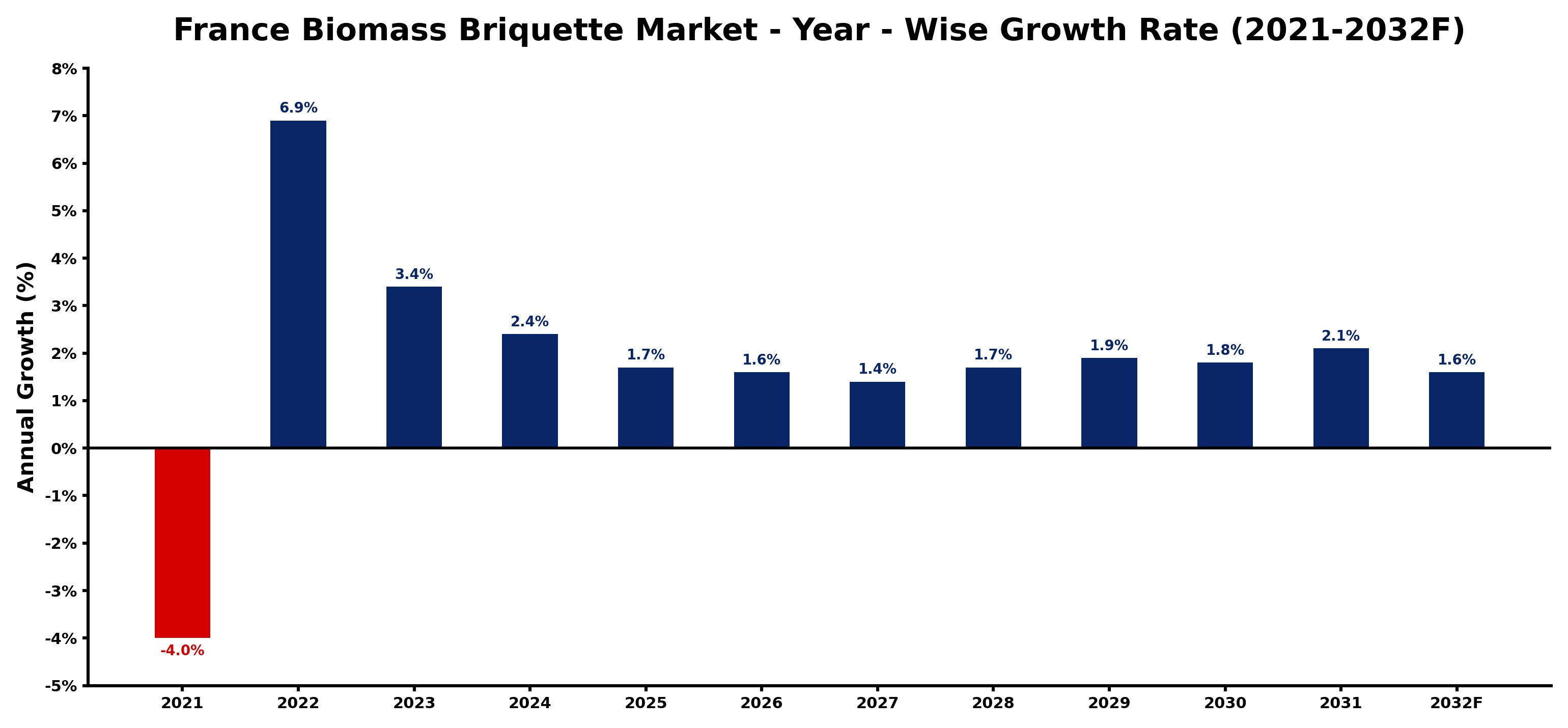
The table below presents the year‑wise growth rates along with the key drivers influencing the market
| Year | Growth Rate | Major Drivers |
| 2021 | -4.0% | Rising electricity demand across industries |
| 2022 | 6.9% | Expansion of commercial construction activities |
| 2023 | 3.4% | Government infrastructure modernization initiatives |
| 2024 | 2.4% | Growing urbanization and commercial development |
| 2025 | 1.7% | Rapid growth in telecom and data center sectors |
| 2026 | 1.6% | Government infrastructure modernization initiatives |
| 2027 | 1.4% | Growing renewable energy integration projects |
| 2028 | 1.7% | Expansion of manufacturing activities |
| 2029 | 1.9% | Increasing industrial infrastructure investments |
| 2030 | 1.8% | Growing renewable energy integration projects |
| 2031 | 2.1% | Growing renewable energy integration projects |
| 2032 | 1.6% | Rising electricity demand across industries |
Note - Market size estimations and growth projections presented in this report are based on 6Wresearch's advanced forecasting approach, validated with industry datasets as of June 2026.
France Biomass Briquette Market Synopsis
The burgeoning interest in sustainable energy solutions has sparked a notable uptick in the demand for biomass briquettes across France. As industries and households seek alternatives to fossil fuels, biomass briquettes, derived from organic materials, have emerged as a popular choice for heating and electricity generation.
With government initiatives encouraging the use of biomass briquettes, the market is experiencing a shift toward innovative production methods and diversified product offerings. This evolving landscape indicates a strong commitment from stakeholders to enhance the sustainability and efficiency of energy practices in France.
France Biomass Briquette Market Key Takeaways
- The market is witnessing a significant shift toward renewable energy, reflecting the global trend of reducing reliance on fossil fuels.
- Increased government incentives and support are driving the growth of biomass briquettes as a viable alternative energy source.
- Collaborative efforts among industry stakeholders are enhancing production efficiency and sustainability practices.
- Rising consumer awareness regarding environmental impact is creating greater demand for cleaner fuel options.
- Advancements in production technology are paving the way for innovative biomass briquette products tailored to diverse consumer needs.
Evaluation of Restraints in France Biomass Briquette Market
Despite the favorable conditions for growth, the France Biomass Briquette Market faces several challenges that could hinder its potential. A lack of widespread understanding and awareness about the benefits of biomass briquettes remains a significant barrier, as many consumers are still wedded to traditional fossil fuels. Additionally, the inconsistent quality and availability of raw materials pose risks for production stability. Regulatory complexities regarding sustainability certifications and fluctuating raw material prices can further complicate market dynamics. Addressing these constraints will require collaborative efforts in education, improved supply chain management, and technological investment.
France Biomass Briquette Market Trends
Several key trends are shaping the France Biomass Briquette Market. The growing consumer preference for sustainable energy sources is prompting more businesses to explore biomass briquettes as a cleaner fuel option. Concurrently, innovations in production techniques are leading to the development of advanced briquette products that cater to various needs, from residential heating to industrial applications. Government policies promoting renewable energy adoption further bolster these trends, creating a fertile ground for ongoing market expansion.
France Biomass Briquette Market Opportunities
Investors and businesses can tap into the promising opportunities presented by the France Biomass Briquette Market. As the demand for renewable energy continues to rise, ventures in biomass briquette production and distribution stand to benefit significantly. Furthermore, opportunities in infrastructure development, such as processing plants and supply chain logistics, could enhance market access. Strategic collaborations with forestry industries for sourcing raw materials and partnerships with energy firms for distribution could also present lucrative prospects, especially as technological advancements emerge to make production more efficient.
Government Initiatives in the France Biomass Briquette Market
The French government is actively fostering a conducive environment for the Biomass Briquette Market through a range of initiatives aimed at promoting renewable energy sources. These measures include financial incentives, such as tax credits and grants, which are designed to encourage the production and consumption of biomass briquettes. Additionally, regulations ensure that the production processes align with sustainability standards, reinforcing the country's commitment to reducing carbon emissions and enhancing energy independence.
Future Insights of the France Biomass Briquette Market
Looking ahead to 2026-2032, the France Biomass Briquette Market is set to witness substantial growth as both consumers and industries increasingly shift towards cleaner energy options. This transition is expected to be bolstered by government policies aimed at further integrating renewable energy into the national energy mix. The continued innovation in production techniques, coupled with rising environmental awareness, positions the market for ongoing expansion. Furthermore, the alignment with climate change objectives will drive further adoption of biomass briquettes, ensuring their relevance in France's energy landscape.
France Biomass Briquette Market Latest Developments (May 2025 - June 2026)
Recent developments in the France Biomass Briquette Market have reflected a strong momentum towards enhanced production capabilities and distribution networks. Innovations in briquette manufacturing processes have been reported, leading to improvements in both quality and efficiency. Additionally, collaborations among industry players are becoming more prevalent, focusing on sustainability and waste management practices. These developments indicate a dynamic shift toward a more integrated and sustainable biomass briquette industry in the country.
France Biomass Briquette Market - Key Attractiveness of the Report
- 10 Years of Market Numbers
- Historical Data Starting from 2022 to 2025
- Base Year: 2025
- Forecast Data until 2032
- Key Performance Indicators Impacting the Market
- Major Upcoming Developments and Projects
Key Highlights of the Report:
- France Biomass Briquette Market Outlook
- Market Size of France Biomass Briquette Market, 2025
- Forecast of France Biomass Briquette Market, 2032
- Historical Data and Forecast of France Biomass Briquette Revenues & Volume for the Period 2022-2032F
- France Biomass Briquette Market Trend Evolution
- France Biomass Briquette Market Drivers and Challenges
- France Biomass Briquette Price Trends
- France Biomass Briquette Porter's Five Forces
- France Biomass Briquette Industry Life Cycle
- Historical Data and Forecast of France Biomass Briquette Market Revenues & Volume By Source for the Period 2022-2032F
- Historical Data and Forecast of France Biomass Briquette Market Revenues & Volume By Agro waste Briquettes for the Period 2022-2032F
- Historical Data and Forecast of France Biomass Briquette Market Revenues & Volume By Sawdust Briquettes for the Period 2022-2032F
- Historical Data and Forecast of France Biomass Briquette Market Revenues & Volume By Wood Briquettes for the Period 2022-2032F
- Historical Data and Forecast of France Biomass Briquette Market Revenues & Volume By Application for the Period 2022-2032F
- Historical Data and Forecast of France Biomass Briquette Market Revenues & Volume By Industrial for the Period 2022-2032F
- Historical Data and Forecast of France Biomass Briquette Market Revenues & Volume By Household for the Period 2022-2032F
- France Biomass Briquette Import Export Trade Statistics
- Market Opportunity Assessment By Source
- Market Opportunity Assessment By Application
- France Biomass Briquette Top Companies Market Share
- France Biomass Briquette Competitive Benchmarking By Technical and Operational Parameters
- France Biomass Briquette Company Profiles
- France Biomass Briquette Key Strategic Recommendations






































