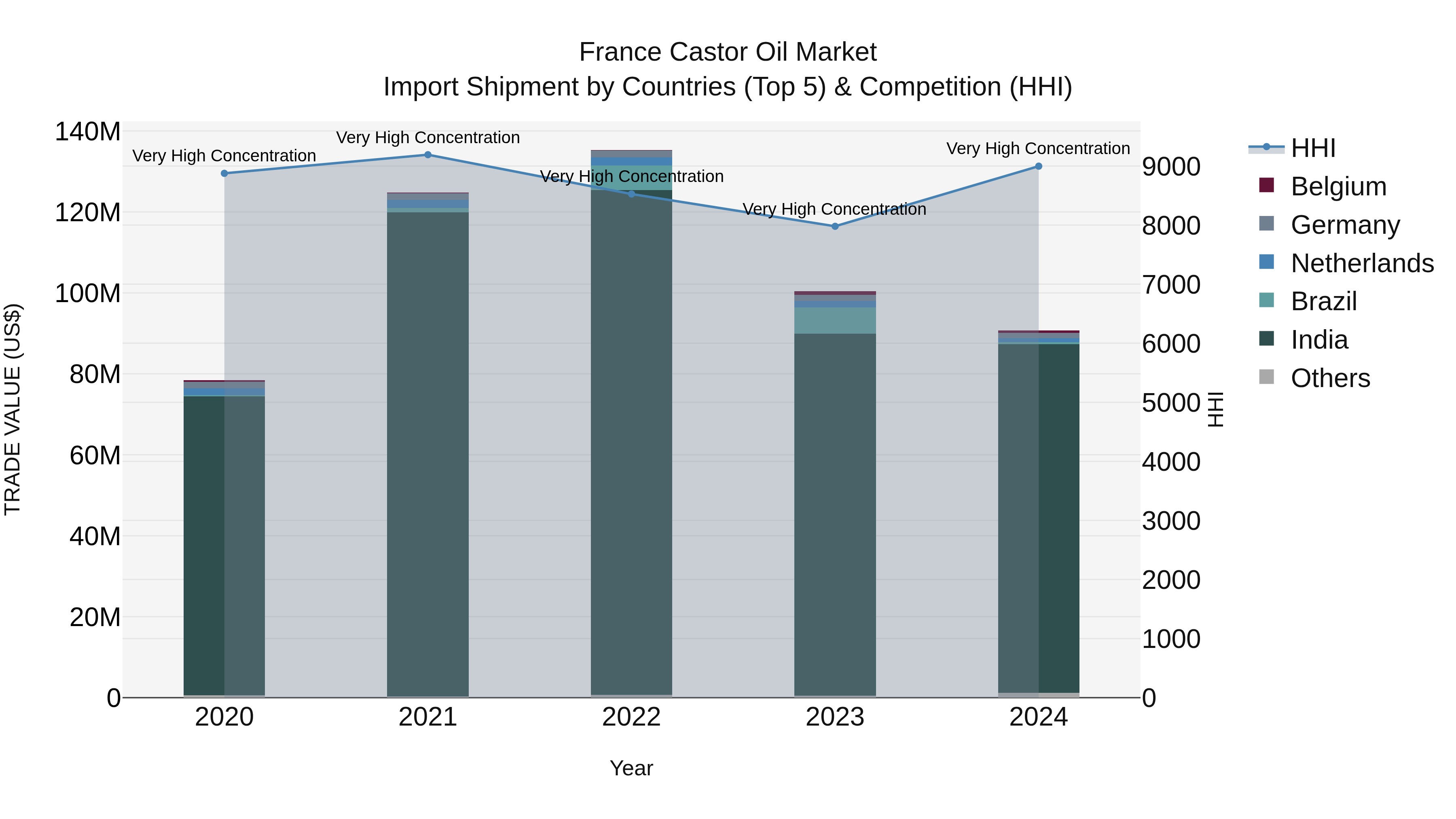
France Castor Oil Market Top 5 Importing Countries and Market Competition (HHI) Analysis
In 2024, France continued to rely on major suppliers like India, Germany, Netherlands, Belgium, and Brazil for castor oil imports. The high Herfindahl-Hirschman Index (HHI) indicates a concentrated market, possibly leading to pricing power for suppliers. Despite a moderate compound annual growth rate (CAGR) of 3.72% from 2020 to 2024, the negative growth rate of -9.6% from 2023 to 2024 suggests a recent decline in demand or other market factors impacting the import landscape for castor oil in France.
France Castor Oil Market Overview
The castor oil market in France is growing steadily, supported by the expanding applications of castor oil in industries such as pharmaceuticals, cosmetics, and automotive. Castor oil is valued for its moisturizing properties, lubricating abilities, and biofuel potential, driving its demand across various sectors.
Drivers of the market
The increasing demand for natural and organic ingredients in the cosmetics, pharmaceuticals, and personal care industries drives the growth of the castor oil market in France. Castor oil, known for its moisturizing, anti-inflammatory, and antimicrobial properties, finds extensive applications in skincare products, hair care formulations, and pharmaceutical preparations. Moreover, the expanding usage of castor oil as a bio-based lubricant and renewable industrial ingredient contributes to market expansion, supported by growing environmental sustainability initiatives.
Challenges of the market
Challenges include fluctuating castor bean prices due to weather conditions and agricultural practices. Moreover, competition from synthetic alternatives and limited awareness about the diverse applications of castor oil hinder market growth.
Government Policy of the market
Government policies in the castor oil market may involve agricultural regulations, trade agreements, and quality standards. The French government may support initiatives to increase castor oil production, improve processing technologies, and promote sustainable farming practices.
Key Highlights of the Report:
- France Castor Oil Market Outlook
- Market Size of France Castor Oil Market, 2021
- Forecast of France Castor Oil Market, 2028
- Historical Data and Forecast of France Castor Oil Revenues & Volume for the Period 2018 - 2028
- France Castor Oil Market Trend Evolution
- France Castor Oil Market Drivers and Challenges
- France Castor Oil Price Trends
- France Castor Oil Porter's Five Forces
- France Castor Oil Industry Life Cycle
- Historical Data and Forecast of France Castor Oil Market Revenues & Volume By End Use for the Period 2018 - 2028
- Historical Data and Forecast of France Castor Oil Market Revenues & Volume By Pharmaceuticals for the Period 2018 - 2028
- Historical Data and Forecast of France Castor Oil Market Revenues & Volume By Lubricants for the Period 2018 - 2028
- Historical Data and Forecast of France Castor Oil Market Revenues & Volume By Paints for the Period 2018 - 2028
- Historical Data and Forecast of France Castor Oil Market Revenues & Volume By Soaps for the Period 2018 - 2028
- Historical Data and Forecast of France Castor Oil Market Revenues & Volume By Others for the Period 2018 - 2028
- France Castor Oil Import Export Trade Statistics
- Market Opportunity Assessment By End Use
- France Castor Oil Top Companies Market Share
- France Castor Oil Competitive Benchmarking By Technical and Operational Parameters
- France Castor Oil Company Profiles
- France Castor Oil Key Strategic Recommendations






































