France Chocolate Market Size & Growth Rate
According to 6Wresearch internal database and industry insights, the France Chocolate Market was valued at USD 4,133.6 million in 2025 and is projected to reach USD 6,381.46 million by 2032, growing at a CAGR of approximately 6.4% during 2026–2032.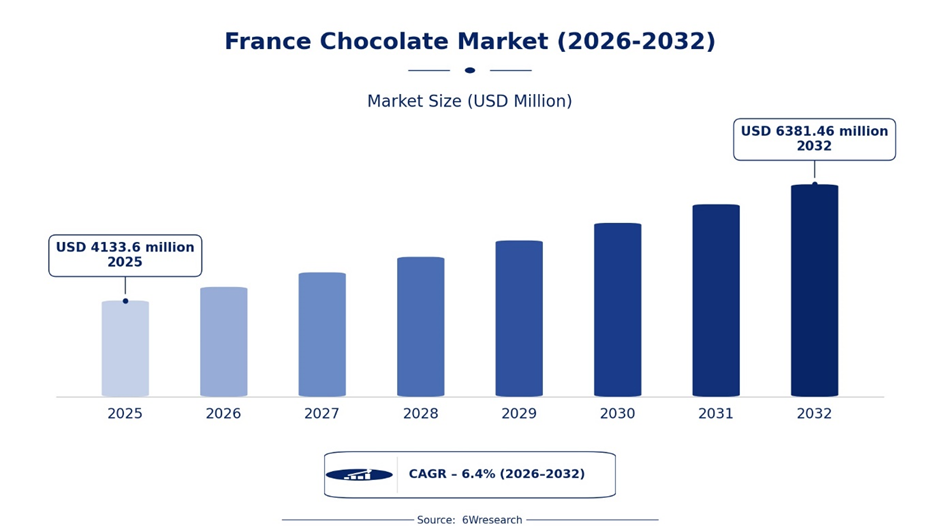
France Chocolate Market Highlights
|
Report Metric |
Details |
|
Report Name |
France Chocolate Market (2026-2032) |
|
Market Size 2025 |
USD 4,133.6 million |
|
Market Size 2032 |
USD 6,381.46 million |
|
Absolute Growth 2025–2032 |
USD 2,247.86 million |
|
CAGR 2026–2032 |
6.4% |
|
Peak Annual Growth |
7.2% in 2030 |
|
Forecast Period |
2026–2032 |
|
Historical Data |
2022–2025 |
|
Base Year |
2025 |
|
Leading Product Types, 2025 |
Milk Chocolate (52.0% share) |
|
Fastest-Growing Product Types |
Dark Chocolate (8.0% CAGR) |
|
Leading Distribution Channels, 2025 |
Supermarkets/ Hypermarkets (46.0% share) |
|
Fastest-Growing Distribution Channels |
Online Channel (9.8% CAGR) |
|
Leading Chocolate Types, 2025 |
Molded or Bar Chocolates (40.0% share) |
|
Fastest-Growing Chocolate Types |
Others (Box chocolates, novelties, etc.) (7.3% CAGR) |
|
Growing Sector |
Premium dark and organic chocolate, and gifting formats |
|
Key End Users |
Household consumers, gift buyers, hospitality and food service operators, specialist retailers, tourism retail outlets |
France Chocolate Market Year-wise Growth Rate and Key Drivers (2022–2032)
This graph illustrates the annual growth rates of the market from 2022 to 2032, highlighting gradual market development in the historical period and stronger expansion during the forecast period.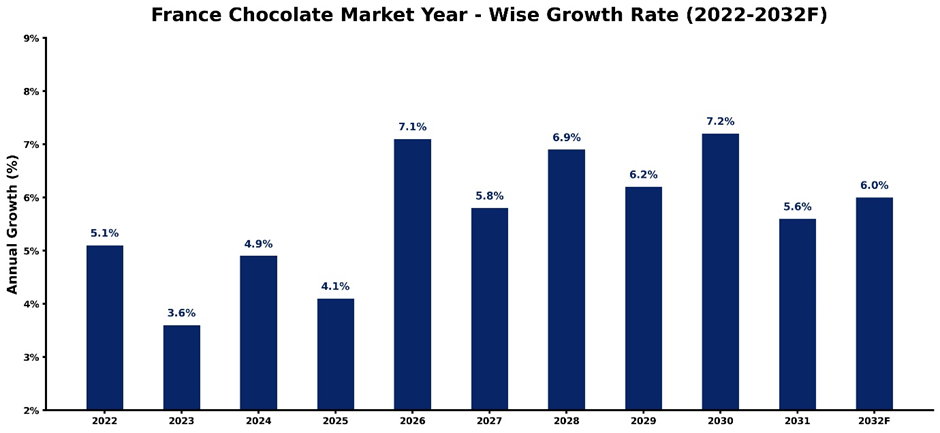
The following table presents the estimated annual growth rate for each year together with the principal factor influencing market performance.
|
Year |
Estimated Annual Growth (%) |
Market Rationale |
|
2022 |
5.1% |
Reopening of hospitality, tourism and gifting occasions after pandemic restrictions lifted consumption and restored premium chocolate sales across France. |
|
2023 |
3.6% |
Food price inflation above 10% in early 2023 eroded household purchasing power and dampened chocolate volumes. |
|
2024 |
4.9% |
Record cocoa futures above USD 12,000 per tonne in December lifted shelf prices and value sales through cost pass-through. |
|
2025 |
4.1% |
Consumers traded down and reduced purchase frequency as cumulative price rises outpaced wages, moderating value growth after the previous year. |
|
2026 |
7.1% |
Easing cocoa costs from the 2024 peak are expected to restore promotions and volume recovery across hypermarkets and Easter ranges. |
|
2027 |
5.8% |
Normalised pricing is expected to remove the one-off recovery effect, returning growth to underlying premiumisation and gifting trends. |
|
2028 |
6.9% |
Retailers are expected to widen certified and organic dark ranges as supply chains complete traceability upgrades. |
|
2029 |
6.2% |
Intensifying retailer price negotiations and private label expansion are expected to cap price increases and temper value growth. |
|
2030 |
7.2% |
Growth in click-and-collect fulfilment and direct-to-consumer artisan brands is expected to lift premium purchases to the period’s peak. |
|
2031 |
5.6% |
Saturation in mature everyday categories and stricter sugar reduction expectations are expected to temper the growth rate. |
|
2032 |
6% |
Wider acceptance of plant-based and reduced-sugar ranges, together with export-oriented premium gifting, is expected to support a modest rebound. |
Note: Market size estimations and growth projections presented in this report are based on 6Wresearch’s proprietary forecasting methodology, utilizing the latest available industry data, government publications, and primary research inputs.
France Chocolate Market Synopsis
The France Chocolate Market comprises milk, white and dark chocolate sold as bars, countlines, panned confectionery, boxed assortments and seasonal novelties through retail, specialist and online channels. Demand is supported by France’s strong gifting culture around Easter and Christmas, the premium positioning of artisan and bean-to-bar makers, rising interest in dark and organic ranges, and the wide reach of hypermarket chains. Domestic manufacturing by established producers also underpins local supply. However, volatile cocoa prices and rising sugar-reduction and sustainability compliance costs continue to pressure manufacturer margins.
Market Dynamics Impact Analysis (2026–2032)
|
Factor |
Type |
Impact |
Primary Segment Affected |
|
Easter and Christmas gifting demand |
Driver |
High |
Others (Box chocolates, novelties, etc.) |
|
Preference for premium, organic and origin-labelled bars |
Driver |
High |
Dark Chocolate |
|
Growth of click-and-collect and home delivery |
Opportunity |
High |
Online Channel |
|
Export-oriented premium gifting and tourism retail |
Opportunity |
Medium |
Others (Box chocolates, novelties, etc.) |
|
Cocoa price volatility |
Restraint |
High |
Milk Chocolate |
|
Sugar and health scrutiny through front-of-pack labelling |
Restraint |
Medium |
Countlines & Straight lines |
|
Traceability compliance for deforestation-free cocoa |
Challenge |
High |
Dark Chocolate |
|
Private label expansion and retailer price negotiations |
Challenge |
Medium |
Supermarkets/ Hypermarkets |
Evaluation of Drivers in France Chocolate Market (2026–2032)
Below mentioned are some major drivers and their influence on market dynamics.
|
Drivers |
Primary Segment Affected |
Why It Matters (Evidence) |
|
Gifting and seasonal consumption |
Others (Box chocolates, novelties, etc.) |
Easter and Christmas concentrate purchases of boxed assortments and novelties, lifting factory throughput and retail promotions in the same weeks, as reflected in the Salon du Chocolat in Paris, held annually since 1995. |
|
Premium and dark chocolate preference |
Dark Chocolate |
Shoppers trade up to origin-labelled and organic bars, which carry higher unit prices and margins, with organic lines certified under the AB label created in 1985. |
|
Hypermarket reach and promotions |
Supermarkets/ Hypermarkets |
Around 2,000 hypermarkets give brands national shelf access and promotion-led volume, particularly for tablets and countlines. |
|
Established domestic production base |
Molded or Bar Chocolates |
Manufacturers such as Cémoi, founded in 1814, and Valrhona, founded in 1922, process cocoa and finish bars in France, shortening supply chains and supporting exports. |
|
Click-and-collect and omnichannel retail |
Online Channel |
The Drive pick-up model, developed in France in the early 2000s, lets shoppers add chocolate to routine grocery orders, easing seasonal and impulse purchasing. |
Market growth is supported by strong inbound tourism, recovering household purchasing power and continuous product innovation. France welcomed around 100 million international visitors in 2024, and airport, railway station and boutique retailing converts this footfall into purchases of souvenir and premium chocolate. Easing inflation, which fell to roughly 1% in 2025, restores discretionary spending on indulgence products. Manufacturers are introducing filled, snackable and reduced-sugar formats that widen occasions for consumption, and social media marketing by established and emerging brands keeps younger consumers engaged throughout the year, supporting steady repeat purchases.
Evaluation of Restraints in France Chocolate Market
Below mentioned are some major restraints and their influence on market dynamics.
|
Market Restraint |
Primary Segment Affected |
Why It Matters (Evidence) |
|
Cocoa price volatility |
Milk Chocolate |
Cocoa is grown mainly on West African smallholdings, and prices more than tripled during 2023 and 2024, forcing makers to raise shelf prices or reduce pack sizes and compressing margins. |
|
Sugar and health scrutiny |
Countlines & Straight lines |
Nutri-Score front-of-pack labelling, voluntary since 2017, exposes high-sugar countlines to lower grades and prompts some retailers and consumers to cut purchases. |
|
Deforestation compliance costs |
Dark Chocolate |
Operators must show that cocoa does not come from land deforested after 2020, which requires geolocation data and segregated supply chains that smaller makers find costly to build. |
|
Retailer price pressure and private labels |
Supermarkets/ Hypermarkets |
Annual supplier negotiations concluded by 1 March each year and expanding store brands limit the ability of branded makers to pass ingredient costs on to shoppers. |
|
Packaging regulation |
Molded or Bar Chocolates |
The 2020 AGEC law targets an end to single-use plastic packaging by 2040, obliging makers to redesign wrappers and trays and absorb higher material costs. |
France Chocolate Market Challenges
Several operational challenges constrain execution. Shrinkflation labelling rules in force since July 2024 require manufacturers to flag reduced pack weights, which complicates price adjustments and exposes brands to consumer scrutiny. Artisan production relies on vocational pathways such as the two-year CAP chocolatier-confiseur qualification, and small workshops struggle to recruit and retain apprentices at peak seasons. Chocolate must be stored at roughly 15°C to 18°C, thus summer distribution and tourist-area retailing raise refrigeration and energy costs. Premium Belgian and Swiss imports also compete directly for the gifting shelf, limiting the pricing room available to French brands.
Trends in the France Chocolate Market
Below mentioned are some of the trends shaping the France Chocolate Market growth.
- Shift from Milk to Dark and Origin-Led Chocolate: French shoppers are moving towards bars with 70% or higher cocoa content and single-origin labelling, supported by the visibility of artisan makers at Paris’s Salon du Chocolat. Hypermarkets are expanding dedicated dark and organic shelf space. The trend favours suppliers of traceable beans and manufacturers able to certify origin and cocoa content.
- Transition from Everyday Tablets to Occasion-Led Gifting Formats: Manufacturers are directing more promotional effort to boxed assortments, filled eggs and seasonal novelties around Easter and Christmas, the two largest gifting peaks in France. Retailers now launch seasonal ranges earlier each year. The shift rewards suppliers with flexible packaging lines and design capability, and it favours short, well-planned production runs.
- Click-and-Collect Emerging as a Core Purchase Route: France developed the Drive pick-up model in the early 2000s, and major grocers now operate thousands of collection points, which has made chocolate a routine online basket item. Subscription boxes and brand websites extend reach for artisan makers. Suppliers gain richer purchase data but must adapt packaging to withstand transit and heat.
Investment Opportunities in the France Chocolate Market
Some of the investment opportunities in the France Chocolate Market are mentioned below.
- Dark and Single-Origin Bar Production: Rising preference for origin-labelled bars creates room for investment in tempering, moulding and wrapping lines for high-cocoa tablets, together with organic certification. Investors can enter through co-manufacturing agreements with bean-to-bar makers or by supplying certified cocoa liquor, with production sited near the Paris or Lyon logistics corridors.
- Traceable and Certified Cocoa Sourcing: Compliance deadlines are making verified supply a purchasing requirement for French processors. Opportunities lie in geolocation tools, segregated storage and partnerships with cooperatives in Côte d’Ivoire and Ghana. Entry is possible through joint ventures with processors or by offering traceability software as a service to manufacturers.
- Premium Gifting Packaging and Seasonal Capacity: Gifting peaks around Easter and Christmas reward flexible production of boxed assortments and novelties. Investors can add automated assembly lines, recyclable packaging and heat-protective shipping formats suited to click-and-collect, entering through joint ventures with packaging specialists or by leasing seasonal capacity from established confectioners.
Leading Players in France Chocolate Market
Stated below are some of the leading companies contributing significantly to the France Chocolate Market share.
1. Ferrero
| Company Name | Ferrero |
|---|---|
| Established Year | 1946 |
| Headquarters | Alba, Italy |
| Official Website | Click Here |
Ferrero is a global confectionery group with a significant production and distribution presence in France, known for filled chocolates, hazelnut spreads and seasonal confectionery.
2. Mondelez International
| Company Name | Mondelez International |
|---|---|
| Established Year | 2012 |
| Headquarters | Chicago, United States |
| Official Website | Click Here |
Mondelez International is a multinational snack and confectionery company supplying branded chocolate bars and tablets to French mass retail.
3. Nestlé
| Company Name | Nestlé |
|---|---|
| Established Year | 1866 |
| Headquarters | Vevey, Switzerland |
| Official Website | Click Here |
Nestlé is a multinational food company with a long-standing presence in French confectionery, offering branded chocolate tablets and countlines.
4. Cémoi
| Company Name | Cémoi |
|---|---|
| Established Year | 1814 |
| Headquarters | Perpignan, France |
| Official Website | Click Here |
Cémoi is a French cocoa processor and chocolate manufacturer supplying consumer brands, private label and industrial customers.
Government Initiatives in the France Chocolate Market
France’s policy framework combines the EGalim laws of 2018 and 2021, which govern price negotiations between suppliers and retailers, with the EU Deforestation Regulation of 2023, which covers seven commodities including cocoa and applies a 31 December 2020 cut-off date. The 2020 AGEC anti-waste law adds packaging obligations, including a target to end single-use plastic packaging by 2040.
Implementation is led by the DGCCRF, which inspects labelling and commercial practices, and by France 2030, the EUR 54 billion national investment plan launched in 2021 that lists healthy and sustainable food among its priorities. Nutri-Score front-of-pack labelling, introduced on a voluntary basis in 2017, is now applied by many large retail and manufacturer brands.
Future Insight of the France Chocolate Market
Future growth will rest on sourcing, technology and retail innovation. Sustainability programmes in West Africa, where Côte d’Ivoire and Ghana supply about 60% of world cocoa and have applied a USD 400 per tonne Living Income Differential since 2020, are expected to improve farmer incomes and stabilise bean supply. Advances in formulation technology will allow reduced-sugar and plant-based recipes to match traditional taste. Recyclable and lighter packaging innovation will lower material costs and appeal to environmentally aware buyers. Experiential retail, including chocolate boutiques and workshops, will deepen brand loyalty and support premium pricing.
Market Segmentation Analysis
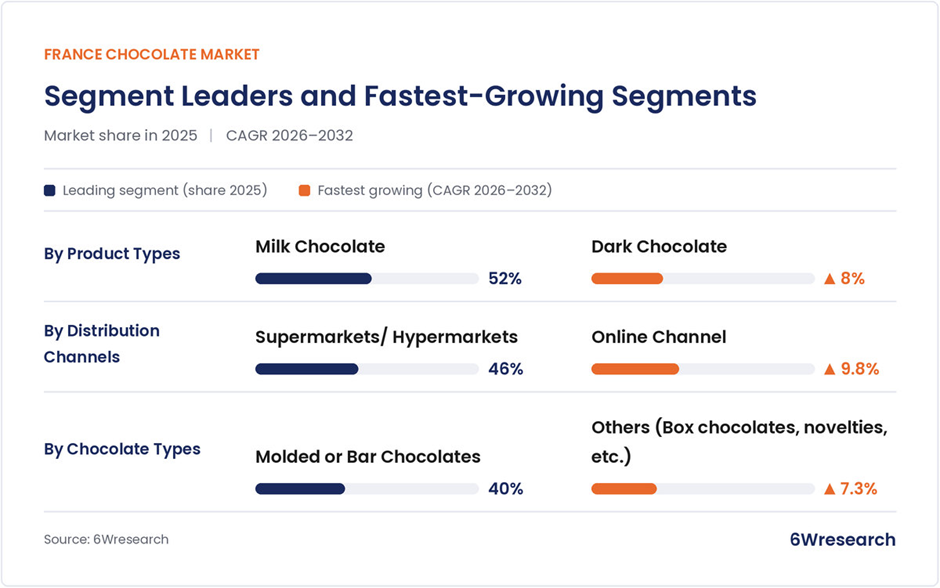
The report offers a comprehensive study of the market across its key segments. The chart below highlights the leading segment by market share in 2025 and the fastest-growing segment by CAGR over 2026–2032, followed by a detailed analysis of each segment.
By Product Types – Milk Chocolate Leads, Dark Chocolate Expected to Grow Fastest
According to Ravi Bhandari, Research Head at 6Wresearch, Milk Chocolate leads the market with a 52.0% share in 2025, owing to its broad acceptance across family, snacking and seasonal purchases sold through French hypermarkets. Dark Chocolate is expected to grow fastest during 2026–2032 at a CAGR of 8.0%, supported by French artisan and bean-to-bar makers and rising demand for organic and origin-labelled bars.
By Distribution Channels – Supermarkets/ Hypermarkets Leads, Online Channel Expected to Grow Fastest
Supermarkets/ Hypermarkets account for the largest 2025 share at 46.0%, as around 2,000 hypermarkets and a dense supermarket network give French shoppers one-stop access to tablets, countlines and seasonal ranges. The Online Channel is expected to expand fastest at 9.8% during 2026–2032, driven by the Drive collection model and growing home-delivery use for gifting.
By Chocolate Types – Molded or Bar Chocolates Leads, Others (Box chocolates, novelties, etc.) Expected to Grow Fastest
Molded or Bar Chocolates hold the leading 40.0% share in 2025, reflecting the French habit of eating tablets and the strong presence of baking and snacking bars in retail aisles. Others (Box chocolates, novelties, etc.) are expected to record the fastest growth at a CAGR of 7.3% during 2026–2032, led by gifting boxes and seasonal novelties around Easter and Christmas.
Key Attractiveness of the Report
- 10 Years of Market Numbers
- Historical Data Starting from 2022 to 2025
- Base Year 2025
- Forecast Data until 2032
- Key Performance Indicators Impacting the Market
- Major Upcoming Developments and Projects
Key Highlights of the Report:
- France Chocolate Market Outlook
- Market Size of France Chocolate Market, 2025
- Forecast of France Chocolate Market, 2032
- Historical Data and Forecast of Chocolate Revenues & Volume for the Period 2022-2032
- France Chocolate Market Trend Evolution
- France Chocolate Market Drivers and Challenges
- Chocolate Price Trends
- Chocolate Porter’s Five Forces
- Chocolate Industry Life Cycle
- Historical Data and Forecast of France Chocolate Market Revenues & Volume By Product Types for the Period 2022-2032
- Historical Data and Forecast of France Chocolate Market Revenues & Volume By Milk Chocolate for the Period 2022-2032
- Historical Data and Forecast of France Chocolate Market Revenues & Volume By White Chocolate for the Period 2022-2032
- Historical Data and Forecast of France Chocolate Market Revenues & Volume By Dark Chocolate for the Period 2022-2032
- Historical Data and Forecast of France Chocolate Market Revenues & Volume By Distribution Channels for the Period 2022-2032
- Historical Data and Forecast of France Chocolate Market Revenues & Volume By Supermarkets/ Hypermarkets for the Period 2022-2032
- Historical Data and Forecast of France Chocolate Market Revenues & Volume By Grocery/ Mom n Pop Stores for the Period 2022-2032
- Historical Data and Forecast of France Chocolate Market Revenues & Volume By Convenience Stores for the Period 2022-2032
- Historical Data and Forecast of France Chocolate Market Revenues & Volume By Online Channel for the Period 2022-2032
- Historical Data and Forecast of France Chocolate Market Revenues & Volume By Others (Specialized Retailers, Pharmacy, etc.) for the Period 2022-2032
- Historical Data and Forecast of France Chocolate Market Revenues & Volume By Chocolate Types for the Period 2022-2032
- Historical Data and Forecast of France Chocolate Market Revenues & Volume By Countlines & Straight lines for the Period 2022-2032
- Historical Data and Forecast of France Chocolate Market Revenues & Volume By Molded or Bar Chocolates for the Period 2022-2032
- Historical Data and Forecast of France Chocolate Market Revenues & Volume By Choco-panned & Sugar panned for the Period 2022-2032
- Historical Data and Forecast of France Chocolate Market Revenues & Volume By Others (Box chocolates, novelties, etc.) for the Period 2022-2032
- Chocolate Import Export Trade Statistics
- Market Opportunity Assessment By Product Types
- Market Opportunity Assessment By Distribution Channels
- Market Opportunity Assessment By Chocolate Types
- Chocolate Top Companies Market Share
- Chocolate Competitive Benchmarking By Technical and Operational Parameters
- Chocolate Company Profiles
- Chocolate Key Strategic Recommendations
Market Covered
The report offers a comprehensive study of the subsequent market segments:
By Product Types
- Milk Chocolate
- White Chocolate
- Dark Chocolate
By Distribution Channels
- Supermarkets/Hypermarkets
- Grocery/Mom n Pop Stores
- Convenience Stores
- Online Channel
- Others (Specialized Retailers, Pharmacy, etc.)
By Chocolate Types
- Countlines & Straight Lines
- Molded or Bar Chocolates
- Choco-panned & Sugar-panned
- Others (Box Chocolates, Novelties, etc.)






































