France Digital Market Size & Growth Rate (2026-2032)
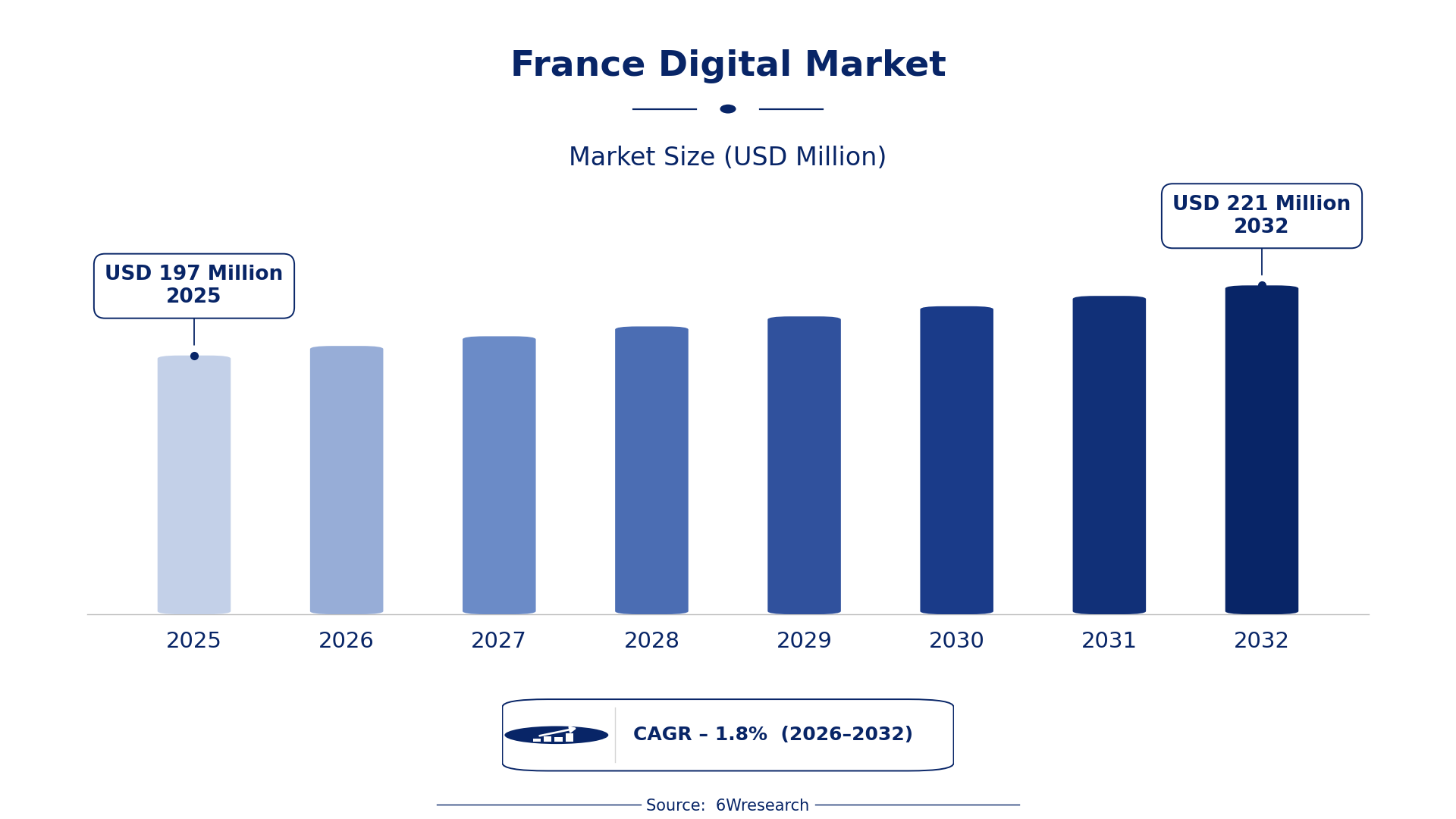
The France Digital Market was estimated at USD 197 Million in 2025 and is projected to reach USD 221 Million by 2032, growing at a CAGR of 1.8% from 2026 to 2032.
France Digital Market Synopsis
The France Digital Market is witnessing a surge in e-commerce, driven by a consumer base that increasingly values convenience and variety. With smartphone penetration rising steadily, mobile commerce is becoming a dominant force, reshaping how purchases are made.
Technological innovation is at the forefront, with companies harnessing data analytics to create personalized shopping experiences. The vibrant startup ecosystem, particularly in cities like Paris and Lyon, further accelerates growth and fosters new ideas in this dynamic sector.
France Digital Market Year-wise Growth Rate and Key Drivers
This graph illustrates the annual growth rates of the France Digital Market from 2021 to 2032, highlighting a steady upward trajectory and projected expansion over the forecast period.
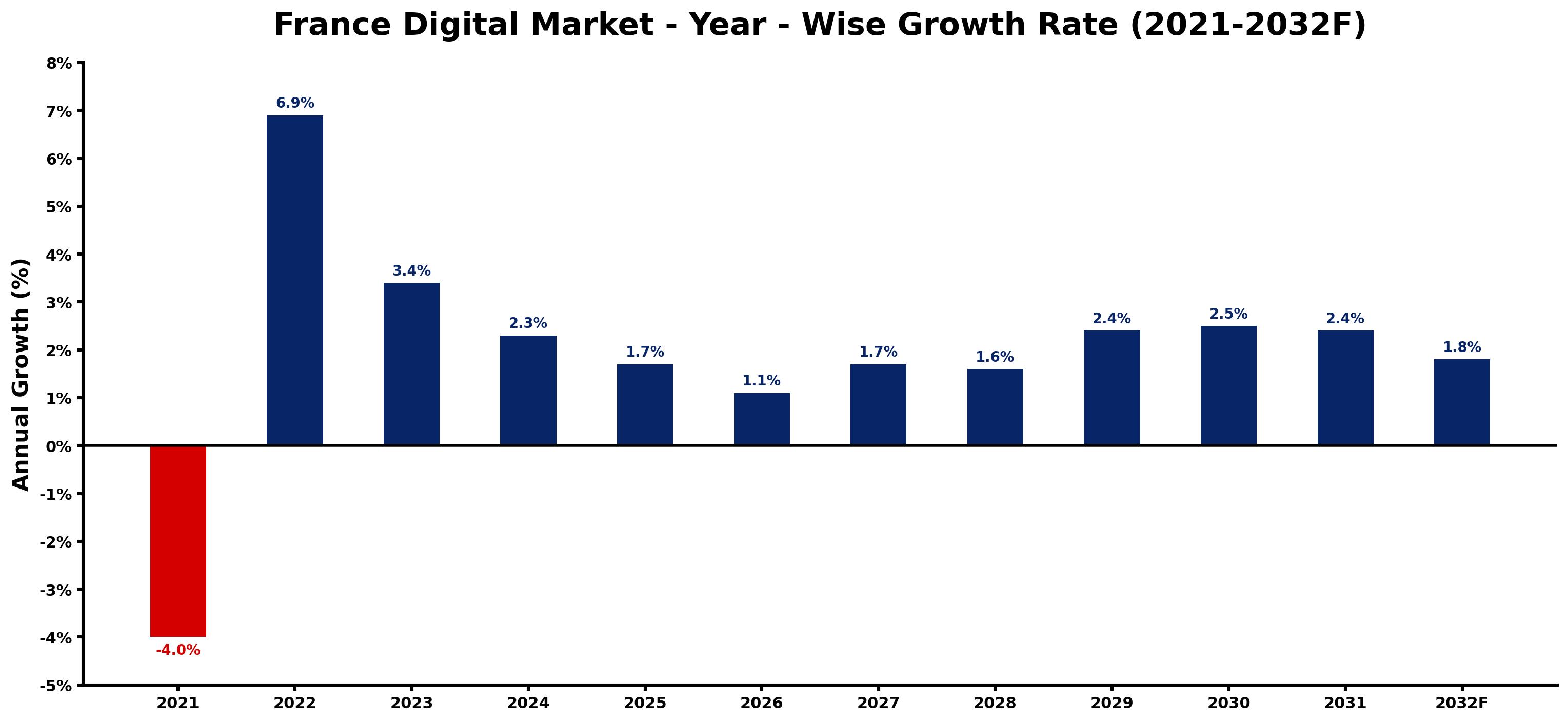
The table below presents the year‑wise growth rates along with the key drivers influencing the market
| Year | Growth Rate | Major Drivers |
| 2021 | -4.0% | Tightened GDPR enforcement limited digital advertising activities. |
| 2022 | 6.9% | France's Digital Services Tax boosting local tech investments |
| 2023 | 3.4% | Increased demand for cybersecurity solutions post-Ukraine conflict |
| 2024 | 2.3% | Growing interest in AI applications among French enterprises |
| 2025 | 1.7% | Government greenlight for digital health innovation projects |
| 2026 | 1.1% | Rising remote work culture driving digital collaboration tools |
| 2027 | 1.7% | Youth digital literacy programs enhancing consumer tech adoption |
| 2028 | 1.6% | E-commerce growth fueled by French consumer online spending |
| 2029 | 2.4% | Local startups innovating in fintech gaining cross-border traction |
| 2030 | 2.5% | Sustainable tech initiatives supported by French government incentives |
| 2031 | 2.4% | Regulatory compliance driving demand for data privacy solutions |
| 2032 | 1.8% | France's commitment to digital sovereignty enhancing local content creation |
Note: Market size estimations and growth projections presented in this report are based on 6Wresearch's proprietary forecasting methodology, utilizing the latest available industry data, government publications, and primary research inputs.
France Digital Market Key Takeaways
Below are some of the specific key takeaways from the market, including:
- E-commerce is a primary growth driver, with online shopping becoming a staple for consumers.
- Mobile commerce is rapidly expanding, as more consumers opt for mobile devices to make purchases.
- The demand for data-driven marketing is increasing, pushing companies to invest in AI and analytics.
- Cybersecurity and data privacy concerns are prompting businesses to enhance their security measures.
- The government is actively supporting digital innovation through various initiatives aimed at startups.
Evaluation of Restraints in France Digital Market
Despite its promising growth trajectory, the France Digital Market faces notable restraints. Stringent data protection regulations, particularly GDPR compliance, complicate data-driven marketing strategies. Companies must navigate a competitive environment with established players and global tech giants, all while meeting the rising expectations of discerning consumers who demand personalized experiences. Rapid technological advancements further pressure businesses to remain agile, adapting to changing market dynamics. Cybersecurity threats continue to loom large, necessitating substantial investment in security infrastructure to protect sensitive customer data and maintain consumer trust.
France Digital Market Trends
Several trends are shaping the future of the France Digital Market. E-commerce remains robust, with consumers gravitating towards online shopping for convenience and an extensive product range. The surge in mobile commerce is notable, as smartphones and tablets increasingly influence purchasing decisions.
There is a growing demand for personalized and interactive content, leading to increased investments in data analytics and artificial intelligence. Additionally, the focus on cybersecurity and data privacy is paramount, especially following GDPR's implementation. Social media continues to evolve as a key marketing channel, with influencer marketing gaining traction among brands looking to connect with consumers.
France Digital Market Opportunities
The France Digital Market presents a wealth of investment opportunities across various sectors. E-commerce is on a trajectory of rapid growth, with online retail sales on track to rise steadily. Fintech represents another lucrative area, as innovative solutions disrupt traditional banking and payment systems.
Software as a Service (SaaS) is gaining momentum, offering scalable solutions that appeal to businesses of all sizes. The French government’s commitment to AI research and development signals a fertile ground for investment, positioning the country as a leader in technological advancements.
Government Initiatives in the France Digital Market
The French government is actively fostering a conducive environment for digital innovation and competition within the digital market. Policies emphasize the promotion of startups, investment in technology, and consumer protection. With a focus on advancing digital infrastructure, these initiatives reflect the government’s commitment to ensuring that France remains a competitive player in the global digital economy.
- A national digital infrastructure upgrade program is currently underway, enhancing connectivity and access across the country.
- The French Tech Visa program, recently launched, aims to attract international talent to the local tech ecosystem.
- Ongoing regulations are being refined to ensure platform transparency and fair competition among digital players.
- A public-private initiative aimed at expanding digital services in rural areas is planned to commence by 2026.
- The government is also investing in AI research and development initiatives to drive technological innovation in the digital sector.
Future Insights of the France Digital Market
Looking ahead to 2026-2032, the France Digital Market is set to continue its upward trajectory, driven by factors such as increased internet penetration and a tech-savvy population. As consumers increasingly embrace online shopping and digital payment solutions, businesses have a prime opportunity to expand their online presence.
The rising digital transformation across industries, including retail, finance, and healthcare, will further fuel demand for innovative digital services. With ongoing government support for digital initiatives, the market is expected to evolve rapidly, offering numerous avenues for growth and investment.
France Digital Market Latest Developments
In recent months, the France Digital Market has seen a flurry of activity, signaling a vigorous phase of growth and adaptation. Companies are ramping up efforts to enhance their digital offerings, responding to evolving consumer needs and technological advancements.
- A major technology vendor launched a new AI-driven marketing platform in Q2 2025, aimed at helping businesses optimize their advertising strategies.
- An initiative focusing on improving cybersecurity protocols began in early 2025 and remains ongoing, reflecting heightened concerns over data breaches.
- A prominent e-commerce player completed a significant upgrade of its mobile app by late 2025, enhancing user experience and functionality.
- A planned rollout of enhanced digital payment systems is expected to begin in late 2026, aimed at streamlining transactions for consumers.
- A collaboration between local startups and educational institutions was announced in early 2025, promoting innovation and skills development within the digital sector.
France Digital Market - Key Attractiveness of the Report
- 10 Years of Market Numbers
- Historical Data Starting from 2022 to 2025
- Base Year: 2025
- Forecast Data until 2032
- Key Performance Indicators Impacting the Market
- Major Upcoming Developments and Projects
Key Highlights of the Report:
- France Digital Market Outlook
- Market Size of France Digital Market, 2025
- Forecast of France Digital Market, 2032
- Historical Data and Forecast of France Digital Revenues & Volume for the Period 2022-2032F
- France Digital Market Trend Evolution
- France Digital Market Drivers and Challenges
- France Digital Price Trends
- France Digital Porter's Five Forces
- France Digital Industry Life Cycle
- Historical Data and Forecast of France Digital Market Revenues & Volume By Software for the Period 2022-2032F
- Historical Data and Forecast of France Digital Market Revenues & Volume By CRM Software for the Period 2022-2032F
- Historical Data and Forecast of France Digital Market Revenues & Volume By Email Marketing Software for the Period 2022-2032F
- Historical Data and Forecast of France Digital Market Revenues & Volume By Social Media Advertising for the Period 2022-2032F
- France Digital Import Export Trade Statistics
- Market Opportunity Assessment By Software
- France Digital Top Companies Market Share
- France Digital Competitive Benchmarking By Technical and Operational Parameters
- France Digital Company Profiles
- France Digital Key Strategic Recommendations






































