France Electrical Components Market Size, Share & Growth Rate
The France Electrical Components Market was estimated at USD 246 Million in 2025 and is projected to reach USD 275 Million by 2032, growing at a CAGR of 1.6% from 2026 to 2032. This growth trajectory is propelled by the increasing demand for energy-efficient and smart home solutions, combined with significant investments in infrastructure and the automotive sector. As sustainability becomes a focal point in both consumer choices and government policies, the market is positioned for a continued upward trend.
France Electrical Components Market Year-wise Growth Rate and Key Drivers
This graph highlights how the France Electrical Components Market has steadily grown over the years, supported by major growth factors.
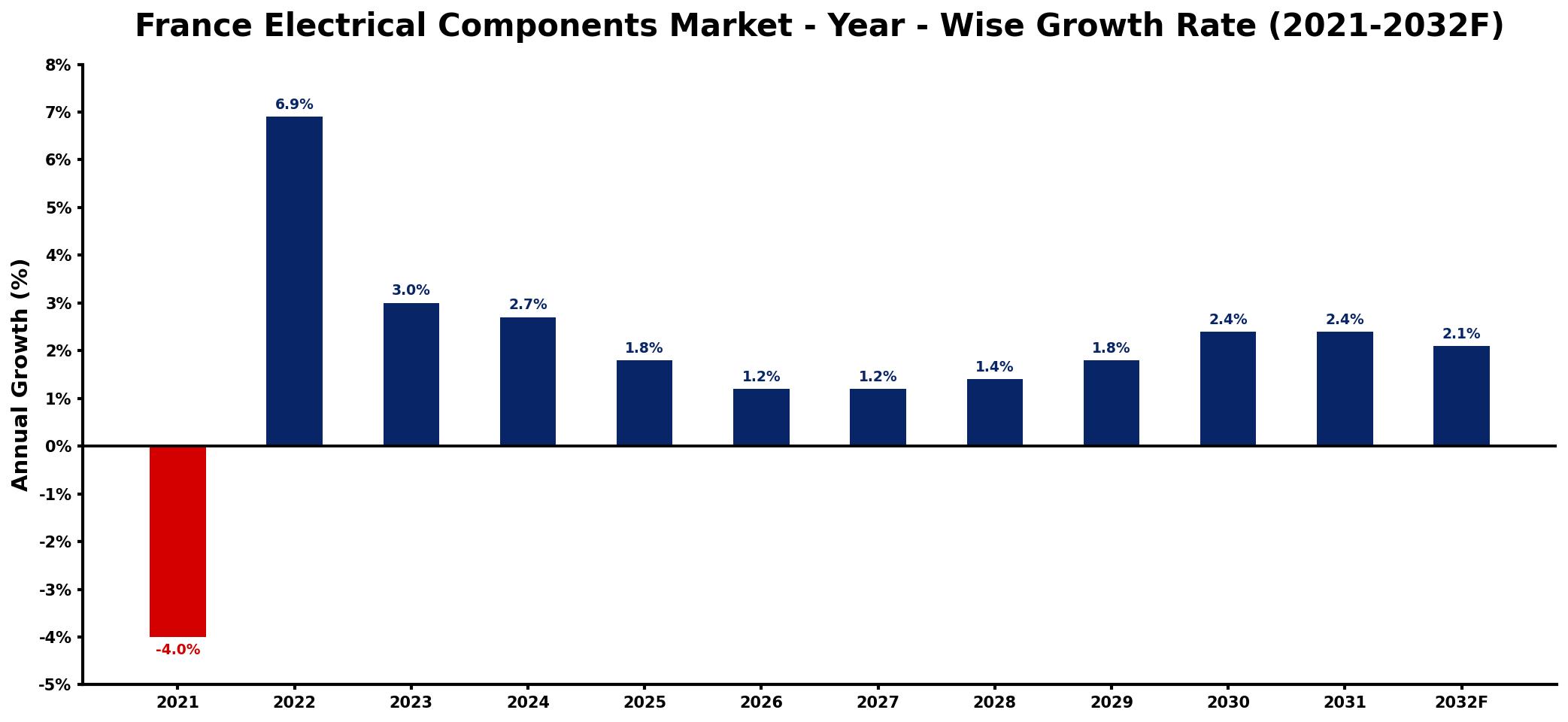
The table below presents the year‑wise growth rates along with the key drivers influencing the market
| Year | Growth Rate | Major Drivers |
| 2021 | -4.0% | decrease in industrial investments |
| 2022 | 6.9% | growth in renewable energy projects |
| 2023 | 3.0% | rise in smart technology adoption |
| 2024 | 2.7% | expansion of electric vehicle market |
| 2025 | 1.8% | increased infrastructure modernization efforts |
| 2026 | 1.2% | surge in automation and robotics |
| 2027 | 1.2% | development of energy efficiency standards |
| 2028 | 1.4% | increased production capacity utilization |
| 2029 | 1.8% | demand for sustainable energy solutions |
| 2030 | 2.4% | investment in grid modernization initiatives |
| 2031 | 2.4% | rising end-use demand growth |
| 2032 | 2.1% | rising demand from electronics |
Note: Market size estimations and growth projections presented in this report are based on 6Wresearch's proprietary forecasting methodology, utilizing the latest available industry data, government publications, and primary research inputs.
France Electrical Components Market Synopsis
The French electrical components market is currently navigating a transformative landscape defined by rapid technological advancements and a pronounced shift towards sustainability. With a diverse range of products including wires, connectors, and circuit breakers, the market is adapting to meet evolving consumer demands and regulatory pressures.
Driven by the rise in smart technologies and the growing emphasis on energy efficiency, the market landscape is set to evolve, attracting investments in innovation and eco-friendly solutions. As French consumers and industries alike prioritize sustainability, the focus on reducing carbon footprints is reshaping the product offerings across the sector.
France Electrical Components Market Key Takeaways
- Growing consumer demand for energy-efficient and smart electrical components is reshaping the market landscape.
- Increased investments in infrastructure and the automotive sector are significant growth drivers for electrical components.
- The market is witnessing a shift towards sustainable and recyclable products, aligning with broader environmental goals.
- Key players are heavily investing in research and development to innovate and enhance product offerings.
- Government regulations focused on environmental sustainability are shaping market practices and product standards.
Evaluation of Restraints in France Electrical Components Market
Despite its promising growth trajectory, the France Electrical Components Market faces several restraints. Intense competition from global players poses challenges for local manufacturers, compelling them to differentiate their offerings. Furthermore, the volatility of raw material prices can hinder profitability and complicate supply chain management. Regulatory requirements related to environmental sustainability and safety are also increasing, necessitating continuous adaptation and compliance from market players. These factors collectively urge companies to invest strategically in innovation and efficiency to maintain their competitive edge.
France Electrical Components Market Trends
A notable trend in the France Electrical Components Market is the surging demand for energy-efficient products, prompted by heightened environmental awareness and governmental regulations. The adoption of smart technologies, such as IoT-enabled devices, is revolutionizing the way electrical components operate and interact. Additionally, manufacturers are increasingly focusing on sustainability, developing eco-friendly products designed to minimize environmental impact and promote recyclability. This amalgamation of trends is driving innovation and enhancing market dynamics.
France Electrical Components Market Opportunities
The burgeoning demand for smart devices and IoT solutions presents significant investment opportunities in the France Electrical Components Market. Furthermore, the increasing focus on renewable energy, including components for solar panels and energy storage systems, signifies another avenue for growth. The automotive sector is witnessing a paradigm shift with the rise of electric vehicles, creating a lucrative market for specialized components like batteries and charging systems. By leveraging these opportunities, investors can tap into promising avenues for long-term growth.
Government Initiatives in the France Electrical Components Market
French government policies are pivotal in shaping the electrical components market. Various regulations, such as the European Union's RoHS Directive, promote eco-friendly practices by restricting hazardous substances. The REACH Regulation further manages chemical risks, ensuring safety in electrical components. Additionally, government initiatives like the France Relance plan aim to foster innovation and technological advancement within the sector. These policies are essential for driving the market towards sustainable practices and enhancing competitiveness.
Future Insights of the France Electrical Components Market
Looking ahead to 2026-2032, the France Electrical Components Market is expected to expand significantly, driven by advancements in automation, industrialization, and smart technologies. The increasing adoption of renewable energy sources and the demand for electric vehicles will further bolster market growth. Government initiatives promoting energy efficiency are anticipated to enhance demand across various sectors, positioning the market for robust development. However, fluctuations in raw material prices and evolving regulatory landscapes may present challenges that companies will need to navigate.
France Electrical Components Market Latest Developments (2025 - 2026)
In recent months, the France Electrical Components Market has seen a surge in collaborations focused on sustainable technologies and energy-efficient solutions. Companies are actively launching new products that cater to the rising demand for smart home and industrial automation systems. Additionally, innovations in the renewable energy sector are prompting developments in electrical components designed specifically for energy storage and distribution. The ongoing emphasis on environmental sustainability remains a key driver for market initiatives.
France Electrical Components Market - Key Attractiveness of the Report
- 10 Years of Market Numbers
- Historical Data Starting from 2022 to 2025
- Base Year: 2025
- Forecast Data until 2032
- Key Performance Indicators Impacting the Market
- Major Upcoming Developments and Projects
Key Highlights of the Report:
- France Electrical Components Market Outlook
- Market Size of France Electrical Components Market, 2025
- Forecast of France Electrical Components Market, 2032
- Historical Data and Forecast of France Electrical Components Revenues & Volume for the Period 2022-2032F
- France Electrical Components Market Trend Evolution
- France Electrical Components Market Drivers and Challenges
- France Electrical Components Price Trends
- France Electrical Components Porter's Five Forces
- France Electrical Components Industry Life Cycle
- Historical Data and Forecast of France Electrical Components Market Revenues & Volume By Building Automation for the Period 2022-2032F
- Historical Data and Forecast of France Electrical Components Market Revenues & Volume By Datacom Accessories for the Period 2022-2032F
- Historical Data and Forecast of France Electrical Components Market Revenues & Volume By Security & wiring Accessories for the Period 2022-2032F
- Historical Data and Forecast of France Electrical Components Market Revenues & Volume By Cables & Wires for the Period 2022-2032F
- Historical Data and Forecast of France Electrical Components Market Revenues & Volume By Datacom Cables for the Period 2022-2032F
- Historical Data and Forecast of France Electrical Components Market Revenues & Volume By LV Cables for the Period 2022-2032F
- Historical Data and Forecast of France Electrical Components Market Revenues & Volume By MV&HV Cables for the Period 2022-2032F
- Historical Data and Forecast of France Electrical Components Market Revenues & Volume By Special Cables for the Period 2022-2032F
- Historical Data and Forecast of France Electrical Components Market Revenues & Volume By Industrial Automation for the Period 2022-2032F
- Historical Data and Forecast of France Electrical Components Market Revenues & Volume By Automation Controls for the Period 2022-2032F
- Historical Data and Forecast of France Electrical Components Market Revenues & Volume By Auxiliary Controls for the Period 2022-2032F
- Historical Data and Forecast of France Electrical Components Market Revenues & Volume By Drives & Motion Controls for the Period 2022-2032F
- Historical Data and Forecast of France Electrical Components Market Revenues & Volume By Measurement Controls and Relays for the Period 2022-2032F
- Historical Data and Forecast of France Electrical Components Market Revenues & Volume By Lighting for the Period 2022-2032F
- Historical Data and Forecast of France Electrical Components Market Revenues & Volume By Fixtures for the Period 2022-2032F
- Historical Data and Forecast of France Electrical Components Market Revenues & Volume By Lamps & LEDs for the Period 2022-2032F
- Historical Data and Forecast of France Electrical Components Market Revenues & Volume By Power Distribution for the Period 2022-2032F
- Historical Data and Forecast of France Electrical Components Market Revenues & Volume By Cable Management for the Period 2022-2032F
- Historical Data and Forecast of France Electrical Components Market Revenues & Volume By Enclosures & Panels for the Period 2022-2032F
- Historical Data and Forecast of France Electrical Components Market Revenues & Volume By LV Electrical Distribution for the Period 2022-2032F
- Historical Data and Forecast of France Electrical Components Market Revenues & Volume By Renewable Energies for the Period 2022-2032F
- Historical Data and Forecast of France Electrical Components Market Revenues & Volume By HVAC for the Period 2022-2032F
- Historical Data and Forecast of France Electrical Components Market Revenues & Volume By Renewable energy for the Period 2022-2032F
- Historical Data and Forecast of France Electrical Components Market Revenues & Volume By Safety & Tools for the Period 2022-2032F
- Historical Data and Forecast of France Electrical Components Market Revenues & Volume By Safety Equipment for the Period 2022-2032F
- Historical Data and Forecast of France Electrical Components Market Revenues & Volume By Working Tools & Accessories for the Period 2022-2032F
- France Electrical Components Import Export Trade Statistics
- Market Opportunity Assessment By Building Automation
- Market Opportunity Assessment By Cables & Wires
- Market Opportunity Assessment By Industrial Automation
- Market Opportunity Assessment By Lighting
- Market Opportunity Assessment By Power Distribution
- Market Opportunity Assessment By Renewable Energies
- Market Opportunity Assessment By Safety & Tools
- France Electrical Components Top Companies Market Share
- France Electrical Components Competitive Benchmarking By Technical and Operational Parameters
- France Electrical Components Company Profiles
- France Electrical Components Key Strategic Recommendations






































