France Industrial Analytics Market Size & Growth Rate (2026-2032)
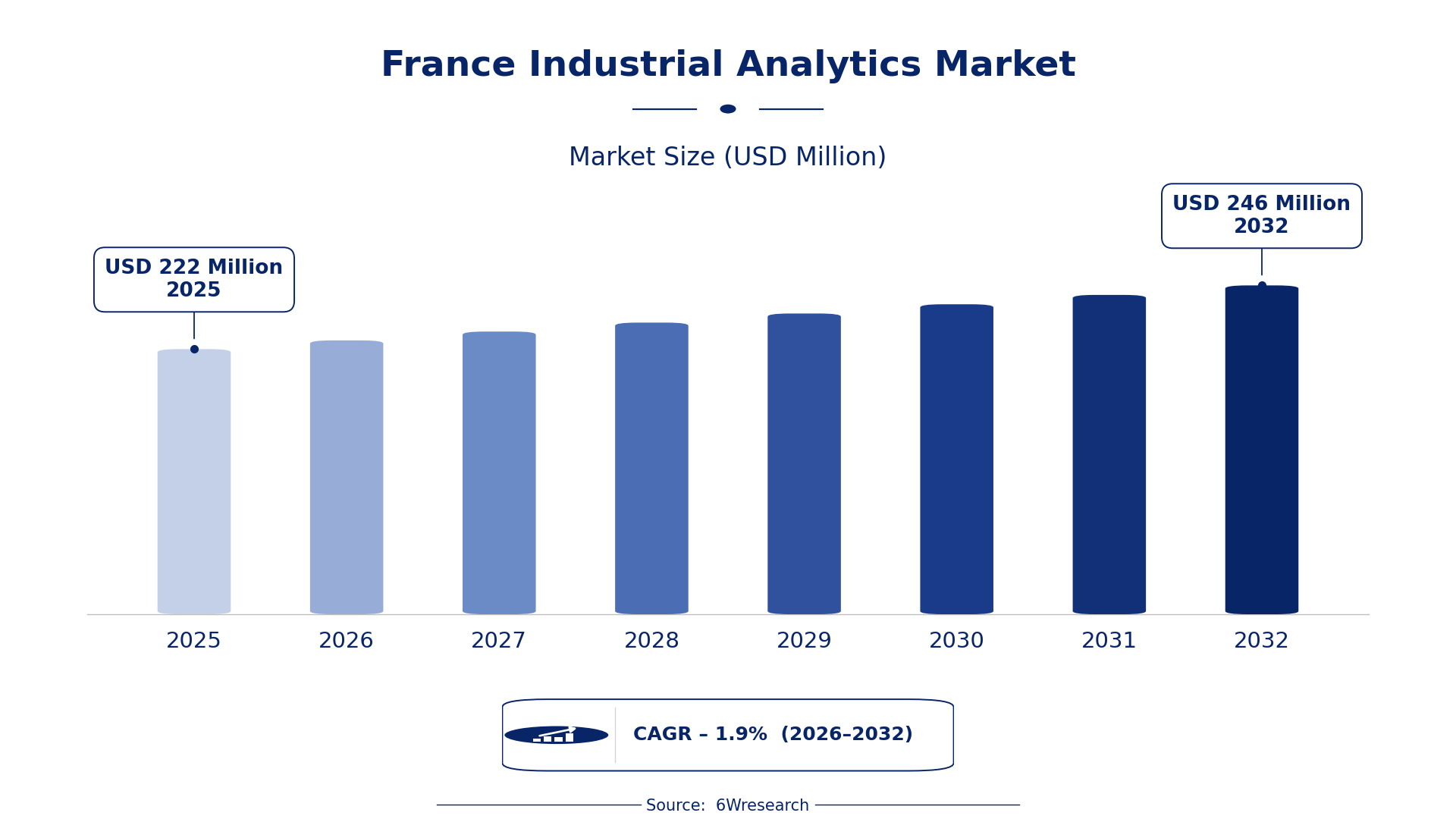
The France Industrial Analytics Market was estimated at USD 222 Million in 2025 and is projected to reach USD 246 Million by 2032, growing at a CAGR of 1.9% from 2026 to 2032.
France Industrial Analytics Market Synopsis
In France, the demand for industrial analytics is accelerating as businesses increasingly focus on operational efficiency and data-driven decision-making. This shift is underscored by the rising adoption of IoT technologies, which generate vast amounts of data that require sophisticated analytics for effective utilization.
Industries such as manufacturing, automotive, and energy are at the forefront of this trend, utilizing analytics tools to enhance productivity and reduce operational costs. Companies are investing in advanced analytics solutions that provide real-time insights, paving the way for significant improvements in processes and outcomes.
France Industrial Analytics Market Year-wise Growth Rate and Key Drivers
This graph illustrates the annual growth rates of the France Industrial Analytics Market from 2021 to 2032, highlighting a steady upward trajectory and projected expansion over the forecast period.
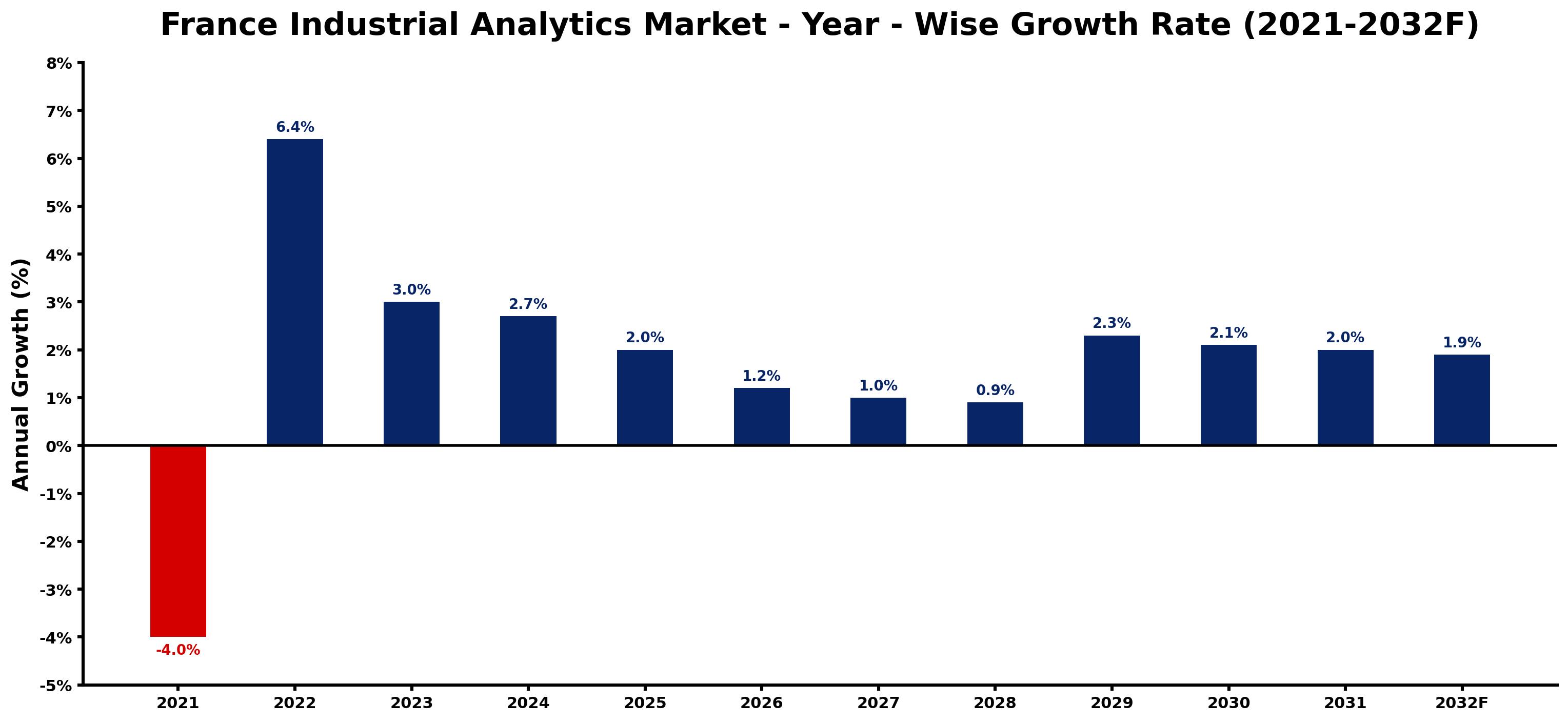
The table below presents the year‑wise growth rates along with the key drivers influencing the market
| Year | Growth Rate | Major Drivers |
| 2021 | -4.0% | Regulatory delays in AI deployment guidance by CNIL. |
| 2022 | 6.4% | Manufacturing optimizations from France's Industry 4.0 strategy. |
| 2023 | 3.0% | Increased demand for predictive maintenance in factories. |
| 2024 | 2.7% | Growing need for data-driven supply chain improvements. |
| 2025 | 2.0% | Adoption of IoT technologies in French manufacturing plants. |
| 2026 | 1.2% | Support from Bpifrance for digital transformation projects. |
| 2027 | 1.0% | Rise of energy efficiency analytics in industry. |
| 2028 | 0.9% | Focus on sustainability analytics driven by EU regulations. |
| 2029 | 2.3% | Investment in AI capabilities among French manufacturers. |
| 2030 | 2.1% | Shift towards real-time analytics for operational efficiency. |
| 2031 | 2.0% | Emergence of collaboration tools enhancing data sharing. |
| 2032 | 1.9% | Regulatory push for transparency in manufacturing processes. |
Note: Market size estimations and growth projections presented in this report are based on 6Wresearch's proprietary forecasting methodology, utilizing the latest available industry data, government publications, and primary research inputs.
France Industrial Analytics Market Key Takeaways
Below are some of the specific key takeaways from the market, including:
- Growing demand for predictive maintenance solutions to minimize downtime.
- Increased integration of AI and machine learning capabilities in analytics processes.
- Proliferation of cloud-based analytics tools enhancing accessibility and scalability.
- Focus on real-time data analytics to facilitate proactive decision-making.
- Investment opportunities in customized solutions tailored to specific industrial needs.
Evaluation of Restraints in France Industrial Analytics Market
Despite its growth potential, the France Industrial Analytics Market faces several restraints. Data privacy regulations, particularly GDPR, impose strict limitations on data collection and usage, creating barriers for companies looking to harness analytics. Additionally, the challenge of integrating data from diverse sources in complex industrial environments demands specialized tools and expertise.
Many traditional industries still exhibit limited awareness of the benefits that industrial analytics can offer, which slows down adoption rates. on top of that, the high initial costs associated with implementing analytics solutions, alongside a shortage of skilled professionals capable of interpreting the insights generated, further complicate market penetration.
France Industrial Analytics Market Trends
The current trajectory of the France Industrial Analytics Market is shaped by several key trends. The rise of predictive maintenance solutions is paramount, allowing companies to optimize operational efficiency while significantly reducing downtime. There's also a notable increase in the integration of AI and machine learning capabilities, enabling more sophisticated data analytics processes.
on top of that, the demand for real-time analytics is surging as businesses strive to make proactive decisions. Cloud-based solutions are gaining traction, providing flexibility and scalability that traditional systems lack. These trends reflect a broader shift towards digitization and automation across the industrial sector.
France Industrial Analytics Market Opportunities
The landscape for investment in the France Industrial Analytics Market is ripe with opportunities. As Industry 4.0 technologies gain traction, areas such as predictive maintenance, real-time asset monitoring, and quality control analytics are particularly appealing. The increasing emphasis on operational efficiency and cost reduction positions these segments as focal points for investment.
Investors should also consider opportunities in advanced analytics software and consulting services, tailored specifically to industry needs. Collaborations with local industrial players and alignment with government initiatives promoting digital transformation will further enhance prospects in this evolving market.
Government Initiatives in the France Industrial Analytics Market
The French government is actively fostering the growth of the Industrial Analytics Market through various initiatives. Recently, the implementation of the French Industrial Internet Plan (PI²) has encouraged the adoption of advanced technologies, including analytics, within manufacturing. This program aims to enhance digital transformation in the industrial sector.
Currently, the government is investing in education and training programs to develop a skilled workforce capable of managing data analytics and industrial automation. Looking ahead, there are plans for further regulatory frameworks focused on data protection and cybersecurity, ensuring secure and ethical data usage in industrial applications.
Future Insights of the France Industrial Analytics Market
The future of the France Industrial Analytics Market appears promising, with substantial growth expected from 2026 to 2032. The continuous adoption of Industry 4.0 technologies will drive demand for advanced analytics solutions across various sectors, including manufacturing, automotive, and energy. As organizations increasingly prioritize operational efficiency and productivity, the need for predictive maintenance, real-time analytics, and asset monitoring will become even more critical.
The market is likely to witness heightened investment in innovation, as companies seek to offer tailored solutions that address the unique challenges of industrial organizations in France. This focus on customization will be key to maintaining a competitive edge in a rapidly changing environment.
France Industrial Analytics Market Latest Developments
In the last year, the France Industrial Analytics Market has seen several noteworthy developments. A leading technology vendor recently launched a new predictive maintenance platform aimed at enhancing operational efficiency in manufacturing, which was completed in late 2025. Ongoing projects include the rollout of cloud-based analytics solutions across various industries, which began in mid-2025 and continues to gain traction.
Looking forward, a major initiative is expected to commence in the second half of 2026, focusing on enhancing data integration capabilities within complex industrial environments. This effort aims to address current challenges in data management and analytics, signaling a proactive approach to market demands.
France Industrial Analytics Market - Key Attractiveness of the Report
- 10 Years of Market Numbers
- Historical Data Starting from 2022 to 2025
- Base Year: 2025
- Forecast Data until 2032
- Key Performance Indicators Impacting the Market
- Major Upcoming Developments and Projects
The French government is promoting digital transformation through initiatives like the French Industrial Internet Plan (PI²). Ongoing investments in workforce training and future regulatory frameworks on data protection are also crucial for market growth.
Key Highlights of the Report:
- France Industrial Analytics Market Outlook
- Market Size of France Industrial Analytics Market, 2025
- Forecast of France Industrial Analytics Market, 2032
- Historical Data and Forecast of France Industrial Analytics Revenues & Volume for the Period 2022-2032F
- France Industrial Analytics Market Trend Evolution
- France Industrial Analytics Market Drivers and Challenges
- France Industrial Analytics Price Trends
- France Industrial Analytics Porter's Five Forces
- France Industrial Analytics Industry Life Cycle
- Historical Data and Forecast of France Industrial Analytics Market Revenues & Volume By Component for the Period 2022-2032F
- Historical Data and Forecast of France Industrial Analytics Market Revenues & Volume By Software for the Period 2022-2032F
- Historical Data and Forecast of France Industrial Analytics Market Revenues & Volume By Service for the Period 2022-2032F
- Historical Data and Forecast of France Industrial Analytics Market Revenues & Volume By Software for the Period 2022-2032F
- Historical Data and Forecast of France Industrial Analytics Market Revenues & Volume By Operational analytics for the Period 2022-2032F
- Historical Data and Forecast of France Industrial Analytics Market Revenues & Volume By Risk analytics for the Period 2022-2032F
- Historical Data and Forecast of France Industrial Analytics Market Revenues & Volume By Financial analytics for the Period 2022-2032F
- Historical Data and Forecast of France Industrial Analytics Market Revenues & Volume By Marketing analytics for the Period 2022-2032F
- Historical Data and Forecast of France Industrial Analytics Market Revenues & Volume By Customer analytics for the Period 2022-2032F
- Historical Data and Forecast of France Industrial Analytics Market Revenues & Volume By Workforce analytics for the Period 2022-2032F
- Historical Data and Forecast of France Industrial Analytics Market Revenues & Volume By Service for the Period 2022-2032F
- Historical Data and Forecast of France Industrial Analytics Market Revenues & Volume By Managed services for the Period 2022-2032F
- Historical Data and Forecast of France Industrial Analytics Market Revenues & Volume By Professional services for the Period 2022-2032F
- Historical Data and Forecast of France Industrial Analytics Market Revenues & Volume By Analytics Type for the Period 2022-2032F
- Historical Data and Forecast of France Industrial Analytics Market Revenues & Volume By Descriptive for the Period 2022-2032F
- Historical Data and Forecast of France Industrial Analytics Market Revenues & Volume By Diagnostic for the Period 2022-2032F
- Historical Data and Forecast of France Industrial Analytics Market Revenues & Volume By Predictive for the Period 2022-2032F
- Historical Data and Forecast of France Industrial Analytics Market Revenues & Volume By Prescriptive for the Period 2022-2032F
- Historical Data and Forecast of France Industrial Analytics Market Revenues & Volume By Organization size for the Period 2022-2032F
- Historical Data and Forecast of France Industrial Analytics Market Revenues & Volume By Large enterprises for the Period 2022-2032F
- Historical Data and Forecast of France Industrial Analytics Market Revenues & Volume By Small and medium-sized enterprises for the Period 2022-2032F
- France Industrial Analytics Import Export Trade Statistics
- Market Opportunity Assessment By Component
- Market Opportunity Assessment By Software
- Market Opportunity Assessment By Service
- Market Opportunity Assessment By Analytics Type
- Market Opportunity Assessment By Organization size
- France Industrial Analytics Top Companies Market Share
- France Industrial Analytics Competitive Benchmarking By Technical and Operational Parameters
- France Industrial Analytics Company Profiles
- France Industrial Analytics Key Strategic Recommendations






































