Qatar Industrial Analytics Market Size & Growth Rate (2026-2032)
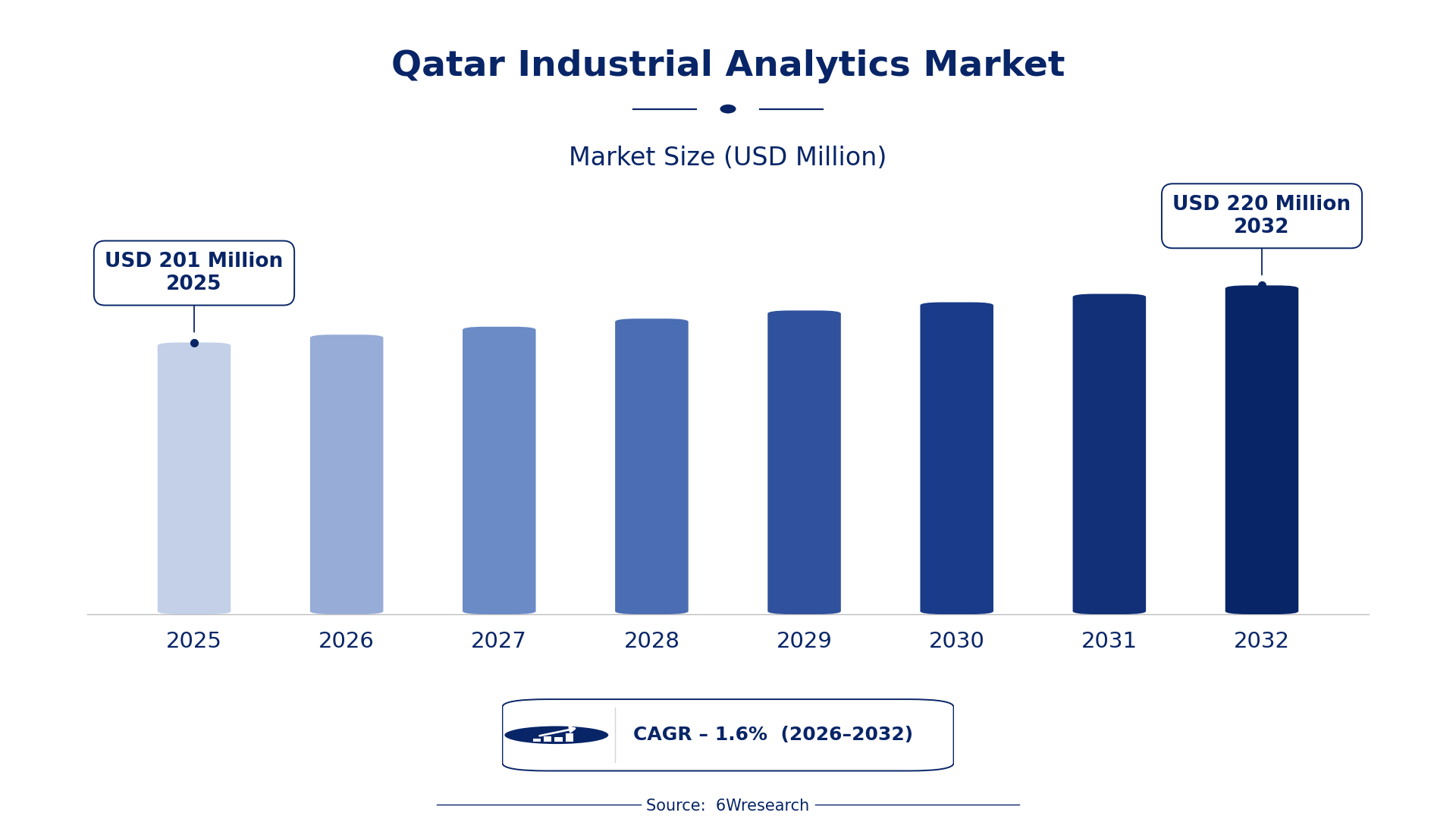
The Qatar Industrial Analytics Market was estimated at USD 201 Million in 2025 and is projected to reach USD 220 Million by 2032, growing at a CAGR of 1.6% from 2026 to 2032.
Qatar Industrial Analytics Market Synopsis
The Qatar Industrial Analytics Market is rapidly gaining traction, driven by the increasing need for data-driven insights across various industrial sectors. Companies are prioritizing analytics solutions to enhance operational efficiency, particularly in manufacturing and energy. This trend aligns closely with Qatar's broader ambitions for industrial diversification and innovation.
As industries transition towards Industry 4.0, the emphasis on predictive maintenance and real-time monitoring becomes more pronounced. The integration of IoT devices and advanced analytics is not just a luxury; it's becoming a necessity for maintaining a competitive edge in the global market.
Qatar Industrial Analytics Market Year-wise Growth Rate and Key Drivers
This graph illustrates the annual growth rates of the Qatar Industrial Analytics Market from 2021 to 2032, highlighting a steady upward trajectory and projected expansion over the forecast period.
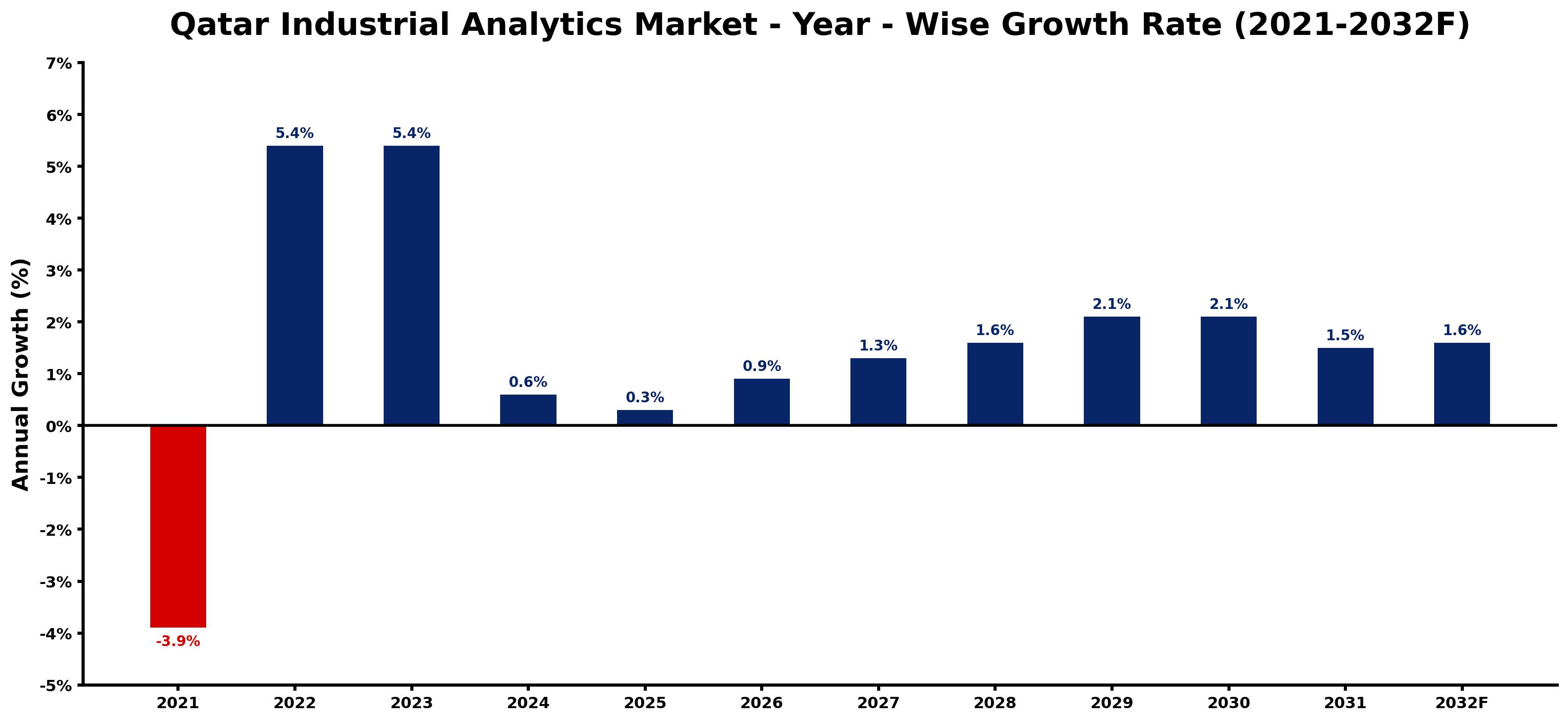
The table below presents the year‑wise growth rates along with the key drivers influencing the market
| Year | Growth Rate | Major Drivers |
| 2021 | -3.9% | Qatar National Vision 2030 delays impacting analytics investments |
| 2022 | 5.4% | Qatar National Vision 2030 promoting data innovation. |
| 2023 | 5.4% | Increased focus on smart manufacturing by local firms. |
| 2024 | 0.6% | Adoption of Industry 4.0 technologies in Qatar's industry. |
| 2025 | 0.3% | Government incentives for analytics-driven decision making. |
| 2026 | 0.9% | Surge in demand for operational efficiency improvements. |
| 2027 | 1.3% | Investment in AI solutions by Qatari businesses. |
| 2028 | 1.6% | Growing partnerships with international analytics providers. |
| 2029 | 2.1% | Emergence of local start-ups specializing in data analytics. |
| 2030 | 2.1% | Focus on enhancing supply chain visibility and efficiency. |
| 2031 | 1.5% | Regulatory support for data privacy and security improvements. |
| 2032 | 1.6% | Growing interest in predictive maintenance among manufacturers. |
Note: Market size estimations and growth projections presented in this report are based on 6Wresearch's proprietary forecasting methodology, utilizing the latest available industry data, government publications, and primary research inputs.
Qatar Industrial Analytics Market Key Takeaways
Below are some of the specific key takeaways from the market, including:
- Industrial analytics is essential for optimizing processes and improving productivity across various sectors.
- The adoption of IoT and sensor technologies is driving real-time data availability and operational insights.
- Investment in analytics solutions is increasing in the oil and gas sector, focusing on safety and efficiency.
- Data integration and quality remain critical challenges, hindering some organizations' ability to implement analytics solutions.
- Skilled professionals capable of managing and interpreting analytics data are in high demand yet short supply.
Evaluation of Restraints in Qatar Industrial Analytics Market
The growth of the Qatar Industrial Analytics Market faces several constraints that can slow its progress. Many traditional industries still depend heavily on legacy systems, making the transition to advanced analytics a complex challenge. on top of that, disparate data sources often lead to integration issues, resulting in unstructured data that require significant cleanup. This complexity is compounded by a shortage of qualified personnel who can handle and interpret analytics effectively. Lastly, the high initial investment costs associated with implementing these technologies can deter smaller companies from participating in this market.
Qatar Industrial Analytics Market Trends
Several trends are shaping the Qatar Industrial Analytics Market. Increasing investment in automation and smart technologies is a prominent trend, with industries focusing on enhancing operational efficiency. There's a noticeable shift towards predictive maintenance, allowing companies to anticipate equipment failures before they occur, thus minimizing downtime. The integration of AI and machine learning into analytics solutions is also gaining momentum, further refining data interpretation and decision-making processes.
Qatar Industrial Analytics Market Opportunities
The Qatar Industrial Analytics Market presents several growth opportunities for stakeholders. The ongoing push for digital transformation across industries offers a fertile ground for analytics adoption. Companies that can innovate in analytics solutions—particularly in predictive maintenance and quality control—stand to gain a competitive advantage. Additionally, as more IoT devices become prevalent, the demand for analytics that can process vast amounts of data will increase, creating openings for specialized service providers.
Government Initiatives in the Qatar Industrial Analytics Market
The Qatari government is actively shaping the Industrial Analytics Market through various initiatives. Recently, the government completed a strategic framework aimed at enhancing data-driven decision-making in industrial sectors. Currently underway is the National Industry Strategy, which emphasizes the integration of advanced analytics in traditional industries. Looking ahead, plans are in place to launch a new regulatory body focused on overseeing and facilitating the digital transformation of industries, ensuring they can fully leverage analytics capabilities.
Future Insights of the Qatar Industrial Analytics Market
From 2026 to 2032, the Qatar Industrial Analytics Market is expected to continue its upward trajectory. The increasing adoption of smart technologies will likely accelerate the demand for analytics solutions. As industries become more data-centric, the focus will shift towards comprehensive data management strategies that incorporate predictive insights. Companies that invest in these technologies now will not only enhance their operational efficiency but also position themselves as leaders in a competitive global market.
Qatar Industrial Analytics Market Latest Developments
Recent activity in the Qatar Industrial Analytics Market reflects a keen interest in advancing analytics capabilities. A major technology vendor recently launched a new analytics platform aimed at optimizing supply chain operations, which was completed in early 2025 and is already yielding positive results. Ongoing partnerships between local industries and analytics solution providers are facilitating a smoother transition to data-driven operations. Additionally, a new initiative expected to begin in the second half of 2026 aims to enhance training programs for professionals in industrial analytics, addressing the skills gap in the market.
Qatar Industrial Analytics Market - Key Attractiveness of the Report
- 10 Years of Market Numbers
- Historical Data Starting from 2022 to 2025
- Base Year: 2025
- Forecast Data until 2032
- Key Performance Indicators Impacting the Market
- Major Upcoming Developments and Projects
Key Highlights of the Report:
- Qatar Industrial Analytics Market Outlook
- Market Size of Qatar Industrial Analytics Market, 2025
- Forecast of Qatar Industrial Analytics Market, 2032
- Historical Data and Forecast of Qatar Industrial Analytics Revenues & Volume for the Period 2022-2032F
- Qatar Industrial Analytics Market Trend Evolution
- Qatar Industrial Analytics Market Drivers and Challenges
- Qatar Industrial Analytics Price Trends
- Qatar Industrial Analytics Porter's Five Forces
- Qatar Industrial Analytics Industry Life Cycle
- Historical Data and Forecast of Qatar Industrial Analytics Market Revenues & Volume By Component for the Period 2022-2032F
- Historical Data and Forecast of Qatar Industrial Analytics Market Revenues & Volume By Software for the Period 2022-2032F
- Historical Data and Forecast of Qatar Industrial Analytics Market Revenues & Volume By Service for the Period 2022-2032F
- Historical Data and Forecast of Qatar Industrial Analytics Market Revenues & Volume By Software for the Period 2022-2032F
- Historical Data and Forecast of Qatar Industrial Analytics Market Revenues & Volume By Operational analytics for the Period 2022-2032F
- Historical Data and Forecast of Qatar Industrial Analytics Market Revenues & Volume By Risk analytics for the Period 2022-2032F
- Historical Data and Forecast of Qatar Industrial Analytics Market Revenues & Volume By Financial analytics for the Period 2022-2032F
- Historical Data and Forecast of Qatar Industrial Analytics Market Revenues & Volume By Marketing analytics for the Period 2022-2032F
- Historical Data and Forecast of Qatar Industrial Analytics Market Revenues & Volume By Customer analytics for the Period 2022-2032F
- Historical Data and Forecast of Qatar Industrial Analytics Market Revenues & Volume By Workforce analytics for the Period 2022-2032F
- Historical Data and Forecast of Qatar Industrial Analytics Market Revenues & Volume By Service for the Period 2022-2032F
- Historical Data and Forecast of Qatar Industrial Analytics Market Revenues & Volume By Managed services for the Period 2022-2032F
- Historical Data and Forecast of Qatar Industrial Analytics Market Revenues & Volume By Professional services for the Period 2022-2032F
- Historical Data and Forecast of Qatar Industrial Analytics Market Revenues & Volume By Analytics Type for the Period 2022-2032F
- Historical Data and Forecast of Qatar Industrial Analytics Market Revenues & Volume By Descriptive for the Period 2022-2032F
- Historical Data and Forecast of Qatar Industrial Analytics Market Revenues & Volume By Diagnostic for the Period 2022-2032F
- Historical Data and Forecast of Qatar Industrial Analytics Market Revenues & Volume By Predictive for the Period 2022-2032F
- Historical Data and Forecast of Qatar Industrial Analytics Market Revenues & Volume By Prescriptive for the Period 2022-2032F
- Historical Data and Forecast of Qatar Industrial Analytics Market Revenues & Volume By Organization size for the Period 2022-2032F
- Historical Data and Forecast of Qatar Industrial Analytics Market Revenues & Volume By Large enterprises for the Period 2022-2032F
- Historical Data and Forecast of Qatar Industrial Analytics Market Revenues & Volume By Small and medium-sized enterprises for the Period 2022-2032F
- Qatar Industrial Analytics Import Export Trade Statistics
- Market Opportunity Assessment By Component
- Market Opportunity Assessment By Software
- Market Opportunity Assessment By Service
- Market Opportunity Assessment By Analytics Type
- Market Opportunity Assessment By Organization size
- Qatar Industrial Analytics Top Companies Market Share
- Qatar Industrial Analytics Competitive Benchmarking By Technical and Operational Parameters
- Qatar Industrial Analytics Company Profiles
- Qatar Industrial Analytics Key Strategic Recommendations






































