France Kosher Food Market Size, Share & Growth Rate
The France Kosher Food Market was estimated at USD 225 Million in 2025 and is projected to reach USD 250 Million by 2032, growing at a CAGR of 1.5% from 2026 to 2032. This growth trajectory is largely fueled by a burgeoning awareness of health and quality among consumers, not just within the Jewish community but also among the general populace. The increasing multicultural landscape in France is fostering interest in kosher products, seen as symbols of purity and ethical sourcing.
France Kosher Food Market Year-wise Growth Rate and Key Drivers
This graph highlights how the France Kosher Food Market has steadily grown over the years, supported by major growth factors.
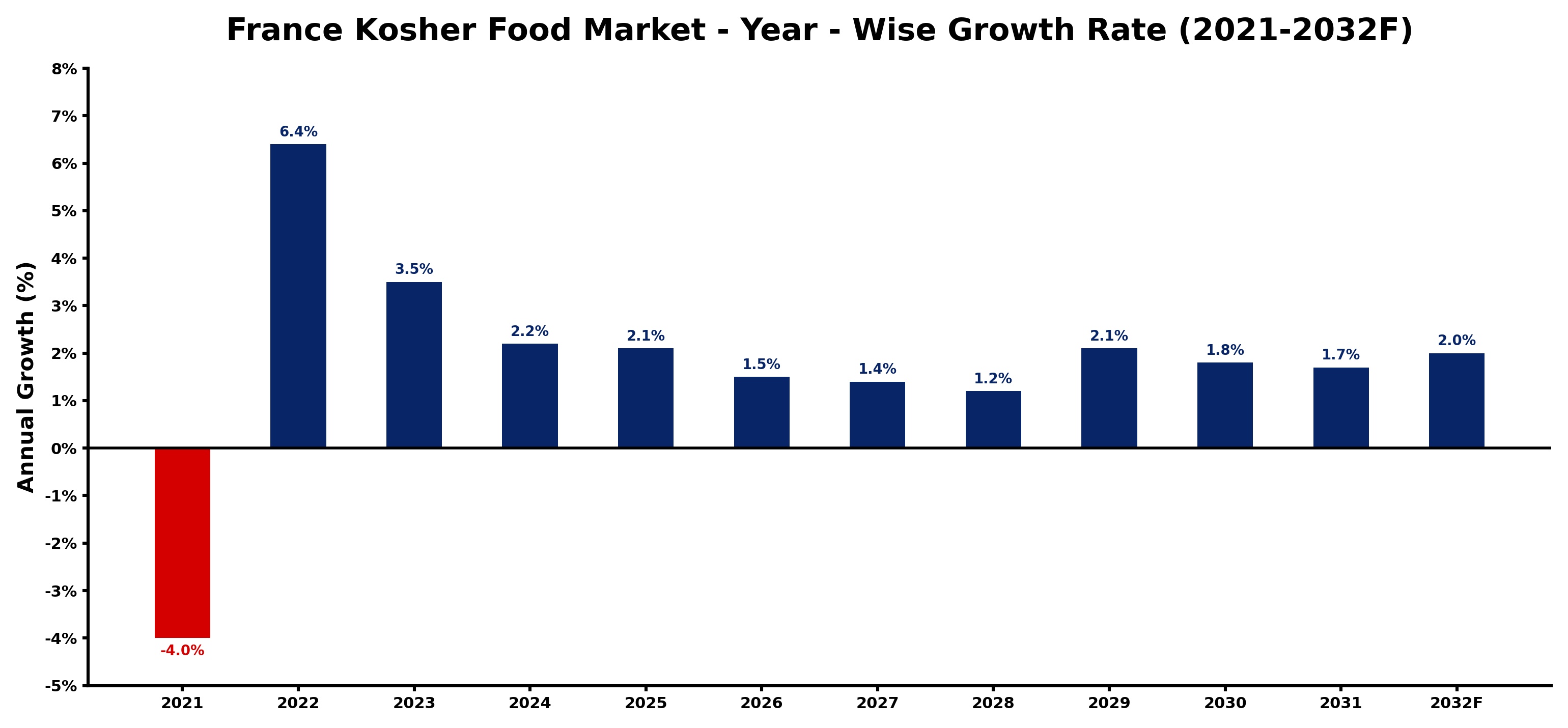
The table below presents the year‑wise growth rates along with the key drivers influencing the market
| Year | Growth Rate | Major Drivers |
| 2021 | -4.0% | Inflationary pressures constrained consumer spending on kosher food products |
| 2022 | 6.4% | Advanced traceability technologies boost kosher food supply chain transparency |
| 2023 | 3.5% | New kosher certification processes accelerated plant capacity investments |
| 2024 | 2.2% | Revamped supply chain logistics boosted kosher food distribution networks |
| 2025 | 2.1% | New kosher certification processes optimize production line efficiency |
| 2026 | 1.5% | Kosher certification modernization boosted production efficiency for local suppliers |
| 2027 | 1.4% | New kosher certification processes streamline meat processing plant productivity |
| 2028 | 1.2% | New kosher processing plants enhanced regional meat supply chain efficiency |
| 2029 | 2.1% | Kosher food certification investments boost local processing facility capabilities |
| 2030 | 1.8% | Export demand for kosher certified products boosted local food processing investments |
| 2031 | 1.7% | Adoption of advanced processing equipment boosts kosher food production efficiency |
| 2032 | 2.0% | Export driven technology adoption streamlined kosher food processing operations |
Note - Market size estimations and growth projections presented in this report are based on 6Wresearch’s advanced forecasting approach, validated with industry datasets as of June 2026.
France Kosher Food Market Synopsis
The kosher food market in France is undergoing a notable transformation, spurred by an evolving consumer base that includes both observant Jewish individuals and health-conscious non-Jewish consumers. As these products gain broader acceptance, the demand for kosher-certified foods is shifting from niche to mainstream.
This movement is underpinned by a strong desire for transparency in food sourcing and preparation, with kosher certification emerging as a trusted seal of quality. Consumers appreciate the rigorous standards that govern kosher food production, further propelling market growth.
France Kosher Food Market Key Takeaways
- The market is experiencing a paradigm shift toward greater acceptance of kosher food beyond Jewish communities.
- Health-conscious consumers are drawn to kosher products due to perceived higher standards of quality and safety.
- Multiculturalism in France is fostering a growing appreciation for kosher dietary laws among diverse populations.
- The expansion of kosher offerings in mainstream retail channels is enhancing product accessibility and variety.
- Increasing awareness of food allergies is boosting the demand for kosher-certified options, perceived as safer choices.
Evaluation of Restraints in France Kosher Food Market
Despite the promising growth of the France Kosher Food Market, several restraints pose challenges to its full potential. One key issue is the complexity of ensuring compliance with stringent kosher certification standards. This often creates barriers for new entrants in the market and complicates supply chain logistics for existing producers. Additionally, consumer education on kosher dietary laws remains limited, which can hinder broader acceptance among potential buyers.
Moreover, while the availability of kosher products has expanded, it still lags behind that of other specialty food categories. This limitation affects consumer choice and may deter those unfamiliar with kosher principles from exploring these options. Addressing these hurdles will be essential for sustaining growth and maximizing market opportunities.
France Kosher Food Market Trends
Current trends in the France Kosher Food Market reflect a broader shift toward premiumization and authenticity in food sourcing. Consumers increasingly seek foods that not only meet dietary restrictions but also adhere to ethical and sustainable practices. Additionally, innovative product offerings that cater to various culinary preferences are emerging, further driving interest in kosher foods.
Digital platforms are playing a significant role in increasing awareness and facilitating access to kosher products, with online retailers expanding their kosher sections to meet rising demand. As the market evolves, we can expect an increase in collaborations between kosher certifying bodies and food producers, aimed at enhancing product offerings while ensuring compliance with kashrut standards.
France Kosher Food Market Opportunities
The burgeoning France Kosher Food Market presents several growth opportunities for stakeholders. Notably, there is a significant potential for the development of innovative kosher products that cater to specific dietary needs, such as gluten-free or vegan options. As more non-Jewish consumers explore the benefits of kosher food, market players can capitalize on this trend by diversifying their product lines.
Furthermore, expanding partnerships with mainstream retailers and restaurants can enhance visibility and accessibility of kosher offerings. The rise of e-commerce also offers a unique avenue for introducing a broader array of kosher products to consumers who may not have local access, thus driving market growth significantly.
Government Initiatives in the France Kosher Food Market
Government regulations significantly impact the France Kosher Food Market, particularly concerning food labeling and safety standards. Policies promoting transparency in food production and labeling for religious dietary practices are vital for maintaining consumer confidence. Additionally, support for local kosher producers through grants or incentives can help sustain the market's growth and ensure compliance with kashrut.
The government's commitment to multiculturalism also paves the way for greater acceptance of diverse dietary practices, including kosher. Such an environment fosters an atmosphere where kosher food is not just a niche market but rather part of the wider culinary landscape in France.
Future Insights of the France Kosher Food Market
Looking ahead to 2026-2032, the France Kosher Food Market is poised for steady growth, driven by increasing consumer demand for quality and ethical food choices. The recognition of kosher certification as a symbol of trust and safety will continue to attract new consumers. Moreover, as the market adapts to evolving dietary preferences, the introduction of innovative and diverse products will likely enhance its appeal.
With the expansion of kosher products in mainstream retail and dining establishments, accessibility will improve, fostering broader acceptance. Coupled with proactive government policies supporting market compliance, these factors suggest a bright outlook for the kosher food sector in France.
France Kosher Food Market Latest Developments (May 2025 - June 2026)
In recent months, the France Kosher Food Market has seen a notable increase in product diversity, as various manufacturers introduce innovative items tailored to different consumer segments. Restaurants and cafes are increasingly featuring kosher options on their menus, responding to the growing interest from patrons seeking these offerings. Additionally, collaborative initiatives between kosher certifying authorities and producers are enhancing awareness and compliance, ensuring that quality remains a cornerstone of the market.
France Kosher Food Market - Key Attractiveness of the Report
- 10 Years of Market Numbers
- Historical Data Starting from 2022 to 2025
- Base Year: 2025
- Forecast Data until 2032
- Key Performance Indicators Impacting the Market
- Major Upcoming Developments and Projects
Key Highlights of the Report:
- France Kosher Food Market Outlook
- Market Size of France Kosher Food Market, 2025
- Forecast of France Kosher Food Market, 2032
- Historical Data and Forecast of France Kosher Food Revenues & Volume for the Period 2022-2032F
- France Kosher Food Market Trend Evolution
- France Kosher Food Market Drivers and Challenges
- France Kosher Food Price Trends
- France Kosher Food Porter's Five Forces
- France Kosher Food Industry Life Cycle
- Historical Data and Forecast of France Kosher Food Market Revenues & Volume By Type for the Period 2022-2032F
- Historical Data and Forecast of France Kosher Food Market Revenues & Volume By Meat for the Period 2022-2032F
- Historical Data and Forecast of France Kosher Food Market Revenues & Volume By Dairy for the Period 2022-2032F
- Historical Data and Forecast of France Kosher Food Market Revenues & Volume By Pareve for the Period 2022-2032F
- Historical Data and Forecast of France Kosher Food Market Revenues & Volume By Application for the Period 2022-2032F
- Historical Data and Forecast of France Kosher Food Market Revenues & Volume By Seafood for the Period 2022-2032F
- Historical Data and Forecast of France Kosher Food Market Revenues & Volume By Processed Meat and Poultry for the Period 2022-2032F
- Historical Data and Forecast of France Kosher Food Market Revenues & Volume By Beverages for the Period 2022-2032F
- Historical Data and Forecast of France Kosher Food Market Revenues & Volume By Staples for the Period 2022-2032F
- Historical Data and Forecast of France Kosher Food Market Revenues & Volume By Snacks & Savoury for the Period 2022-2032F
- Historical Data and Forecast of France Kosher Food Market Revenues & Volume By Bakery and Confectionery for the Period 2022-2032F
- Historical Data and Forecast of France Kosher Food Market Revenues & Volume By Others for the Period 2022-2032F
- Historical Data and Forecast of France Kosher Food Market Revenues & Volume By Distribution Channel for the Period 2022-2032F
- Historical Data and Forecast of France Kosher Food Market Revenues & Volume By Supermarkets and Hypermarkets for the Period 2022-2032F
- Historical Data and Forecast of France Kosher Food Market Revenues & Volume By Grocery Stores for the Period 2022-2032F
- Historical Data and Forecast of France Kosher Food Market Revenues & Volume By Online Stores for the Period 2022-2032F
- France Kosher Food Import Export Trade Statistics
- Market Opportunity Assessment By Type
- Market Opportunity Assessment By Application
- Market Opportunity Assessment By Distribution Channel
- France Kosher Food Top Companies Market Share
- France Kosher Food Competitive Benchmarking By Technical and Operational Parameters
- France Kosher Food Company Profiles
- France Kosher Food Key Strategic Recommendations






































