France Lumber Market Top 5 Importing Countries and Market Competition (HHI) Analysis
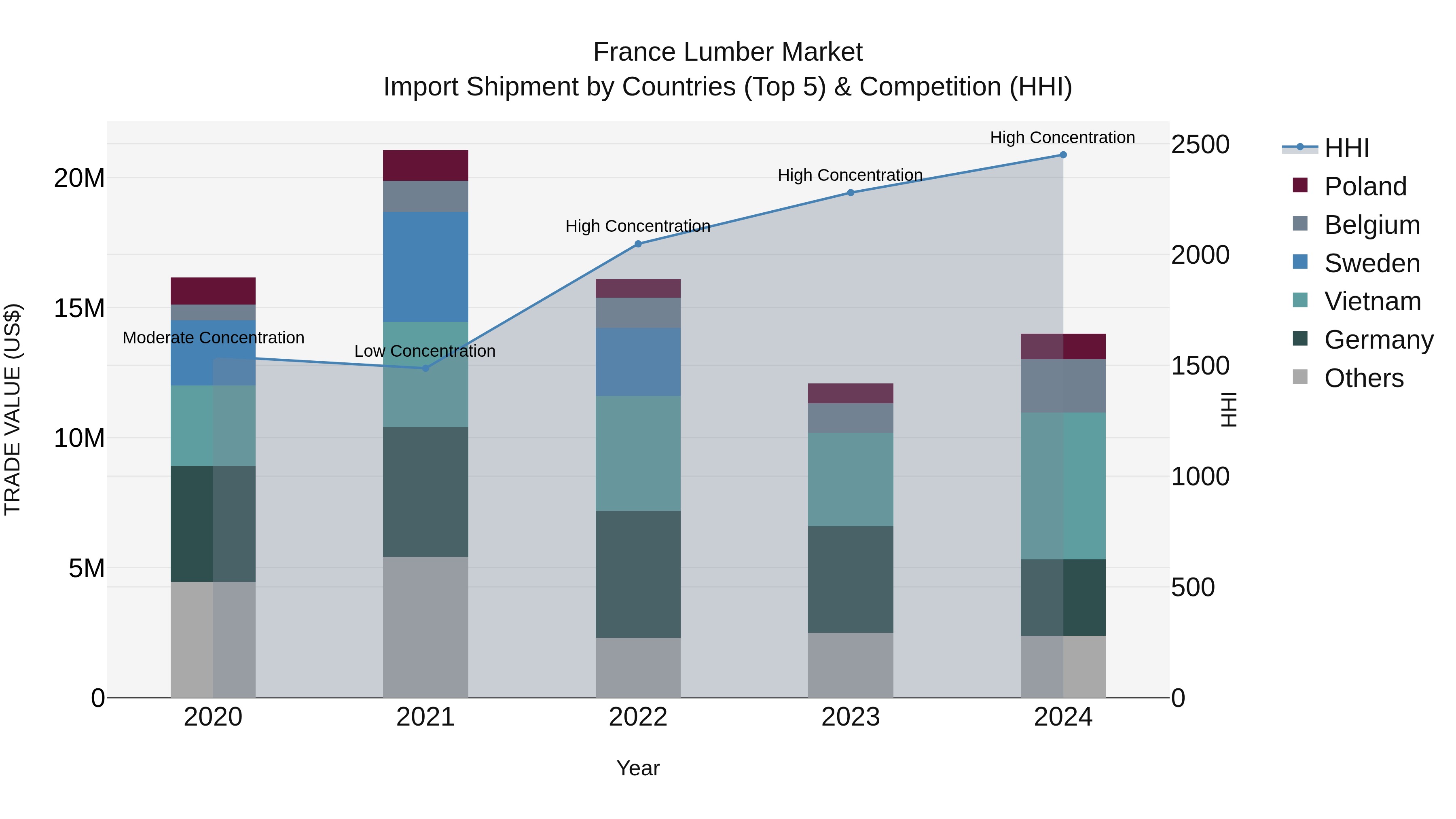
France`s lumber import market in 2024 continued to showcase high concentration, with Vietnam, Germany, Belgium, Spain, and Poland emerging as the top countries exporting to France. Despite a negative compound annual growth rate (CAGR) of -3.51% from 2020 to 2024, there was a notable growth rate of 15.94% from 2023 to 2024. These trends indicate both challenges and opportunities for stakeholders in the lumber import industry in France, necessitating a strategic approach to navigate market dynamics effectively.
France Lumber Market Highlights
| Report Name | France Lumber Market |
| Forecast period | 2025-2031 |
| CAGR | 5% |
| Growing Sector | Construction & Manufacturing |
Topics Covered in the France Lumber Market Report
The France Lumber Market report thoroughly covers the market segmentation by types and by application. The report provides an unbiased and detailed analysis of the ongoing market trends, opportunities/high growth areas, and market drivers, helping stakeholders devise and align their strategies according to current and future market dynamics.
France Lumber Market Synopsis
The France Lumber Market is witnessing robust growth due to increasing demand in the construction and furniture industries. With a surge in sustainable building practices, the market's significance in providing eco-friendly materials has dramatically increased. Key trends driving this market include the growing preference for hardwoods in high-end furniture and the resurgence of wood as a primary building material. Challenges include fluctuating timber prices and strict environmental regulations that can impact sourcing and production.
According to 6Wresearch, The France Lumber Market size is expected to grow at a significant CAGR of 5% during the forecast period 2025-2031. The expansion of the market is fueled by innovations in lumber processing and a growing commitment to sustainable forest management practices. Regulatory reforms encouraging the use of renewable resources are prompting industries to prefer lumber over synthetic alternatives. Furthermore, the rising consumer inclination towards natural and environmentally friendly products is driving demand in both the residential and commercial construction sectors. This trend aligns with broader market dynamics, as the focus on eco-consciousness becomes more prevalent. The confluence of these factors is significantly contributing to the France Lumber Market growth
Significant challenges include stringent environmental regulations on logging and deforestation, affecting supply chains. Economic factors such as fluctuating timber prices and trade policies also create market volatility. Furthermore, technological limitations in processing and the shortage of skilled labor pose hurdles to efficient production.
France Lumber Market Trends
The France lumber market is experiencing a robust transformation driven by environmental concerns and evolving consumer preferences. There is a growing demand for sustainably sourced timber, with consumers and industries increasingly favoring products that support ecological balance. This trend is further accentuated by government initiatives advocating for sustainable construction practices and the use of renewable materials. Furthermore, advancements in processing technologies are improving the quality and efficiency of lumber production in France, making the industry more competitive on the global stage. As eco-friendly building materials gain popularity, the French lumber market is expected to continue its upward trajectory, emphasizing sustainability and innovation.
Investment Opportunities in the France Lumber Market
Investment opportunities within the France lumber market are plentiful, particularly in sectors that align with sustainability and innovation. The push towards green building materials presents a significant opportunity for investors looking to support environmentally responsible ventures. Additionally, the adoption of new technologies such as automation and digital tracking systems offers prospects for enhancing production efficiency and supply chain transparency. Investors can capitalize on the growing demand for certified timber products, which are increasingly sought after in both domestic and international markets.
Leading Players of the France Lumber Market
The French lumber market is prominently led by key players like Groupe Lapeyre, Rougier, and Bois & Matériaux. These industry giants are not only at the forefront of production but are also champions of innovation, driving advancements in sustainability and efficiency. Their commitment to eco-friendly practices and streamlined distribution methods sets a benchmark for the sector, ensuring that they remain competitive while minimizing their environmental impact.
Government Regulations Introduced in the France Lumber Market
The French government has launched innovative initiatives such as the "Plan Bois" to champion sustainable forestry practices. This visionary plan focuses on minimizing carbon footprints while promoting the use of locally sourced timber across various industries. By implementing these policies, the government ensures regulatory compliance and stimulates market growth, ultimately contributing to a greener economy. For example, under the "Plan Bois," businesses are incentivized to utilize wood from sustainably managed forests, enhancing environmental responsibility and boosting local economies. This approach not only helps combat climate change but also strengthens the timber market by creating demand for eco-friendly materials, fostering a robust and sustainable future for both the forestry sector and the economy as a whole.
Future Insights of the France Lumber Market
The France lumber industry is poised for transformative growth driven by the continued emphasis on sustainability and technological innovation. Increasing awareness and concern over climate change are likely to bolster demand for carbon-friendly building materials. This orientation towards environmentally conscious construction will cement the role of sustainably sourced timber. Additionally, technological advancements such as AI-driven inventory management and precision forestry techniques are expected to enhance production efficiencies, reduce waste, and optimize resource use. The integration of digital tools for monitoring timber sustainability certifications could also become standard practice, ensuring transparency and trust in the supply chain.
Market Segmentation Analysis
The report offers a comprehensive study of the subsequent market segments and their leading categories.
Softwood Lumber to Dominate the Market- By Types
According to Ravi Bhandari, Research Head, 6wresearch, Softwood Lumber is emerging as the fastest-growing segment in France's lumber market. Its lightweight nature, coupled with cost-effectiveness and sustainability, makes it an excellent choice for various construction projects.
Construction to Dominate the Market By Application
Within the application segments, Construction is leading the way in expansion. This growth is driven by urbanization and an increasing focus on sustainable infrastructure in France. With major cities investing in green buildings and eco-sustainable architecture, the construction sector necessitates a steady supply of lumber, thereby carving out a significant share of the market.
Key Attractiveness of the Report
- 10 Years of Market Numbers.
- Historical Data Starting from 2021 to 2024.
- Base Year: 2024
- Forecast Data until 2031.
- Key Performance Indicators Impacting the Market.
- Major Upcoming Developments and Projects.
Key Highlights of the Report:
- France Lumber Market Outlook
- Market Size of France Lumber Market, 2024
- Forecast of France Lumber Market, 2031
- Historical Data and Forecast of France Lumber Revenues & Volume for the Period 2021-2031
- France Lumber Market Trend Evolution
- France Lumber Market Drivers and Challenges
- France Lumber Price Trends
- France Lumber Porter's Five Forces
- France Lumber Industry Life Cycle
- Historical Data and Forecast of France Lumber Market Revenues & Volume By Types for the Period 2021-2031
- Historical Data and Forecast of France Lumber Market Revenues & Volume By Hardwood Lumber for the Period 2021-2031
- Historical Data and Forecast of France Lumber Market Revenues & Volume By Softwood Lumber for the Period 2021-2031
- Historical Data and Forecast of France Lumber Market Revenues & Volume By Application for the Period 2021-2031
- Historical Data and Forecast of France Lumber Market Revenues & Volume By Construction for the Period 2021-2031
- Historical Data and Forecast of France Lumber Market Revenues & Volume By Furniture for the Period 2021-2031
- Historical Data and Forecast of France Lumber Market Revenues & Volume By Flooring for the Period 2021-2031
- Historical Data and Forecast of France Lumber Market Revenues & Volume By Moldings for the Period 2021-2031
- Historical Data and Forecast of France Lumber Market Revenues & Volume By Others for the Period 2021-2031
- France Lumber Import Export Trade Statistics
- Market Opportunity Assessment By Types
- Market Opportunity Assessment By Application
- France Lumber Top Companies Market Share
- France Lumber Competitive Benchmarking By Technical and Operational Parameters
- France Lumber Company Profiles
- France Lumber Key Strategic Recommendations
Market Covered
The report offers a comprehensive study of the subsequent market segments:
By Types
- Hardwood Lumber
- Softwood Lumber
By Application
- Construction
- Furniture
- Flooring
- Moldings
- Others






































