Iraq Lumber Market Summary
The iraq lumber market was estimated at USD 299 Million in 2025 and is projected to reach USD 399 Million by 2032, growing at a CAGR of 5.3% from 2026 to 2032.
Iraq Lumber Market Year-wise Growth Rate and Key Drivers
This graph highlights how the Iraq Lumber Market has steadily grown over the past five years, supported by major growth factors.
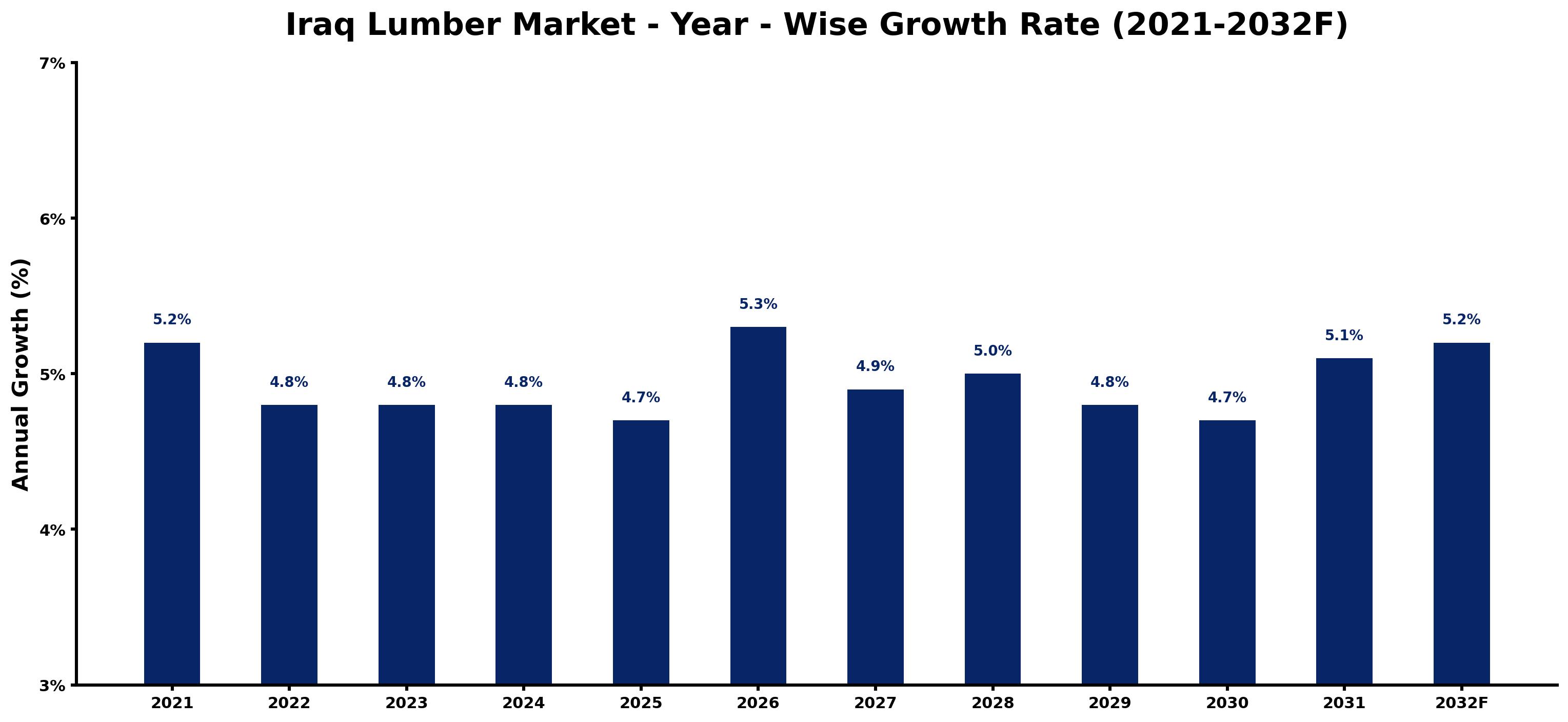
The table below presents the year wise growth rates along with the key drivers influencing the market
| Year | Growth Rate | Major Drivers |
| 2021 | 5.2% | Post-conflict infrastructure projects significantly stimulated the lumber sector's revival. |
| 2022 | 4.8% | Increased foreign investments focused on construction fostered a vibrant lumber supply chain. |
| 2023 | 4.8% | Local manufacturers enhance production capacity, meeting increasing domestic construction needs. |
| 2024 | 4.8% | Sustainability trends encourage eco-friendly lumber sourcing from regional forests. |
| 2025 | 4.7% | Urbanization trends demand more residential buildings, boosting lumber consumption across cities. |
| 2026 | 5.3% | Emerging technologies in construction improve efficiency, creating greater lumber demand. |
| 2027 | 4.9% | Regional trade agreements expand market access, facilitating smoother lumber imports and exports. |
| 2028 | 5.0% | Collaboration with international firms enhances local lumber quality and production techniques. |
| 2029 | 4.8% | Rise in tourism leads to increased hospitality construction, driving lumber requirements. |
| 2030 | 4.7% | Focus on renewable energy projects necessitates specialized lumber for infrastructure. |
| 2031 | 5.1% | Market diversification strategies encourage local businesses to explore innovative lumber products. |
| 2032 | 5.2% | Overall economic stability supports consistent growth across various construction-related sectors. |
Note - Market size estimations and growth projections presented in this report are based on 6Wresearch's advanced forecasting approach, validated with industry datasets as of June 2026.
Iraq Lumber Market Synopsis
The Iraq Lumber Market is projected to reach 5.3% and witness significant growth during the forecast period (2026-2032). The sector is shaped by several pivotal factors, including a surge in construction activities, infrastructure development, and the growing demand for furniture manufacturing. As urbanization accelerates and the population rises, there is an increased need for lumber products to support the construction of homes, offices, and other essential structures.
Iraq Lumber Market Growth Drivers
The growth of the Iraq Lumber Market is primarily driven by a combination of demographic trends, economic recovery, and policy initiatives. Key factors contributing to this growth include:
- An expanding construction sector that caters to the housing and infrastructure needs of an urbanizing populace, necessitating higher lumber consumption for various structural applications such as framing and flooring.
- Reconstruction efforts in areas affected by conflict which are propelling demand for lumber, as the rebuilding of both residential and commercial properties requires substantial timber resources.
- A heightened awareness among consumers and businesses regarding sustainable forestry practices, which is driving the preference for certified lumber products.
- Investment in infrastructure projects funded by government and international entities, leading to increased utilization of lumber in public works and commercial constructions.
- The flow of foreign investments into the real estate sector, which boosts the demand for quality lumber to support contemporary architectural designs.
Iraq Lumber Market Trends and Opportunities
In the dynamic landscape of the Iraq Lumber Market, several trends are emerging that offer significant opportunities for stakeholders:
- The increasing adoption of eco-friendly building materials, including certified lumber products, reflects the growing trend towards sustainability in construction.
- Technological advancements in timber processing technologies are improving the efficiency of lumber production and enhancing product quality.
- The growth of e-commerce platforms is simplifying access to lumber products, allowing consumers to source materials conveniently and competitively.
- The rising demand for customized furniture is creating niches within the lumber market, encouraging the production of unique and tailored timber products.
- Increased collaboration between the public and private sectors is fostering innovation and investment in the lumber industry, shaping a robust market outlook.
Iraq Lumber Market Challenges and Restraints
Despite the positive growth trajectory, the Iraq Lumber Market faces certain challenges that could impede its progress:
- The depletion of natural forests driven by illegal logging practices poses a significant threat to sustainability and resource availability in the lumber sector.
- Inadequate infrastructure for sustainable forestry management restricts the ability to efficiently harvest and process timber, affecting overall market supply.
- Fluctuations in global timber prices create uncertainty, making it difficult for local producers to plan and price their products competitively.
- Regulatory challenges and trade restrictions can limit access to high-quality imported lumber that meets market demands.
- The overall economic instability in certain regions may deter investment, impacting market growth and development.
Iraq Lumber Market Government Investment and Initiatives
Government policy plays a significant role in shaping the Iraq Lumber Market. The Iraqi government has been actively promoting sustainable forestry practices and supporting domestic production of lumber. Key initiatives include:
- Implementation of regulations aimed at preventing illegal logging and protecting precious forest ecosystems, ensuring that lumber sourcing is conducted responsibly.
- Investment incentives for establishing lumber processing facilities, which are crucial for enhancing the local supply chain and reducing dependency on imports.
- Funding for reforestation programs to restore forest areas and sustainably manage existing resources, thereby addressing the issue of forest depletion.
- Collaboration with international organizations to develop best practices in forestry management and establish certification schemes for sustainable lumber.
- Public awareness campaigns that educate stakeholders about the benefits of sustainable lumber sourcing, fostering a culture of environmental responsibility.
Iraq Lumber Market Latest Developments (May 2025 - June 2026)
Recent developments in the Iraq Lumber Market indicate a proactive approach towards enhancing the industry's framework. Over the period from May 2025 to June 2026, notable trends include a strengthened focus on policies aimed at combating illegal logging and promoting sustainable practices. Additionally, there has been a concerted effort to bolster domestic lumber production capabilities to meet growing demands. Furthermore, initiatives to integrate advanced technology in lumber processing commenced to improve efficiency and product quality. This pursuit of modernization aligns with the overarching goals of urban development and infrastructure reconstruction across the nation, thereby reinforcing the market's potential for growth.
Iraq Lumber Market - Key Attractiveness of the Report
- 10 Years of Market Numbers
- Historical Data Starting from 2022 to 2025
- Base Year: 2025
- Forecast Data until 2032
- Key Performance Indicators Impacting the Market
- Major Upcoming Developments and Projects
Key Highlights of the Report:
- Iraq Lumber Market Outlook
- Market Size of Iraq Lumber Market, 2025
- Forecast of Iraq Lumber Market, 2032
- Historical Data and Forecast of Iraq Lumber Revenues & Volume for the Period 2022-2032F
- Iraq Lumber Market Trend Evolution
- Iraq Lumber Market Drivers and Challenges
- Iraq Lumber Price Trends
- Iraq Lumber Porter's Five Forces
- Iraq Lumber Industry Life Cycle
- Historical Data and Forecast of Iraq Lumber Market Revenues & Volume By Types for the Period 2022-2032F
- Historical Data and Forecast of Iraq Lumber Market Revenues & Volume By Hardwood Lumber for the Period 2022-2032F
- Historical Data and Forecast of Iraq Lumber Market Revenues & Volume By Softwood Lumber for the Period 2022-2032F
- Historical Data and Forecast of Iraq Lumber Market Revenues & Volume By Application for the Period 2022-2032F
- Historical Data and Forecast of Iraq Lumber Market Revenues & Volume By Construction for the Period 2022-2032F
- Historical Data and Forecast of Iraq Lumber Market Revenues & Volume By Furniture for the Period 2022-2032F
- Historical Data and Forecast of Iraq Lumber Market Revenues & Volume By Flooring for the Period 2022-2032F
- Historical Data and Forecast of Iraq Lumber Market Revenues & Volume By Moldings for the Period 2022-2032F
- Historical Data and Forecast of Iraq Lumber Market Revenues & Volume By Others for the Period 2022-2032F
- Iraq Lumber Import Export Trade Statistics
- Market Opportunity Assessment By Types
- Market Opportunity Assessment By Application
- Iraq Lumber Top Companies Market Share
- Iraq Lumber Competitive Benchmarking By Technical and Operational Parameters
- Iraq Lumber Company Profiles
- Iraq Lumber Key Strategic Recommendations






































