France Minimal Residual Disease Testing Market Size, Share & Growth Rate
The France Minimal Residual Disease Testing Market was estimated at USD 241 Million in 2025 and is projected to reach USD 268 Million by 2032, growing at a CAGR of 1.5% from 2026 to 2032. This growth trajectory is bolstered by the increasing prevalence of cancer, particularly hematological malignancies, which has led to heightened awareness regarding the critical role of MRD testing in monitoring treatment outcomes. Additionally, advancements in technology, including next-generation sequencing and polymerase chain reaction methods, are enhancing the sensitivity and accuracy of MRD detection, further propelling market expansion.
France Minimal Residual Disease Testing Market Year-wise Growth Rate and Key Drivers
This graph highlights how the France Minimal Residual Disease Testing Market has steadily grown over the years, supported by major growth factors.
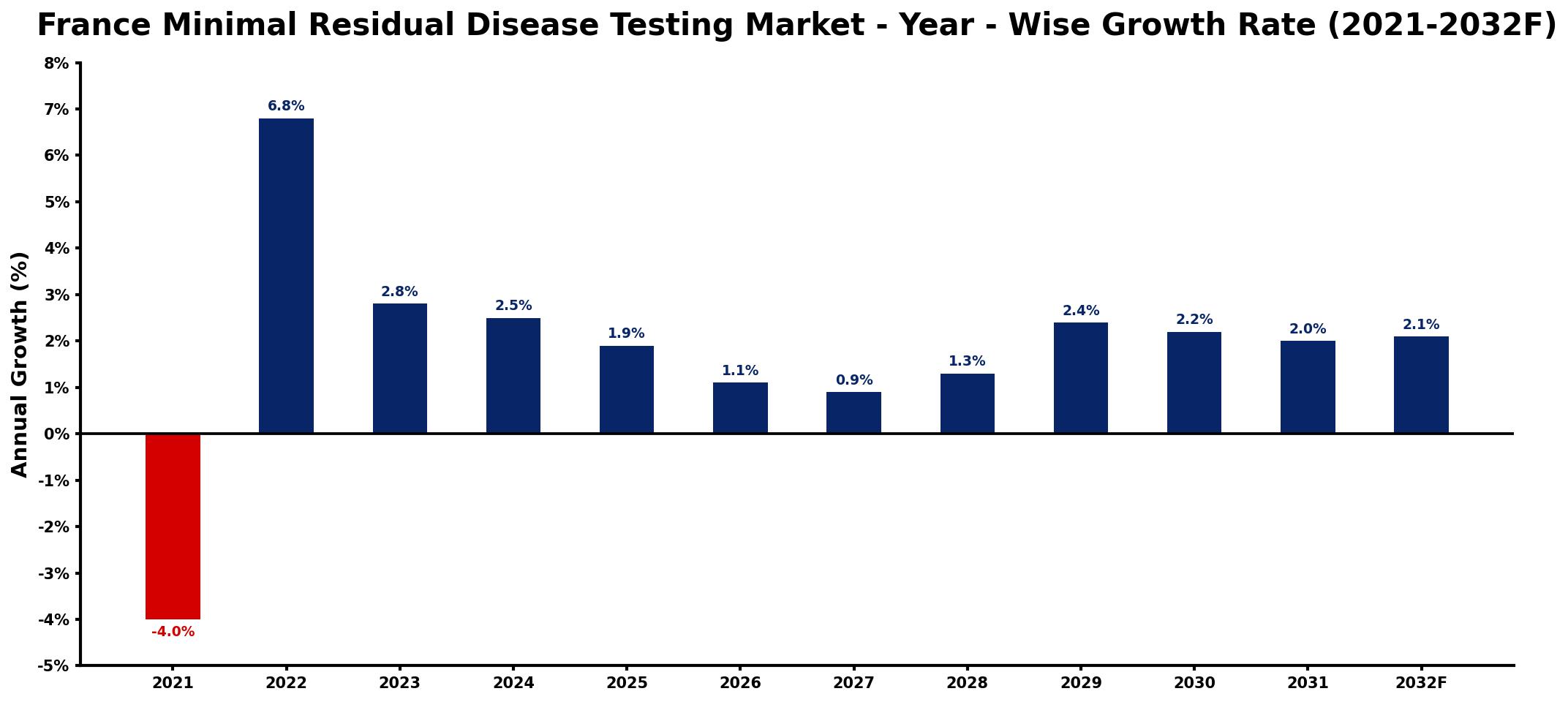
The table below presents the year‑wise growth rates along with the key drivers influencing the market
| Year | Growth Rate | Major Drivers |
| 2021 | -4.0% | Research funding decreased significantly |
| 2022 | 6.8% | Increased awareness of diagnostics |
| 2023 | 2.8% | Technological advancements in healthcare |
| 2024 | 2.5% | Growing patient population requiring monitoring |
| 2025 | 1.9% | Expansion of healthcare infrastructure investments |
| 2026 | 1.1% | Rising demand for personalized medicine |
| 2027 | 0.9% | Enhanced collaboration among research institutions |
| 2028 | 1.3% | Emergence of novel treatment protocols |
| 2029 | 2.4% | Increased adoption of preventive healthcare |
| 2030 | 2.2% | Strengthened regulatory support initiatives |
| 2031 | 2.0% | Broader access to innovative therapies |
| 2032 | 2.1% | Growing emphasis on preventive strategies |
Note: Market size estimations and growth projections presented in this report are based on 6Wresearch's proprietary forecasting methodology, utilizing the latest available industry data, government publications, and primary research inputs.
France Minimal Residual Disease Testing Market Synopsis
In France, the demand for Minimal Residual Disease (MRD) testing is surging due to its pivotal role in cancer management, particularly in hematologic cancers. As healthcare professionals emphasize personalized medicine, MRD testing has become essential for tailoring treatment plans and improving patient outcomes.
The market is supported by collaborative efforts between research institutions and industry players focused on developing innovative testing solutions. These partnerships are crucial for translating laboratory advancements into clinical practices, ensuring that patients benefit from the latest diagnostic tools.
France Minimal Residual Disease Testing Market Key Takeaways
- The market is driven by increasing awareness of MRD's significance in cancer treatment monitoring.
- Technological advancements, particularly in NGS and PCR, are enhancing MRD testing accuracy.
- There is a growing trend towards noninvasive liquid biopsy assays for MRD detection.
- Standardization of testing protocols is becoming a priority to ensure reliable results across facilities.
- Government initiatives are reinforcing the integration of MRD testing within clinical pathways.
Evaluation of Restraints in France Minimal Residual Disease Testing Market
Despite the market's growth, several restraints hinder its full potential. A prominent challenge is the lack of standardized protocols across healthcare facilities, leading to discrepancies in MRD testing results. This inconsistency complicates data interpretation and hinders the comparative assessment of treatment efficacy. Furthermore, limited access to specialized equipment and trained professionals adds another layer of difficulty, particularly in smaller healthcare settings. Addressing these barriers through structured guidelines and training initiatives will be essential to optimize MRD testing's integration into cancer care.
France Minimal Residual Disease Testing Market Trends
The landscape of the France Minimal Residual Disease testing market is characterized by several key trends. The adoption of next-generation sequencing and flow cytometry is rising sharply, providing enhanced sensitivity and specificity in MRD detection. Concurrently, there is a noticeable shift towards the development of liquid biopsy assays, which offer a less invasive approach for monitoring residual disease. Additionally, ongoing efforts to standardize testing protocols are gaining traction, aimed at ensuring comparability and reliability across various testing environments. This evolution aligns with the broader shift towards personalized medicine and optimized patient care in oncology.
France Minimal Residual Disease Testing Market Opportunities
Investment opportunities within the France Minimal Residual Disease testing market are robust and multifaceted. With increasing demand for precision oncology, companies that innovate in MRD testing technologies, particularly those utilizing NGS and PCR methods, are likely to find significant growth prospects. Collaborations with healthcare providers and academic institutions to facilitate the implementation of MRD testing in clinical settings can also yield substantial benefits. As the market matures, there will be ample opportunity for stakeholders to develop cost-effective and accessible MRD testing solutions, ensuring broader adoption across the healthcare system.
Government Initiatives in the France Minimal Residual Disease Testing Market
The French government has established several initiatives to enhance the integration of Minimal Residual Disease testing into the healthcare framework. The French National Cancer Institute (INCa) has set forth guidelines to standardize the application of MRD testing across various cancer types. Additionally, the inclusion of MRD testing in the list of reimbursable medical procedures by the French Ministry of Health illustrates a commitment to facilitating access to advanced diagnostic technologies. These efforts are indicative of the government's recognition of MRD testing's critical role in improving cancer management outcomes.
Future Insights of the France Minimal Residual Disease Testing Market
Looking ahead, the France Minimal Residual Disease Testing Market is poised for substantial growth from 2026 to 2032. The increasing focus on personalized medicine and targeted therapies will drive demand for precise MRD detection methods. As research initiatives continue to enhance testing methodologies and improve accuracy, healthcare providers will increasingly rely on MRD testing for early detection and ongoing monitoring of cancer treatments. The trend toward liquid biopsies will further solidify MRD testing's role in patient management, ensuring its place at the forefront of oncology diagnostics.
France Minimal Residual Disease Testing Market Latest Developments (2025 - 2026)
In recent months, there has been a notable uptick in collaborations between diagnostic companies and clinical research institutions aimed at advancing MRD testing methodologies. These partnerships focus on leveraging technological innovations to develop more sensitive and accurate testing options. Additionally, educational programs are being launched to train healthcare professionals on standardized MRD testing protocols. Such initiatives are crucial for enhancing the reliability of MRD testing results and promoting its adoption across diverse clinical settings.
France Minimal Residual Disease Testing Market - Key Attractiveness of the Report
- 10 Years of Market Numbers
- Historical Data Starting from 2022 to 2025
- Base Year: 2025
- Forecast Data until 2032
- Key Performance Indicators Impacting the Market
- Major Upcoming Developments and Projects
Key Highlights of the Report:
- France Minimal Residual Disease Testing Market Outlook
- Market Size of France Minimal Residual Disease Testing Market, 2025
- Forecast of France Minimal Residual Disease Testing Market, 2032
- Historical Data and Forecast of France Minimal Residual Disease Testing Revenues & Volume for the Period 2022-2032F
- France Minimal Residual Disease Testing Market Trend Evolution
- France Minimal Residual Disease Testing Market Drivers and Challenges
- France Minimal Residual Disease Testing Price Trends
- France Minimal Residual Disease Testing Porter's Five Forces
- France Minimal Residual Disease Testing Industry Life Cycle
- Historical Data and Forecast of France Minimal Residual Disease Testing Market Revenues & Volume By Application for the Period 2022-2032F
- Historical Data and Forecast of France Minimal Residual Disease Testing Market Revenues & Volume By Hematological Malignancy for the Period 2022-2032F
- Historical Data and Forecast of France Minimal Residual Disease Testing Market Revenues & Volume By Solid Tumor for the Period 2022-2032F
- Historical Data and Forecast of France Minimal Residual Disease Testing Market Revenues & Volume By End User for the Period 2022-2032F
- Historical Data and Forecast of France Minimal Residual Disease Testing Market Revenues & Volume By Hospital and Specialty Clinics for the Period 2022-2032F
- Historical Data and Forecast of France Minimal Residual Disease Testing Market Revenues & Volume By Diagnostic Laboratories for the Period 2022-2032F
- Historical Data and Forecast of France Minimal Residual Disease Testing Market Revenues & Volume By Research Institutions for the Period 2022-2032F
- Historical Data and Forecast of France Minimal Residual Disease Testing Market Revenues & Volume By Other for the Period 2022-2032F
- France Minimal Residual Disease Testing Import Export Trade Statistics
- Market Opportunity Assessment By Application
- Market Opportunity Assessment By End User
- France Minimal Residual Disease Testing Top Companies Market Share
- France Minimal Residual Disease Testing Competitive Benchmarking By Technical and Operational Parameters
- France Minimal Residual Disease Testing Company Profiles
- France Minimal Residual Disease Testing Key Strategic Recommendations






































