France Natural Fragrance Market Size, Share & Growth Rate
The France Natural Fragrance Market was estimated at USD 125 Million in 2025 and is projected to reach USD 138 Million by 2032, growing at a CAGR of 1.4% from 2026 to 2032. This growth trajectory is largely fueled by an increasing consumer shift towards natural and sustainable products, which aligns with broader wellness and ethical consumption trends. As French consumers become more discerning about ingredients and their origins, the demand for natural fragrances, characterized by transparency and environmental responsibility, is expected to rise steadily.
France Natural Fragrance Market Year-wise Growth Rate and Key Drivers
This graph highlights how the France Natural Fragrance Market has steadily grown over the years, supported by major growth factors.
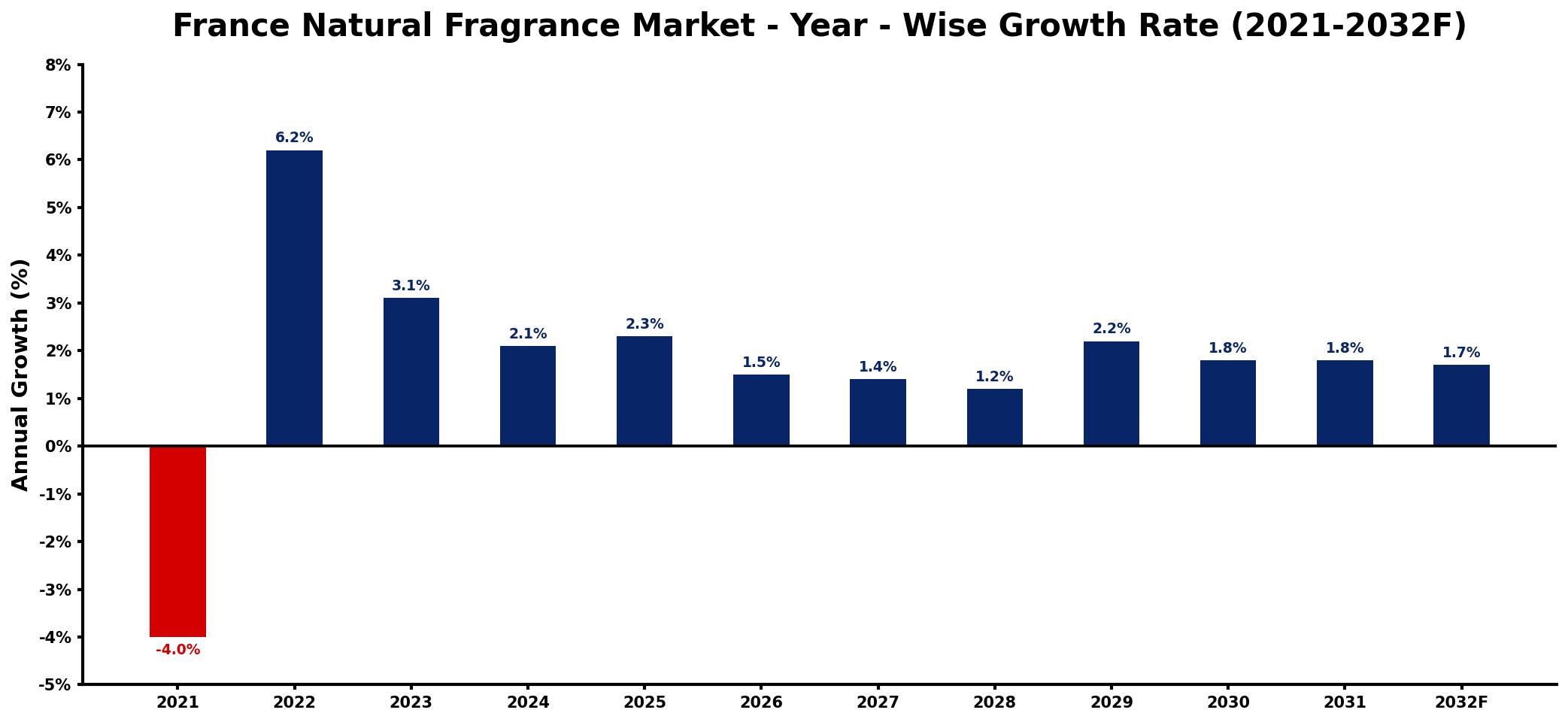
The table below presents the year‑wise growth rates along with the key drivers influencing the market
| Year | Growth Rate | Major Drivers |
| 2021 | -4.0% | Consumer preferences shifted towards sustainability |
| 2022 | 6.2% | Rising awareness of eco-friendly options |
| 2023 | 3.1% | Increased investment in sustainable sourcing |
| 2024 | 2.1% | Growing popularity of artisanal products |
| 2025 | 2.3% | Expansion of online retail channels |
| 2026 | 1.5% | Emergence of new market entrants |
| 2027 | 1.4% | Strengthened supply chain partnerships |
| 2028 | 1.2% | growing regional consumption patterns |
| 2029 | 2.2% | Diversification into wellness sectors |
| 2030 | 1.8% | Collaboration with lifestyle brands |
| 2031 | 1.8% | Adoption of innovative packaging solutions |
| 2032 | 1.7% | Focus on personalized consumer experiences |
Note: Market size estimations and growth projections presented in this report are based on 6Wresearch's proprietary forecasting methodology, utilizing the latest available industry data, government publications, and primary research inputs.
France Natural Fragrance Market Synopsis
Recently, the France Natural Fragrance Market has gained substantial momentum, driven by heightened consumer awareness and a preference for products crafted from botanical sources. However, as the market matures, stakeholders must navigate complexities around sourcing, competition from synthetic alternatives, and compliance with stringent regulations.
Moving forward, the emphasis on sustainability and ethical sourcing will continue to dominate the agenda, shaping product innovations and marketing strategies. The market's future hinges on the ability of manufacturers to offer unique, high-quality natural fragrances that resonate with health-conscious consumers.
France Natural Fragrance Market Key Takeaways
- Natural fragrances are increasingly sought after by consumers prioritizing sustainability and authenticity.
- Manufacturers emphasize ethical sourcing and transparency in their supply chains, driving product differentiation.
- The market faces challenges from sourcing sustainable ingredients and competition with synthetic fragrances.
- Government regulations are crucial in shaping market dynamics and ensuring compliance with safety standards.
- Rising trends in wellness and clean beauty contribute to the increasing demand for natural fragrance products.
Evaluation of Restraints in France Natural Fragrance Market
Despite its promising growth, the France Natural Fragrance Market grapples with several restraints that limit its potential. One significant challenge is the difficulty in consistently sourcing sustainable and ethically harvested natural ingredients, which is critical for maintaining product integrity and meeting consumer expectations. Moreover, ensuring traceability and authenticity in natural fragrance products remains a concern as consumers become more discerning. Additionally, manufacturers must continuously innovate to differentiate their offerings in a market increasingly influenced by synthetic fragrances, which are often more cost-effective and readily available. These factors collectively place pressure on producers to balance quality, innovation, and compliance in a competitive landscape.
France Natural Fragrance Market Trends
Several trends are currently shaping the France Natural Fragrance Market. Notably, the rise of clean beauty continues to drive consumer preferences, pushing brands to offer more products with transparent ingredient lists. Additionally, the integration of advanced technology in fragrance formulation is fostering innovative approaches to scent development, allowing for unique and diverse product offerings. Furthermore, increased interest in aromatherapy and holistic wellness is expanding the market's reach beyond traditional fragrances into areas like personal care and well-being, indicating a broader acceptance of natural aromatics.
France Natural Fragrance Market Opportunities
The France Natural Fragrance Market presents numerous opportunities for growth and investment. As consumers seek personalized experiences, the demand for customized fragrance solutions is on the rise, encouraging brands to explore bespoke offerings. Additionally, expanding awareness around mental health and well-being opens avenues for aromatherapy-based products that harness the benefits of natural fragrances. Collaborations with wellness brands and the development of multi-purpose products can further enhance market potential, making it an exciting space for innovation.
Government Initiatives in the France Natural Fragrance Market
Government regulations in France play a pivotal role in the natural fragrance market, emphasizing consumer safety and environmental sustainability. Policies governing the use of natural ingredients ensure that products meet rigorous safety standards, while initiatives promoting sustainable sourcing practices support the ethical dimensions of ingredient procurement. Furthermore, the government encourages research in fragrance chemistry, aiming to enhance the biodiversity of natural sources and the overall quality of natural fragrance offerings. Such initiatives not only bolster market credibility but also help cultivate a thriving environment for natural fragrance producers.
Future Insights of the France Natural Fragrance Market
Looking ahead to the period from 2026 to 2032, the France Natural Fragrance Market is poised for steady growth, driven by the persistent consumer demand for sustainable and authentic products. As regulatory frameworks tighten and consumer awareness escalates, companies that prioritize transparency, ethical sourcing, and innovative formulations will likely find a competitive edge. The market's evolution will also be characterized by advancements in technology and an increasing focus on holistic wellness, positioning natural fragrances as integral components of modern personal care regimens.
France Natural Fragrance Market Latest Developments (2025 - 2026)
In recent months, the France Natural Fragrance Market has witnessed notable developments as manufacturers respond to shifting consumer preferences and regulatory changes. Companies are increasingly launching products that highlight their commitment to sustainability and ethical practices. Moreover, there has been a surge in partnerships between natural fragrance producers and wellness brands, creating synergies that tap into the growing consumer interest in holistic health. Innovations in scent delivery and formulation techniques are also emerging, allowing brands to offer more personalized and engaging fragrance experiences.
France Natural Fragrance Market - Key Attractiveness of the Report
- 10 Years of Market Numbers
- Historical Data Starting from 2022 to 2025
- Base Year: 2025
- Forecast Data until 2032
- Key Performance Indicators Impacting the Market
- Major Upcoming Developments and Projects
Key Highlights of the Report:
- France Natural Fragrance Market Outlook
- Market Size of France Natural Fragrance Market, 2025
- Forecast of France Natural Fragrance Market, 2032
- Historical Data and Forecast of France Natural Fragrance Revenues & Volume for the Period 2022-2032F
- France Natural Fragrance Market Trend Evolution
- France Natural Fragrance Market Drivers and Challenges
- France Natural Fragrance Price Trends
- France Natural Fragrance Porter's Five Forces
- France Natural Fragrance Industry Life Cycle
- Historical Data and Forecast of France Natural Fragrance Market Revenues & Volume By Ingredient for the Period 2022-2032F
- Historical Data and Forecast of France Natural Fragrance Market Revenues & Volume By Essential Oils for the Period 2022-2032F
- Historical Data and Forecast of France Natural Fragrance Market Revenues & Volume By Natural Extracts for the Period 2022-2032F
- Historical Data and Forecast of France Natural Fragrance Market Revenues & Volume By Type for the Period 2022-2032F
- Historical Data and Forecast of France Natural Fragrance Market Revenues & Volume By Top note for the Period 2022-2032F
- Historical Data and Forecast of France Natural Fragrance Market Revenues & Volume By Middle Note for the Period 2022-2032F
- Historical Data and Forecast of France Natural Fragrance Market Revenues & Volume By Base Note for the Period 2022-2032F
- Historical Data and Forecast of France Natural Fragrance Market Revenues & Volume By Application for the Period 2022-2032F
- Historical Data and Forecast of France Natural Fragrance Market Revenues & Volume By Fine Fragrances for the Period 2022-2032F
- Historical Data and Forecast of France Natural Fragrance Market Revenues & Volume By Personal Care & Cosmetics for the Period 2022-2032F
- Historical Data and Forecast of France Natural Fragrance Market Revenues & Volume By Household Care for the Period 2022-2032F
- France Natural Fragrance Import Export Trade Statistics
- Market Opportunity Assessment By Ingredient
- Market Opportunity Assessment By Type
- Market Opportunity Assessment By Application
- France Natural Fragrance Top Companies Market Share
- France Natural Fragrance Competitive Benchmarking By Technical and Operational Parameters
- France Natural Fragrance Company Profiles
- France Natural Fragrance Key Strategic Recommendations






































