France Oilfield Air Drilling Market Size, Share & Growth Rate
The France Oilfield Air Drilling Market was estimated at USD 318 Million in 2025 and is projected to reach USD 409 Million by 2032, growing at a CAGR of 3.7% from 2026 to 2032. This upward trajectory is driven by a blend of increasing environmental regulations and a growing shift among operators towards sustainable drilling practices. Additionally, the rising demand for efficiency in challenging geological formations further supports the expansion of air drilling techniques across the country.
France Oilfield Air Drilling Market Year-wise Growth Rate and Key Drivers
This graph highlights how the France Oilfield Air Drilling Market has steadily grown over the years, supported by major growth factors.
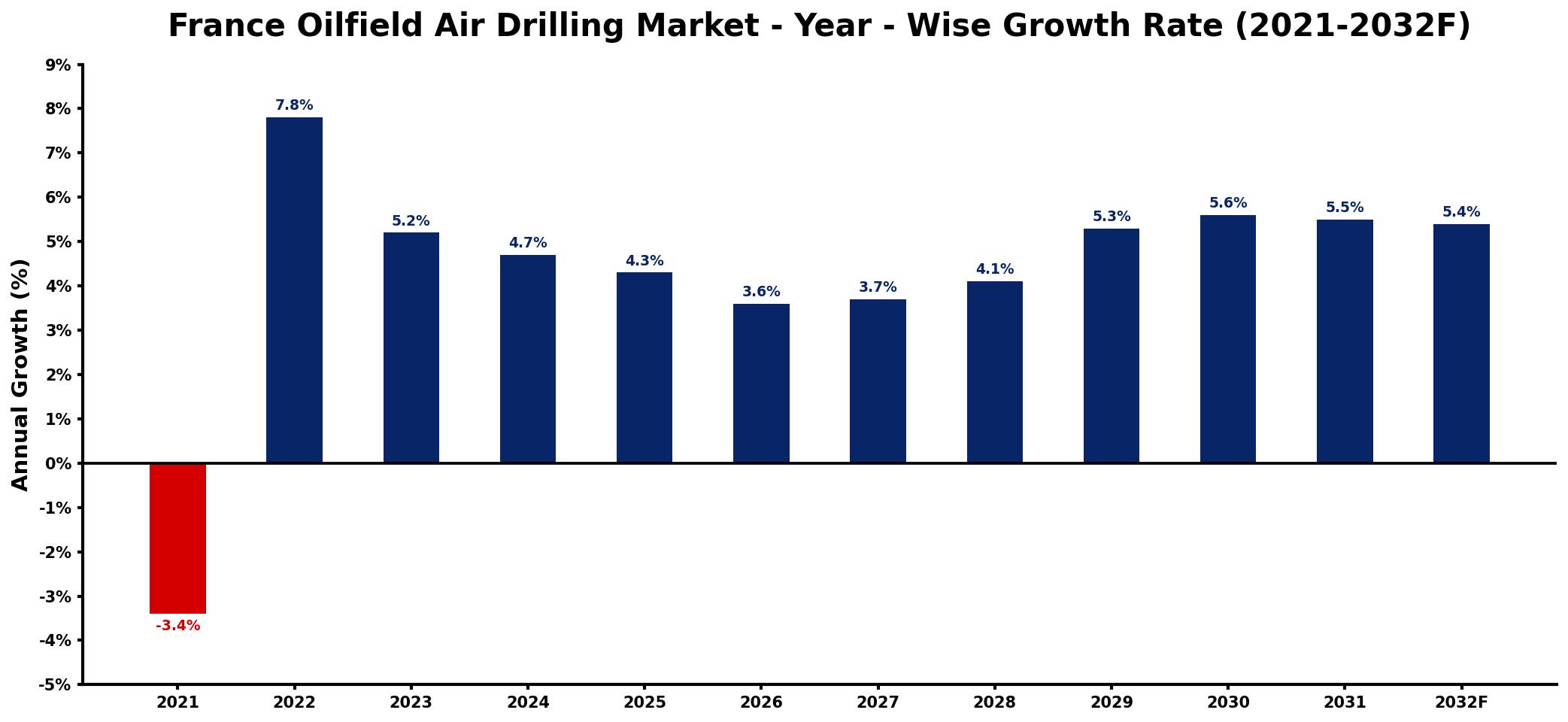
The table below presents the year‑wise growth rates along with the key drivers influencing the market
| Year | Growth Rate | Major Drivers |
| 2021 | -3.4% | decrease in exploration activities |
| 2022 | 7.8% | rising demand for energy solutions |
| 2023 | 5.2% | increased investment in technology |
| 2024 | 4.7% | expansion of renewable energy projects |
| 2025 | 4.3% | growth in emerging markets |
| 2026 | 3.6% | enhanced environmental regulations compliance |
| 2027 | 3.7% | increased focus on efficiency improvements |
| 2028 | 4.1% | higher global energy consumption rates |
| 2029 | 5.3% | technological advancements driving innovation |
| 2030 | 5.6% | growing partnerships in energy sector |
| 2031 | 5.5% | strengthened supply chain collaborations |
| 2032 | 5.4% | growing commercial sector adoption |
Note: Market size estimations and growth projections presented in this report are based on 6Wresearch's proprietary forecasting methodology, utilizing the latest available industry data, government publications, and primary research inputs.
France Oilfield Air Drilling Market Synopsis
Recent developments in the France Oilfield Air Drilling Market reveal a significant transition towards air drilling methods, which provide notable environmental benefits compared to traditional drilling fluids. This method not only conserves water but also reduces waste disposal challenges, appealing to a sector that increasingly prioritizes sustainability.
Moreover, air drilling offers enhanced operational efficiency, allowing for faster drilling speeds and improved accuracy in complex geological conditions. As the market continues to evolve, key stakeholders are exploring innovative technologies to further enhance these advantages, positioning air drilling as a viable alternative for future oilfield operations.
France Oilfield Air Drilling Market Key Takeaways
- The market is witnessing a transformation towards sustainable drilling practices driven by strict environmental regulations.
- Technological advancements, such as automation and real-time data analytics, are enhancing drilling efficiency and safety.
- Investment opportunities in air drilling equipment and services are expanding as operators seek cost-effective solutions.
- Challenges remain, including regulatory hurdles and the necessity for skilled personnel in air drilling techniques.
- Overall market growth is supported by the rising exploration of unconventional oil and gas reserves within France.
Evaluation of Restraints in France Oilfield Air Drilling Market
The France Oilfield Air Drilling Market faces several constraints that may impede its growth trajectory. High initial capital investments for air drilling equipment create a barrier for some operators, limiting their ability to transition from traditional methods. Additionally, the complexity of regulatory compliance and environmental concerns regarding air emissions can further complicate the operational landscape. Furthermore, the current skill gap in the workforce, particularly in air drilling techniques, exacerbates the challenge of adopting this innovative approach. As the market evolves, addressing these restraints will be crucial for unlocking its full potential.
France Oilfield Air Drilling Market Trends
A key trend in the France Oilfield Air Drilling Market is the increasing integration of advanced technologies aimed at improving drilling performance. The adoption of automation, alongside real-time data analytics, is becoming more prevalent as companies strive to minimize downtime and enhance productivity. Additionally, theres a concerted focus on environmental sustainability, pushing operators towards air drilling techniques that significantly reduce water usage and waste generation. The trend towards innovation is evident, with ongoing research and development efforts directed at creating robust air drilling solutions capable of overcoming the challenges posed by various terrains.
France Oilfield Air Drilling Market Opportunities
Investment opportunities within the France Oilfield Air Drilling Market are expanding, particularly in the area of equipment manufacturing and service provision. As environmental concerns take center stage, there is a significant demand for technologies that facilitate efficient air drilling. Companies that can deliver innovative air drilling solutions tailored to challenging geological conditions stand to gain substantial market traction. Furthermore, the increasing number of oilfield exploration projects emphasizes the need for cost-effective drilling methods, making this an opportune time for investors to capitalize on the market's growth potential.
Government Initiatives in the France Oilfield Air Drilling Market
The French government has implemented a series of stringent environmental regulations to guide the oilfield air drilling sector. These policies aim to minimize environmental impacts, particularly in terms of air emissions and waste management practices. Regulatory frameworks also emphasize safety standards, ensuring that operations do not compromise the well-being of workers and nearby communities. Compliance with these initiatives is vital for companies operating in the air drilling domain, shaping a sustainable and responsible industry in France.
Future Insights of the France Oilfield Air Drilling Market
Looking ahead to 2026-2032, the outlook for the France Oilfield Air Drilling Market is optimistic, bolstered by increased investments in oil and gas exploration. The growing focus on advanced air drilling technologies is expected to not only enhance operational efficiency but also reduce overall costs. As exploration efforts pivot towards unconventional oil and gas reserves, such as shale formations, the demand for air drilling techniques is likely to escalate. However, potential regulatory challenges and volatile oil prices may influence market dynamics, necessitating strategic adaptability among stakeholders.
France Oilfield Air Drilling Market Latest Developments (2025 - 2026)
In recent months, there has been a notable uptick in the exploration of air drilling technologies across various regions in France. Companies are investing in research collaborations aimed at refining air drilling techniques to improve performance and reduce costs. Additionally, regulatory bodies have intensified their focus on compliance standards, prompting operators to enhance their environmental protocols. The industry is also observing a shift toward digital transformation, with more firms adopting data analytics tools to optimize drilling operations effectively.
France Oilfield Air Drilling Market - Key Attractiveness of the Report
- 10 Years of Market Numbers
- Historical Data Starting from 2022 to 2025
- Base Year: 2025
- Forecast Data until 2032
- Key Performance Indicators Impacting the Market
- Major Upcoming Developments and Projects
The market was estimated at USD 318 Million in 2025 and is projected to grow to USD 409 Million by 2032, representing a CAGR of 3.7% from 2026 to 2032.
Environmental regulations are prompting operators to adopt air drilling techniques, as they significantly reduce water usage and minimize waste generation, making operations more sustainable.
Automation, real-time data analytics, and digital monitoring tools are enhancing drilling efficiency and productivity, enabling operators to minimize downtime and improve safety.
Investors can capitalize on the demand for innovative air drilling solutions and technologies, particularly those focused on sustainable practices and efficiency improvements.
Strict environmental and safety regulations require companies to maintain compliance, which can influence operational decisions and investment strategies in the air drilling sector.
Key Highlights of the Report:
- France Oilfield Air Drilling Market Outlook
- Market Size of France Oilfield Air Drilling Market, 2025
- Forecast of France Oilfield Air Drilling Market, 2032
- Historical Data and Forecast of France Oilfield Air Drilling Revenues & Volume for the Period 2022-2032F
- France Oilfield Air Drilling Market Trend Evolution
- France Oilfield Air Drilling Market Drivers and Challenges
- France Oilfield Air Drilling Price Trends
- France Oilfield Air Drilling Porter's Five Forces
- France Oilfield Air Drilling Industry Life Cycle
- Historical Data and Forecast of France Oilfield Air Drilling Market Revenues & Volume By Type for the Period 2022-2032F
- Historical Data and Forecast of France Oilfield Air Drilling Market Revenues & Volume By Dust for the Period 2022-2032F
- Historical Data and Forecast of France Oilfield Air Drilling Market Revenues & Volume By Aerated fluid for the Period 2022-2032F
- Historical Data and Forecast of France Oilfield Air Drilling Market Revenues & Volume By Foam for the Period 2022-2032F
- Historical Data and Forecast of France Oilfield Air Drilling Market Revenues & Volume By Mist for the Period 2022-2032F
- Historical Data and Forecast of France Oilfield Air Drilling Market Revenues & Volume By Nitrogen membrane for the Period 2022-2032F
- France Oilfield Air Drilling Import Export Trade Statistics
- Market Opportunity Assessment By Type
- France Oilfield Air Drilling Top Companies Market Share
- France Oilfield Air Drilling Competitive Benchmarking By Technical and Operational Parameters
- France Oilfield Air Drilling Company Profiles
- France Oilfield Air Drilling Key Strategic Recommendations






































