France Physical Security Market Size & Growth Rate (2026-2032)
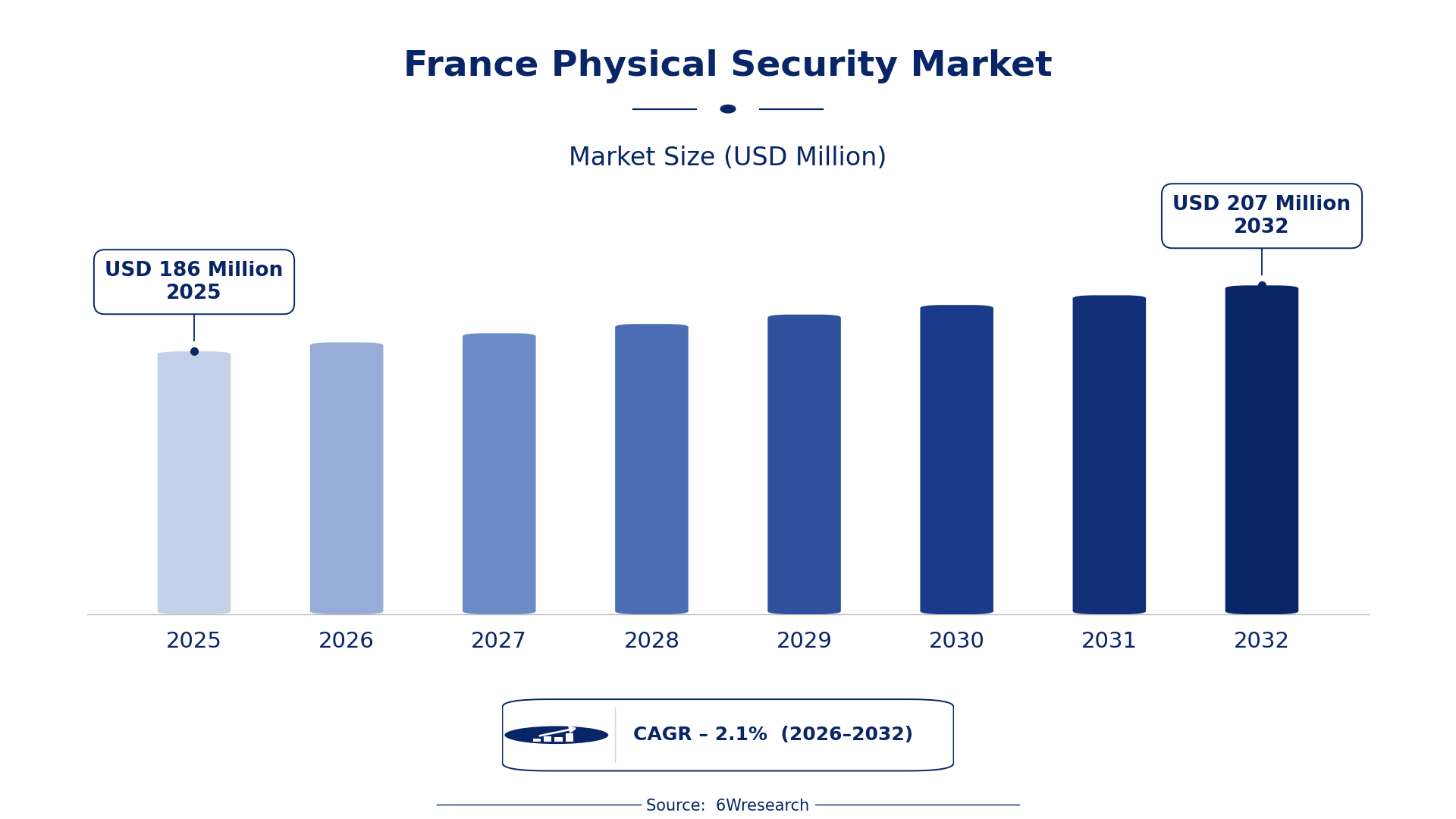
The France Physical Security Market was estimated at USD 186 Million in 2025 and is projected to reach USD 207 Million by 2032, growing at a CAGR of 2.1% from 2026 to 2032.
France Physical Security Market Synopsis
The physical security market in France has witnessed a notable surge, driven largely by escalating concerns surrounding safety across key sectors. As crime rates and threats of terrorism grow, the urgency for effective security solutions is palpable, prompting organizations to invest heavily in advanced technologies.
Looking ahead, the market is on a trajectory towards integrated security systems that combine various technologies for enhanced protection. This evolution reflects a broader shift towards smarter, interconnected solutions aimed at addressing both physical and digital security challenges.
France Physical Security Market Year-wise Growth Rate and Key Drivers
This graph illustrates the annual growth rates of the France Physical Security Market from 2021 to 2032, highlighting a steady upward trajectory and projected expansion over the forecast period.
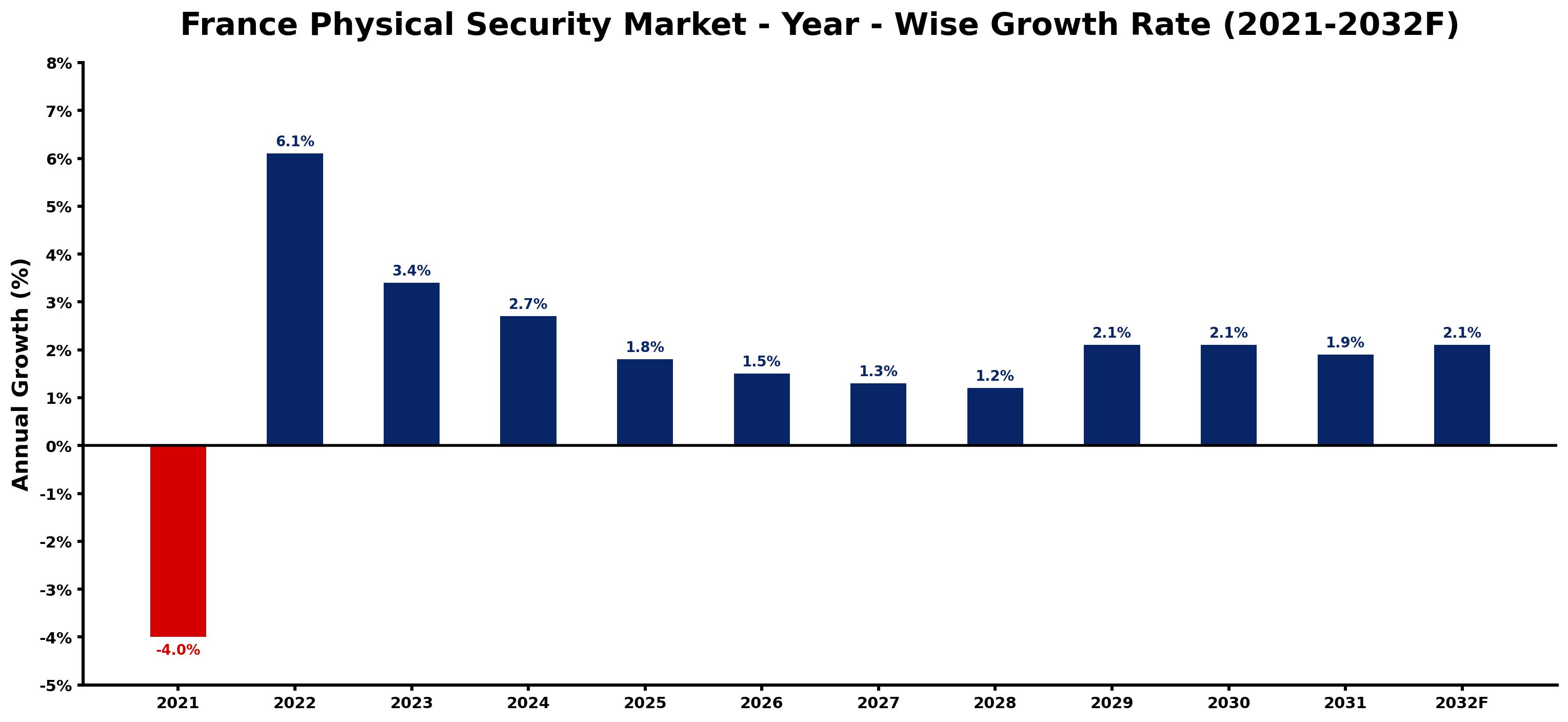
The table below presents the year‑wise growth rates along with the key drivers influencing the market
| Year | Growth Rate | Major Drivers |
| 2021 | -4.0% | COVID-19 restrictions limited security system installations. |
| 2022 | 6.1% | New cybersecurity regulations from ANSSI boosting physical security |
| 2023 | 3.4% | Increased demand for surveillance systems in retail stores |
| 2024 | 2.7% | Government funding for public safety measures post-pandemic |
| 2025 | 1.8% | Rise in theft rates driving security system investments |
| 2026 | 1.5% | Adoption of smart locks in urban residential developments |
| 2027 | 1.3% | Local security services partnering with tech startups |
| 2028 | 1.2% | Major events in Paris increasing need for security solutions |
| 2029 | 2.1% | Growing private sector spending on security personnel |
| 2030 | 2.1% | Urban development projects necessitating enhanced safety measures |
| 2031 | 1.9% | Local regulation requiring advanced fire safety systems |
| 2032 | 2.1% | Increased awareness of security threats among businesses |
Note: Market size estimations and growth projections presented in this report are based on 6Wresearch's proprietary forecasting methodology, utilizing the latest available industry data, government publications, and primary research inputs.
France Physical Security Market Key Takeaways
Below are some of the specific key takeaways from the market, including:
- Increasing adoption of AI-driven surveillance technologies enhances monitoring capabilities.
- Growing demand for integrated security systems combining video surveillance, access control, and intrusion detection.
- Focus on cybersecurity measures to safeguard physical security systems from cyber threats.
- Emergence of sustainable and energy-efficient security solutions as a market priority.
- Investment opportunities in cutting-edge technologies such as biometrics and cloud-based systems.
Evaluation of Restraints in France Physical Security Market
The France Physical Security Market faces several constraints that challenge its growth trajectory. Chief among these is the rising complexity of security threats, including cyber-physical attacks that require constantly evolving solutions. Companies must not only invest in advanced technologies but also in expertise to provide holistic security measures.
Additionally, regulatory compliance poses a significant challenge. Organizations are required to navigate a complicated legal framework concerning data privacy and security, which can slow down the implementation of necessary security measures.
France Physical Security Market Trends
Several noteworthy trends are currently shaping the France Physical Security Market. The move towards AI-powered surveillance systems is revolutionizing how threats are detected and managed. Companies are increasingly integrating multiple security systems into cohesive solutions for comprehensive protection.
There's also a noticeable shift towards sustainability, with firms seeking energy-efficient solutions that mitigate their environmental impact. As awareness of cybersecurity issues grows, integrating cybersecurity features into physical security systems has become a pressing priority, reflecting the interconnected nature of today's threats.
France Physical Security Market Opportunities
The France Physical Security Market is rife with investment opportunities across various segments. Demand for advanced technologies like video surveillance, access control, and biometrics is expanding, providing fertile ground for innovative solutions. The growing emphasis on public safety and the enhancement of critical infrastructure further drives market growth.
Collaboration with local security solution providers presents a strategic avenue for investors looking to penetrate this market. on top of that, involvement in infrastructure projects that necessitate comprehensive security measures offers substantial prospects for growth.
Government Initiatives in the France Physical Security Market
Government policies significantly influence the France Physical Security Market by prioritizing public safety and infrastructure security. Recent regulatory measures have mandated the deployment of advanced security systems in critical sectors, reinforcing the need for sophisticated solutions.
- A recently launched national strategy focused on enhancing public space surveillance capabilities has seen the introduction of state-of-the-art camera systems.
- Currently ongoing public-private partnerships are aimed at upgrading transport security measures, focusing on technological integration and collaborative response strategies.
- A planned framework for 2026 aims to establish stricter compliance protocols for data privacy in physical security systems.
- The government is promoting the adoption of smart security technologies as part of its long-term infrastructure improvement plan, set to commence in late 2025.
- Initiatives encouraging innovation in cybersecurity for physical security measures have been rolled out, aimed at addressing emerging threats.
Future Insights of the France Physical Security Market
Between 2026 and 2032, the France Physical Security Market is anticipated to evolve significantly. The integration of AI and machine learning into security solutions will drive further advancements, enhancing response times and threat detection capabilities. Organizations are likely to prioritize comprehensive systems that combine physical and digital security features to mitigate complex risks.
As government policies continue to emphasize public safety and infrastructure security, we can expect sustained market growth. The rising demand for cloud-based solutions and analytics will also shape future investments, ensuring that the market remains agile and responsive to emerging security challenges.
France Physical Security Market Latest Developments
In the last year, the France Physical Security Market has seen significant advancements, particularly in technology integration and strategic partnerships. Companies are actively responding to the growing demand for enhanced security measures, leading to innovative solutions that address both physical and cybersecurity needs.
- A major technology vendor completed the rollout of an advanced AI surveillance system in early 2025, significantly improving threat detection capabilities for urban areas.
- An ongoing initiative, started in mid-2025, focuses on enhancing access control systems across government buildings, integrating biometric technologies for improved security.
- A planned expansion of cloud-based storage solutions for video surveillance is expected to begin in late 2026, aimed at improving data accessibility and security.
- A regional operator has partnered with local authorities to implement an innovative public safety app that centralizes emergency response data and enhances communication.
- A recent product launch in Q1 2025 introduced a new line of energy-efficient security cameras, designed to meet the growing sustainability demands of modern enterprises.
France Physical Security Market - Key Attractiveness of the Report
- 10 Years of Market Numbers
- Historical Data Starting from 2022 to 2025
- Base Year: 2025
- Forecast Data until 2032
- Key Performance Indicators Impacting the Market
- Major Upcoming Developments and Projects
Key Highlights of the Report:
- France Physical Security Market Outlook
- Market Size of France Physical Security Market, 2025
- Forecast of France Physical Security Market, 2032
- Historical Data and Forecast of France Physical Security Revenues & Volume for the Period 2022-2032F
- France Physical Security Market Trend Evolution
- France Physical Security Market Drivers and Challenges
- France Physical Security Price Trends
- France Physical Security Porter's Five Forces
- France Physical Security Industry Life Cycle
- Historical Data and Forecast of France Physical Security Market Revenues & Volume By Component for the Period 2022-2032F
- Historical Data and Forecast of France Physical Security Market Revenues & Volume By Systems (PACS, PSIM, PIAM, Video Surveillance, Fire and Life Safety) for the Period 2022-2032F
- Historical Data and Forecast of France Physical Security Market Revenues & Volume By Services for the Period 2022-2032F
- Historical Data and Forecast of France Physical Security Market Revenues & Volume By Vertical for the Period 2022-2032F
- Historical Data and Forecast of France Physical Security Market Revenues & Volume By BFSI for the Period 2022-2032F
- Historical Data and Forecast of France Physical Security Market Revenues & Volume By Government for the Period 2022-2032F
- Historical Data and Forecast of France Physical Security Market Revenues & Volume By Retail for the Period 2022-2032F
- Historical Data and Forecast of France Physical Security Market Revenues & Volume By Transportation for the Period 2022-2032F
- Historical Data and Forecast of France Physical Security Market Revenues & Volume By Residential for the Period 2022-2032F
- Historical Data and Forecast of France Physical Security Market Revenues & Volume By Telecom and IT for the Period 2022-2032F
- Historical Data and Forecast of France Physical Security Market Revenues & Volume By Other Verticals (Healthcare, Manufacturing, Energy and Utilities, and Education). for the Period 2022-2032F
- Historical Data and Forecast of France Physical Security Market Revenues & Volume By Organization Size for the Period 2022-2032F
- Historical Data and Forecast of France Physical Security Market Revenues & Volume By SMEs for the Period 2022-2032F
- Historical Data and Forecast of France Physical Security Market Revenues & Volume By Large Enterprises for the Period 2022-2032F
- France Physical Security Import Export Trade Statistics
- Market Opportunity Assessment By Component
- Market Opportunity Assessment By Vertical
- Market Opportunity Assessment By Organization Size
- France Physical Security Top Companies Market Share
- France Physical Security Competitive Benchmarking By Technical and Operational Parameters
- France Physical Security Company Profiles
- France Physical Security Key Strategic Recommendations






































