Oman Physical Security Market Size & Growth Rate (2026-2032)

The Oman Physical Security Market was estimated at USD 292 Million in 2025 and is projected to reach USD 401 Million by 2032, growing at a CAGR of 5.1% from 2026 to 2032.
Oman Physical Security Market Synopsis
The increasing security concerns across multiple sectors is the driving force behind the growth of the Oman Physical Security Market. Escalating crime rates and the urgent need to protect critical infrastructure are compelling businesses and government entities to invest in advanced security solutions.
A noticeable shift toward the integration of advanced technologies marks this market. Key sectors, including government, commercial, and residential, are rapidly adopting sophisticated systems like video surveillance and biometric identification, enhancing their overall security measures.
Oman Physical Security Market Year-wise Growth Rate and Key Drivers
This graph illustrates the annual growth rates of the Oman Physical Security Market from 2021 to 2032, highlighting a steady upward trajectory and projected expansion over the forecast period.
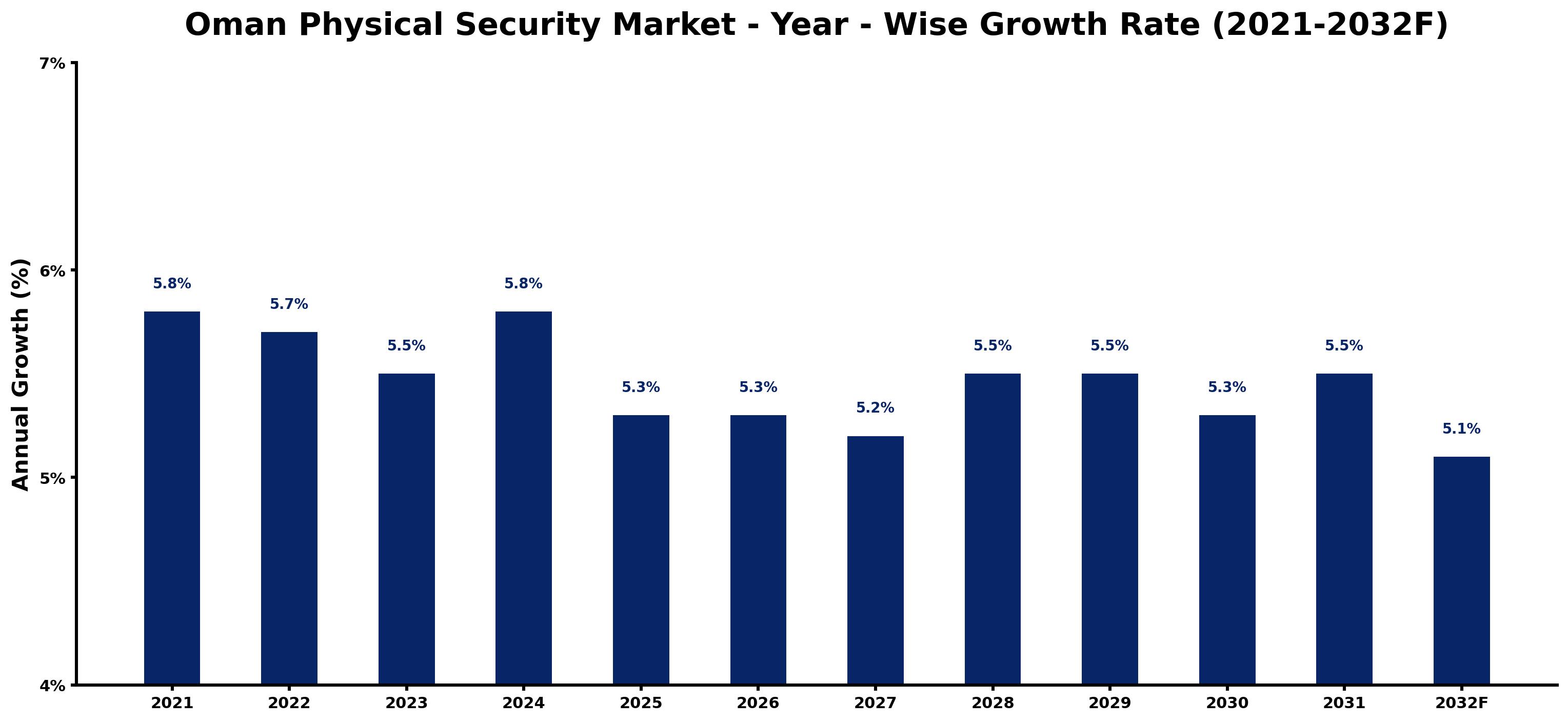
The table below presents the year‑wise growth rates along with the key drivers influencing the market
| Year | Growth Rate | Major Drivers |
| 2021 | 5.8% | Government safety regulations boosting security system installations. |
| 2022 | 5.7% | Increased tourism driving demand for enhanced public security. |
| 2023 | 5.5% | Rising urbanization necessitating advanced monitoring systems. |
| 2024 | 5.8% | Oman's Vision 2040 prioritizing national safety enhancements. |
| 2025 | 5.3% | Growing corporate sector investing in comprehensive security solutions. |
| 2026 | 5.3% | Strengthened cybersecurity threats raising physical security importance. |
| 2027 | 5.2% | Development of strategic projects enhancing perimeter security needs. |
| 2028 | 5.5% | Greater focus on private property security upgrades. |
| 2029 | 5.5% | Increased international events heightening security requirements. |
| 2030 | 5.3% | Regulatory body promoting advanced security technology adoption. |
| 2031 | 5.5% | Local manufacturing initiatives reducing reliance on imported systems. |
| 2032 | 5.1% | Community-driven safety initiatives amplifying physical security awareness. |
Note: Market size estimations and growth projections presented in this report are based on 6Wresearch's proprietary forecasting methodology, utilizing the latest available industry data, government publications, and primary research inputs.
Oman Physical Security Market Key Takeaways
Below are some of the specific key takeaways from the market, including:
- The market is currently experiencing heightened demand for integrated security solutions that offer real-time monitoring.
- Government initiatives are significantly influencing investment strategies in the physical security sector.
- Cloud-based security solutions are gaining traction for their flexibility and remote management capabilities.
- Ongoing investments in advanced biometric and access control technologies are reshaping security protocols.
- Geopolitical factors continue to shape the urgency for improved physical security measures across various sectors.
Evaluation of Restraints in Oman Physical Security Market
Despite its growth, the Oman Physical Security Market faces several constraints. A significant challenge is the general lack of awareness regarding the importance of comprehensive security solutions. Many organizations are slow to allocate sufficient budgets for these investments, leading to inadequate protection levels.
Additionally, the market is fragmented due to the presence of numerous unorganized small-scale providers, which can lead to inconsistent service quality. The fast-paced technological advancements in security solutions demand ongoing investments, presenting a burden for organizations with limited resources.
Oman Physical Security Market Trends
Key trends driving the Oman Physical Security Market include the increased adoption of video surveillance and access control systems. Organizations are now focusing on integrated security measures that provide centralized monitoring, allowing for swift response to potential threats.
There is a growing preference for cloud-based solutions, which facilitate remote management and scalability. This trend is accompanied by a heightened emphasis on cybersecurity, ensuring that physical security systems are safeguarded against potential cyber threats.
Oman Physical Security Market Opportunities
The market presents substantial investment opportunities across various segments, particularly in video surveillance and access control technologies. Growing awareness of security needs in both commercial and residential areas makes this an attractive space for potential investors.
Partnerships with local security providers can yield profitable returns, while advancements in technology create avenues for enhanced service offerings. The government's ongoing commitment to strengthening security infrastructure in critical sectors amplifies the investment potential significantly.
Government Initiatives in the Oman Physical Security Market
Government policies play a crucial role in shaping the Oman Physical Security Market, with a focus on enhancing national security and protecting vital infrastructure. Recent regulations mandate the implementation of advanced security solutions in sectors like oil and gas and banking, underscoring the importance of proactive measures against security threats.
- A national regulatory framework launched in early 2025 requiring enhanced surveillance systems for critical infrastructure.
- A current initiative to integrate biometric systems across government facilities is underway, with plans to expand to commercial sectors by late 2026.
- Funding has been allocated for a comprehensive upgrade of existing security technology across key industries.
- A public-private partnership initiative planned for 2027 aims to boost investment in cyber-physical security measures.
Future Insights of the Oman Physical Security Market
Looking forward, the Oman Physical Security Market is set for steady expansion. Rising crime rates and increasing infrastructural investments will continue to drive demand for effective security solutions. The focus will remain on enhancing cybersecurity and integrating innovative technologies into existing frameworks.
on top of that, as awareness around security threats escalates, both public and private sectors will seek to bolster their protection measures. This ongoing evolution will present ample opportunities for companies to innovate and adapt to meet emerging security needs.
Oman Physical Security Market Latest Developments
In the last year, the Oman Physical Security Market has seen a surge in activity as organizations prioritize security enhancements. The trend towards adopting state-of-the-art technology is becoming increasingly evident, with businesses looking for integrated security solutions that also address cybersecurity concerns.
- A major technology vendor completed the rollout of an advanced video surveillance system for a key commercial sector in early 2025.
- A leading regional operator is currently implementing a nationwide biometric access control system, expected to finish by mid-2026.
- Several partnerships between local firms and international providers have been established to bolster offerings in cloud-based security solutions, launched in Q1 2025.
- Plans for a new public-private collaboration are set to kick off in late 2026, focusing on comprehensive perimeter security improvements.
Oman Physical Security Market - Key Attractiveness of the Report
- 10 Years of Market Numbers
- Historical Data Starting from 2022 to 2025
- Base Year: 2025
- Forecast Data until 2032
- Key Performance Indicators Impacting the Market
- Major Upcoming Developments and Projects
Key Highlights of the Report:
- Oman Physical Security Market Outlook
- Market Size of Oman Physical Security Market, 2025
- Forecast of Oman Physical Security Market, 2032
- Historical Data and Forecast of Oman Physical Security Revenues & Volume for the Period 2022-2032F
- Oman Physical Security Market Trend Evolution
- Oman Physical Security Market Drivers and Challenges
- Oman Physical Security Price Trends
- Oman Physical Security Porter's Five Forces
- Oman Physical Security Industry Life Cycle
- Historical Data and Forecast of Oman Physical Security Market Revenues & Volume By Component for the Period 2022-2032F
- Historical Data and Forecast of Oman Physical Security Market Revenues & Volume By Systems (PACS, PSIM, PIAM, Video Surveillance, Fire and Life Safety) for the Period 2022-2032F
- Historical Data and Forecast of Oman Physical Security Market Revenues & Volume By Services for the Period 2022-2032F
- Historical Data and Forecast of Oman Physical Security Market Revenues & Volume By Vertical for the Period 2022-2032F
- Historical Data and Forecast of Oman Physical Security Market Revenues & Volume By BFSI for the Period 2022-2032F
- Historical Data and Forecast of Oman Physical Security Market Revenues & Volume By Government for the Period 2022-2032F
- Historical Data and Forecast of Oman Physical Security Market Revenues & Volume By Retail for the Period 2022-2032F
- Historical Data and Forecast of Oman Physical Security Market Revenues & Volume By Transportation for the Period 2022-2032F
- Historical Data and Forecast of Oman Physical Security Market Revenues & Volume By Residential for the Period 2022-2032F
- Historical Data and Forecast of Oman Physical Security Market Revenues & Volume By Telecom and IT for the Period 2022-2032F
- Historical Data and Forecast of Oman Physical Security Market Revenues & Volume By Other Verticals (Healthcare, Manufacturing, Energy and Utilities, and Education). for the Period 2022-2032F
- Historical Data and Forecast of Oman Physical Security Market Revenues & Volume By Organization Size for the Period 2022-2032F
- Historical Data and Forecast of Oman Physical Security Market Revenues & Volume By SMEs for the Period 2022-2032F
- Historical Data and Forecast of Oman Physical Security Market Revenues & Volume By Large Enterprises for the Period 2022-2032F
- Oman Physical Security Import Export Trade Statistics
- Market Opportunity Assessment By Component
- Market Opportunity Assessment By Vertical
- Market Opportunity Assessment By Organization Size
- Oman Physical Security Top Companies Market Share
- Oman Physical Security Competitive Benchmarking By Technical and Operational Parameters
- Oman Physical Security Company Profiles
- Oman Physical Security Key Strategic Recommendations






































