Kuwait Physical Security Market Size & Growth Rate (2026-2032)
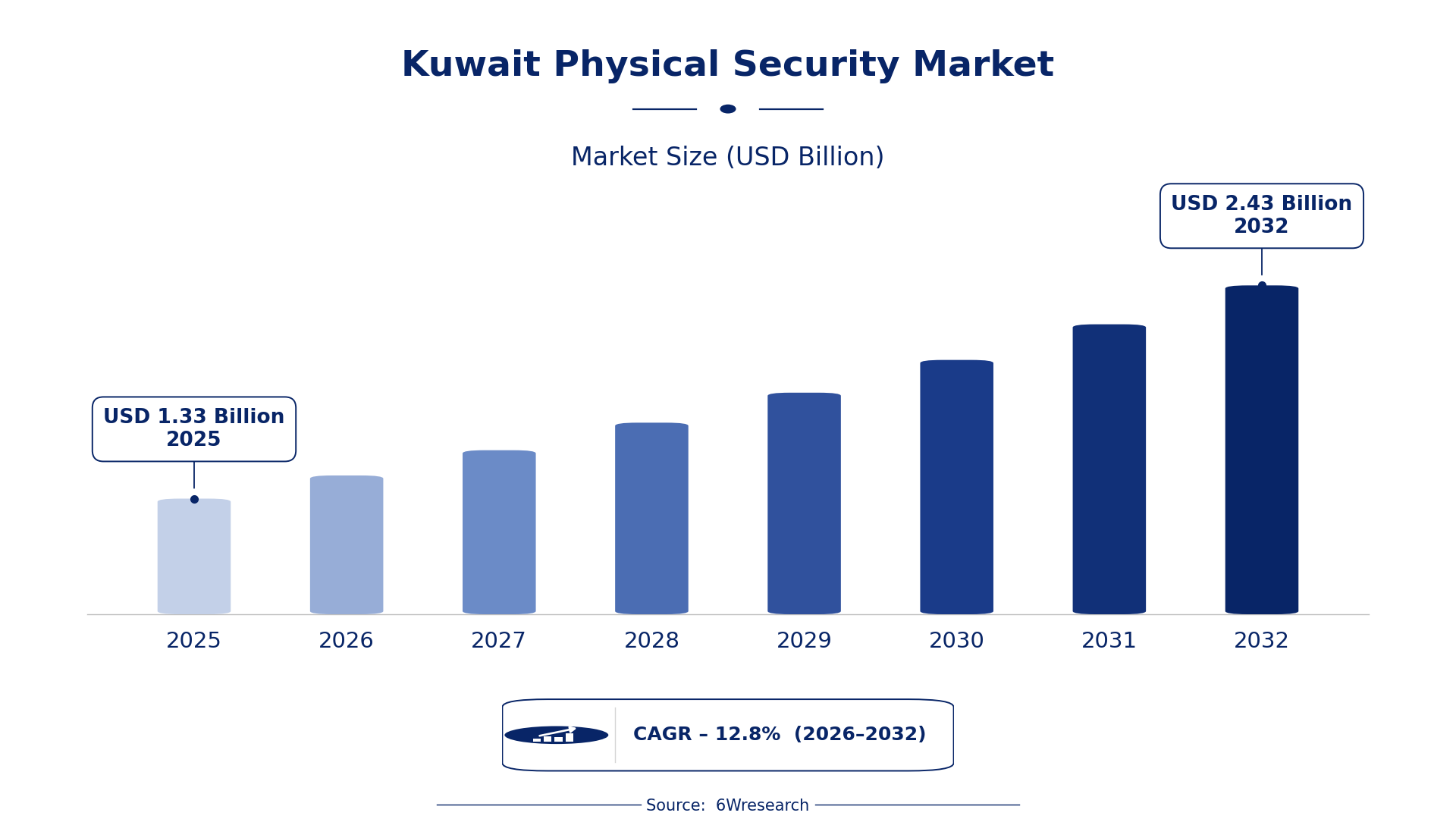
The Kuwait Physical Security Market was estimated at USD 1328 Million in 2025 and is projected to reach USD 2430 Million by 2032, growing at a CAGR of 12.8% from 2026 to 2032.
Kuwait Physical Security Market Synopsis
In Kuwait, the demand for physical security solutions is rising sharply, driven by sectors like government, oil & gas, and retail. This surge stems from escalating security concerns and an increased commitment to safeguarding public and private assets.
Technological advancements are transforming the physical security landscape in Kuwait. Organizations are increasingly adopting integrated systems featuring video surveillance, access controls, and biometric solutions to enhance their security frameworks.
Kuwait Physical Security Market Year-wise Growth Rate and Key Drivers
This graph illustrates the annual growth rates of the Kuwait Physical Security Market from 2021 to 2032, highlighting a steady upward trajectory and projected expansion over the forecast period.
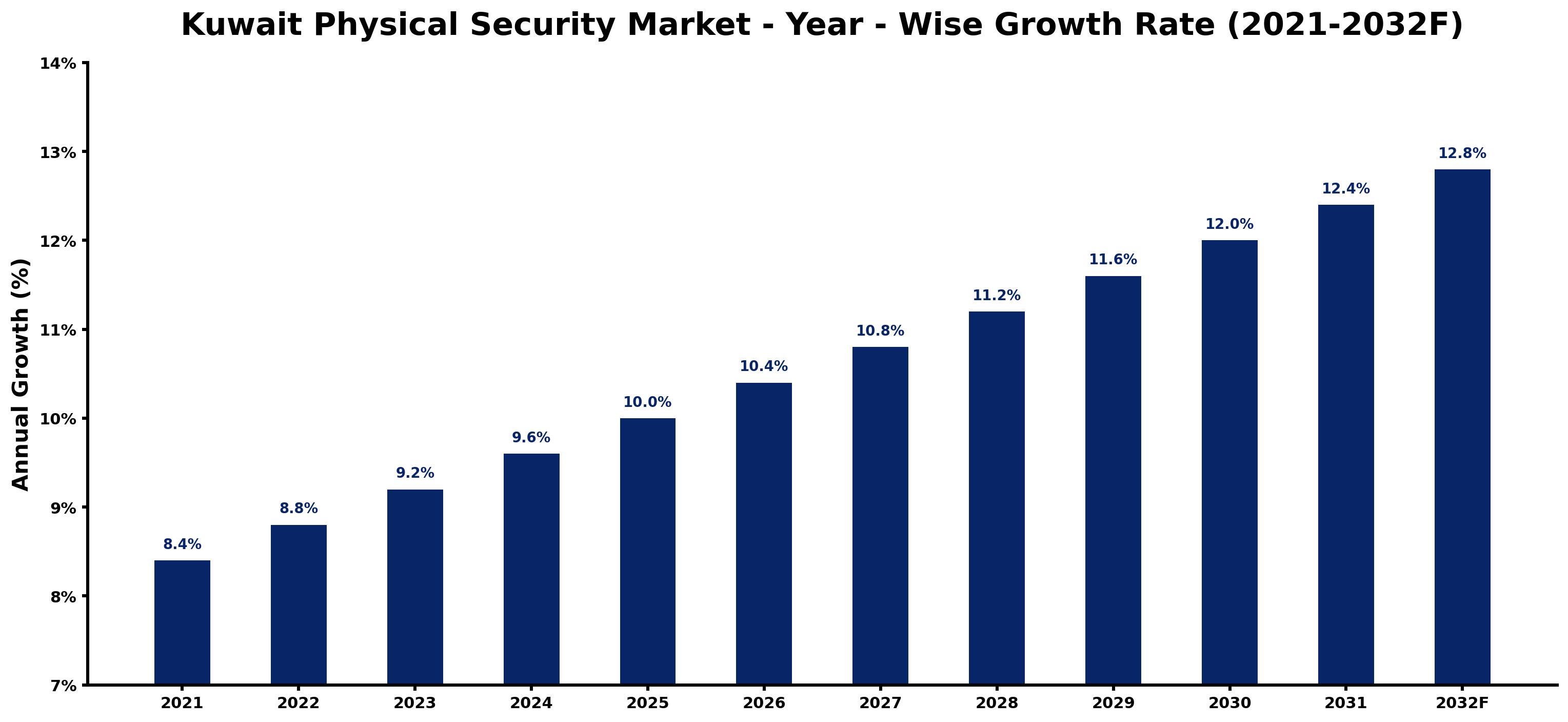
The table below presents the year‑wise growth rates along with the key drivers influencing the market
| Year | Growth Rate | Major Drivers |
| 2021 | 8.4% | Kuwait's governmental mandate for enhanced border security initiatives. |
| 2022 | 8.8% | Increased investments in cybersecurity integration for physical security. |
| 2023 | 9.2% | Rising oil sector projects fueling demand for advanced surveillance. |
| 2024 | 9.6% | Growing expatriate population drives need for residential security. |
| 2025 | 10.0% | Kuwait's hosting of international events boosts security requirements. |
| 2026 | 10.4% | Implementation of new building codes prioritizing security technology. |
| 2027 | 10.8% | Government grants encouraging adoption of smart security solutions. |
| 2028 | 11.2% | Regional geopolitical tensions heightening investments in physical security. |
| 2029 | 11.6% | Smart city projects enhancing demand for integrated security systems. |
| 2030 | 12.0% | Private sector's surge in security outsourcing for efficiency. |
| 2031 | 12.4% | Expanding tourism sector requires enhanced public safety measures. |
| 2032 | 12.8% | Ongoing construction developments necessitating advanced access control systems. |
Note: Market size estimations and growth projections presented in this report are based on 6Wresearch's proprietary forecasting methodology, utilizing the latest available industry data, government publications, and primary research inputs.
Kuwait Physical Security Market Key Takeaways
Below are some of the specific key takeaways from the market, including:
- The market is experiencing a notable shift toward advanced technology solutions, driven by heightened security demands.
- Urbanization and infrastructure development are significant factors fueling the adoption of physical security systems.
- Integration of AI and cloud-based solutions is becoming a prominent trend in the market.
- There is a growing emphasis on cybersecurity to protect physical security systems from potential threats.
- Investment opportunities are expanding in areas such as surveillance, access control, and consulting services.
Evaluation of Restraints in Kuwait Physical Security Market
Several barriers hinder the Kuwait Physical Security Market. A significant challenge is the continued reliance on traditional security measures, which limits the adoption of advanced technology solutions. Additionally, budget constraints often restrict organizations from upgrading their security frameworks. Limited awareness about sophisticated security technologies further complicates the market, as does the urgent need for skilled professionals who can effectively manage these systems. Regulatory compliance adds another layer of complexity, compelling companies to navigate a landscape of evolving threats and standards.
Kuwait Physical Security Market Trends
The market is witnessing a clear shift toward sophisticated security technologies. Video surveillance systems and access control solutions are increasingly integrated with artificial intelligence for enhanced decision-making and monitoring capabilities. on top of that, cloud-based solutions are gaining traction, enabling real-time management of security measures. Notably, the focus on cybersecurity is intensifying as businesses recognize the necessity of protecting physical systems from cyber threats.
Kuwait Physical Security Market Opportunities
Investment prospects are abundant within the Kuwait Physical Security Market. Opportunities exist in developing comprehensive surveillance systems, implementing cutting-edge access control technologies, and offering tailored cybersecurity solutions. on top of that, with the pressing need for robust protection against threats like terrorism and vandalism, there's a substantial demand for integrated security solutions. Companies providing security consulting, training, and maintenance services are also well-positioned to capitalize on this evolving market.
Government Initiatives in the Kuwait Physical Security Market
The Kuwaiti government is actively shaping the physical security market through various initiatives that prioritize public safety and the protection of critical infrastructure. A regulatory framework established to promote the adoption of advanced security technologies emphasizes compliance and quality in service delivery. Collaboration with private sector stakeholders further enhances innovation and effectiveness in security solutions.
- A comprehensive national digital infrastructure upgrade program launched recently aims to enhance surveillance capabilities across urban areas.
- Ongoing training programs designed to equip security personnel with advanced skills and knowledge are currently being implemented.
- A public-private initiative expected to expand smart city projects is planned for late 2026, which will include enhanced security measures.
- The government is reviewing existing licensing requirements for security firms to ensure compliance with industry standards, with changes anticipated in early 2026.
Future Insights of the Kuwait Physical Security Market
Looking ahead to 2026-2032, the Kuwait Physical Security Market is expected to continue its upward trajectory. The increasing focus on safety, coupled with advancements in surveillance and access control technologies, indicates significant growth potential. Integration of cloud solutions and the escalation of smart city projects will further propel the market. As urbanization progresses, businesses and government entities will increasingly invest in comprehensive security solutions, ensuring a safe environment for residents and tourists alike.
Kuwait Physical Security Market Latest Developments
Recent months have seen notable activity in the Kuwait Physical Security Market, with various advancements reflecting the sector's growth and adaptation to new challenges. Companies are launching innovative products, while collaborative efforts between public and private sectors are enhancing the security infrastructure across the nation.
- A leading technology vendor launched an advanced video surveillance solution aimed at urban environments in Q1 2025, enhancing monitoring capabilities.
- An initiative that began in mid-2025, focusing on the integration of AI analytics into existing security systems, remains underway.
- A planned expansion of access control systems in government facilities is expected to kick off in early 2026, aiming to improve security measures.
- In late 2025, a partnership was formed between local firms to develop comprehensive training programs for security personnel, enhancing skill sets nationwide.
Kuwait Physical Security Market - Key Attractiveness of the Report
- 10 Years of Market Numbers
- Historical Data Starting from 2022 to 2025
- Base Year: 2025
- Forecast Data until 2032
- Key Performance Indicators Impacting the Market
- Major Upcoming Developments and Projects
The growth is propelled by heightened security concerns in sectors like government, oil & gas, and retail, alongside technological advancements in security systems.
Key Highlights of the Report:
- Kuwait Physical Security Market Outlook
- Market Size of Kuwait Physical Security Market, 2025
- Forecast of Kuwait Physical Security Market, 2032
- Historical Data and Forecast of Kuwait Physical Security Revenues & Volume for the Period 2022-2032F
- Kuwait Physical Security Market Trend Evolution
- Kuwait Physical Security Market Drivers and Challenges
- Kuwait Physical Security Price Trends
- Kuwait Physical Security Porter's Five Forces
- Kuwait Physical Security Industry Life Cycle
- Historical Data and Forecast of Kuwait Physical Security Market Revenues & Volume By Component for the Period 2022-2032F
- Historical Data and Forecast of Kuwait Physical Security Market Revenues & Volume By Systems (PACS, PSIM, PIAM, Video Surveillance, Fire and Life Safety) for the Period 2022-2032F
- Historical Data and Forecast of Kuwait Physical Security Market Revenues & Volume By Services for the Period 2022-2032F
- Historical Data and Forecast of Kuwait Physical Security Market Revenues & Volume By Vertical for the Period 2022-2032F
- Historical Data and Forecast of Kuwait Physical Security Market Revenues & Volume By BFSI for the Period 2022-2032F
- Historical Data and Forecast of Kuwait Physical Security Market Revenues & Volume By Government for the Period 2022-2032F
- Historical Data and Forecast of Kuwait Physical Security Market Revenues & Volume By Retail for the Period 2022-2032F
- Historical Data and Forecast of Kuwait Physical Security Market Revenues & Volume By Transportation for the Period 2022-2032F
- Historical Data and Forecast of Kuwait Physical Security Market Revenues & Volume By Residential for the Period 2022-2032F
- Historical Data and Forecast of Kuwait Physical Security Market Revenues & Volume By Telecom and IT for the Period 2022-2032F
- Historical Data and Forecast of Kuwait Physical Security Market Revenues & Volume By Other Verticals (Healthcare, Manufacturing, Energy and Utilities, and Education). for the Period 2022-2032F
- Historical Data and Forecast of Kuwait Physical Security Market Revenues & Volume By Organization Size for the Period 2022-2032F
- Historical Data and Forecast of Kuwait Physical Security Market Revenues & Volume By SMEs for the Period 2022-2032F
- Historical Data and Forecast of Kuwait Physical Security Market Revenues & Volume By Large Enterprises for the Period 2022-2032F
- Kuwait Physical Security Import Export Trade Statistics
- Market Opportunity Assessment By Component
- Market Opportunity Assessment By Vertical
- Market Opportunity Assessment By Organization Size
- Kuwait Physical Security Top Companies Market Share
- Kuwait Physical Security Competitive Benchmarking By Technical and Operational Parameters
- Kuwait Physical Security Company Profiles
- Kuwait Physical Security Key Strategic Recommendations






































