Russia Physical Security Market Size & Growth Rate (2026-2032)
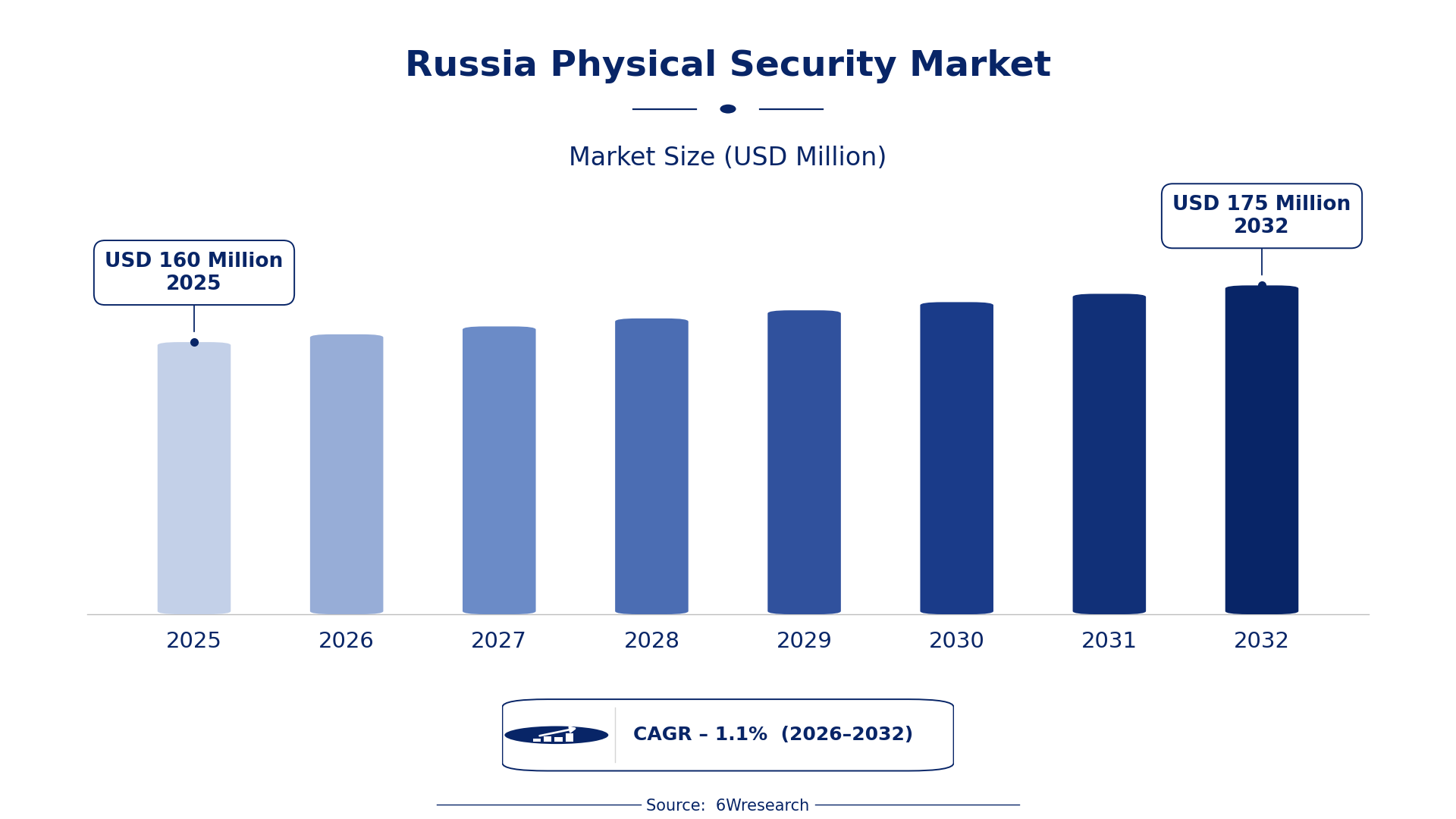
The Russia Physical Security Market was estimated at USD 160 Million in 2025 and is projected to reach USD 175 Million by 2032, growing at a CAGR of 1.1% from 2026 to 2032.
Russia Physical Security Market Synopsis
In the wake of escalating concerns over terrorism and criminal activities, the Russia Physical Security Market is witnessing a surge in demand for advanced security solutions. Organizations across sectors such as government, banking, and transportation are increasingly investing in comprehensive physical security measures to protect their assets and ensure safety.
This market encompasses a diverse range of products, including video surveillance systems, access control solutions, and perimeter security technologies. The integration of artificial intelligence into these systems is enhancing their effectiveness, while government initiatives are further driving modernization efforts within the sector.
Russia Physical Security Market Year-wise Growth Rate and Key Drivers
This graph illustrates the annual growth rates of the Russia Physical Security Market from 2021 to 2032, highlighting a steady upward trajectory and projected expansion over the forecast period.
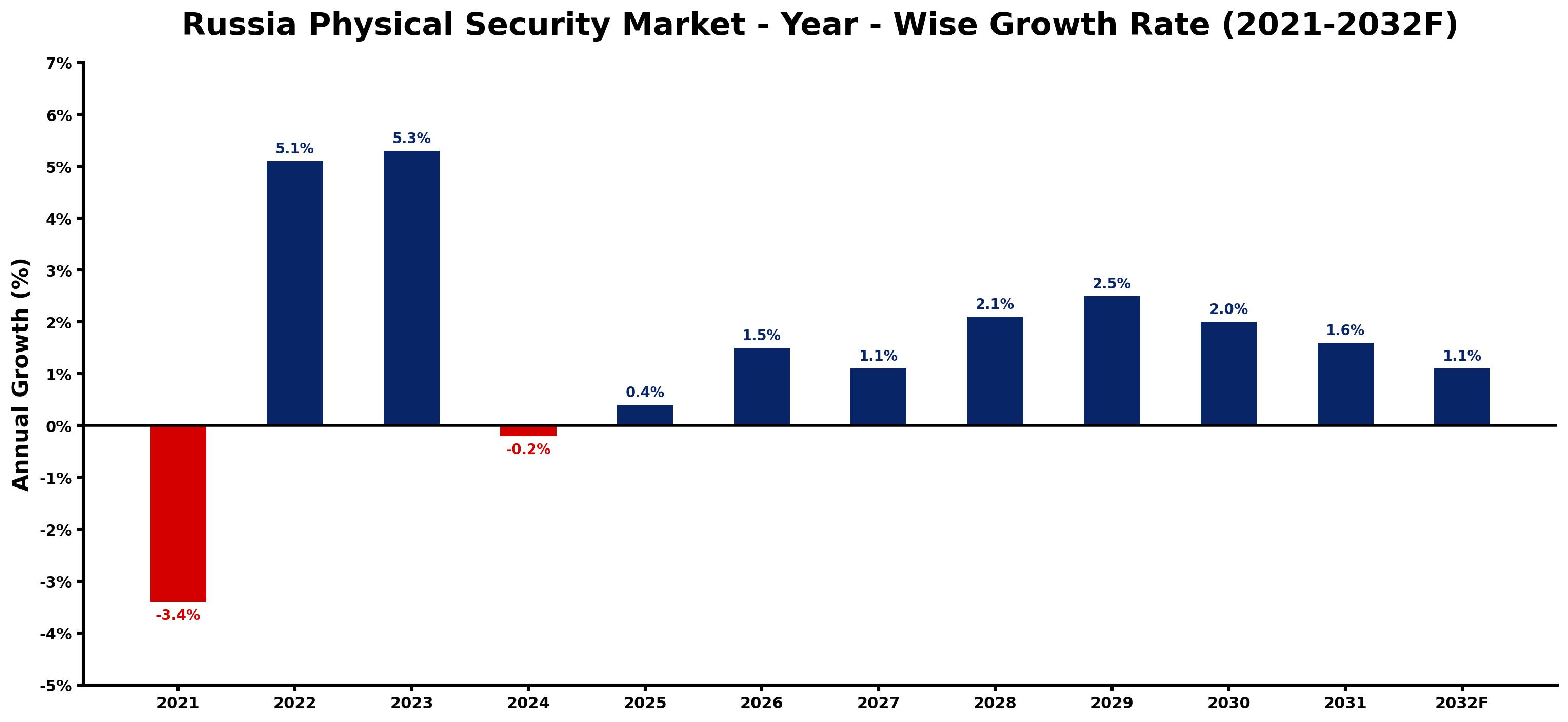
The table below presents the year‑wise growth rates along with the key drivers influencing the market
| Year | Growth Rate | Major Drivers |
| 2021 | -3.4% | Economic sanctions hinder physical security investments in Russia. |
| 2022 | 5.1% | Enhanced border security measures by Federal Security Service |
| 2023 | 5.3% | Increased demand for surveillance due to social tensions |
| 2024 | -0.2% | Increased crime rates reduce demand for security systems. |
| 2025 | 0.4% | Local political events driving demand for event security |
| 2026 | 1.5% | Growing private sector investment in security infrastructure |
| 2027 | 1.1% | Government focus on securing critical infrastructure facilities |
| 2028 | 2.1% | Emergence of biometric systems for enhanced access control |
| 2029 | 2.5% | Heightened threat perception boosting demand for security services |
| 2030 | 2.0% | Rise in urban crime rates prompting security upgrades |
| 2031 | 1.6% | Increase in private security firm registrations and services |
| 2032 | 1.1% | Regulatory pushes for improved workplace safety protocols |
Note: Market size estimations and growth projections presented in this report are based on 6Wresearch's proprietary forecasting methodology, utilizing the latest available industry data, government publications, and primary research inputs.
Russia Physical Security Market Key Takeaways
Below are some of the specific key takeaways from the market, including:
- Increasing investment in AI and cloud-based technologies for enhanced security.
- Rising demand for biometric access control solutions across various sectors.
- Government initiatives aimed at upgrading national security infrastructure.
- Significant growth potential in video analytics and surveillance technologies.
- Growing awareness of the importance of physical security measures among organizations.
Evaluation of Restraints in Russia Physical Security Market
The Russia Physical Security Market faces notable challenges that may impede its growth trajectory. A complex and frequently changing regulatory environment makes compliance difficult for companies, potentially leading to operational inefficiencies. Economic instability can deter investment, as fluctuating currency values and geopolitical tensions create uncertainties. on top of that, intense competition from both local and international players forces existing companies to continuously innovate and differentiate themselves in a crowded market.
Russia Physical Security Market Trends
Several prominent trends are currently shaping the Russia Physical Security Market. The integration of advanced video surveillance and analytics technologies is becoming commonplace, with organizations leveraging artificial intelligence to improve threat detection and response times. Additionally, the popularity of cloud-based security solutions is on the rise, providing businesses with scalable options to enhance their security infrastructure. There's also a marked increase in the deployment of biometric access control systems, particularly in sectors where security is paramount.
Russia Physical Security Market Opportunities
There are abundant opportunities for investment in the Russia Physical Security Market, particularly in cutting-edge surveillance systems and integrated security technologies. The heightened need for effective security solutions in both public and private sectors is propelling growth. Investments in state-of-the-art technologies, such as biometric identification systems and advanced video analytics, are likely to yield substantial returns. Additionally, the government's focus on smart city initiatives is expected to further stimulate demand for innovative security solutions.
Government Initiatives in the Russia Physical Security Market
Government policy plays a crucial role in shaping the trajectory of the Russia Physical Security Market. With a heightened emphasis on national security, recent policies have focused on regulating security technologies and enhancing the country’s overall safety framework. These measures not only promote the adoption of advanced security systems but also facilitate compliance with industry standards, especially in combating terrorism and cyber threats.
- A recent initiative launched in early 2025 aims to modernize security infrastructure across key urban centers, enhancing surveillance capabilities in public areas.
- Ongoing efforts are focused on developing a national cybersecurity framework intended to protect critical data and infrastructure, with expected implementation throughout 2026.
- Planned regulations for 2027 will mandate increased data protection measures in all physical security installations to safeguard personal information.
- Current government projects prioritize the expansion of funding for domestic manufacturers of security technologies to reduce dependency on foreign solutions.
Future Insights of the Russia Physical Security Market
Looking ahead to the period from 2026 to 2032, the Russia Physical Security Market is set for steady expansion. The government’s consistent focus on enhancing national security and a growing recognition among businesses of the need for enhanced security measures will drive continued investments. The integration of innovative technologies such as AI and cloud solutions will likely evolve, allowing organizations to address emerging threats with greater efficiency. While economic uncertainties may pose challenges, the overall outlook remains positive as companies adapt to shifting demands.
Russia Physical Security Market Latest Developments
Over the past year, the Russia Physical Security Market has experienced significant advancements, reflecting a heightened commitment to security. Companies are increasingly rolling out cutting-edge technologies to meet the growing demand for enhanced safety solutions.
- A leading regional operator launched a comprehensive video surveillance system in Q1 2025, integrating AI for advanced threat detection.
- An initiative currently underway focuses on upgrading access control systems across major transportation hubs, set to complete by mid-2026.
- Plans announced in early 2025 for a public-private partnership aim to fund the development of next-generation perimeter security technologies by 2027.
- A major technology vendor is piloting a new cloud-based security management platform that is expected to begin rollout by Q3 2026.
Russia Physical Security Market - Key Attractiveness of the Report
- 10 Years of Market Numbers
- Historical Data Starting from 2022 to 2025
- Base Year: 2025
- Forecast Data until 2032
- Key Performance Indicators Impacting the Market
- Major Upcoming Developments and Projects
Key Highlights of the Report:
- Russia Physical Security Market Outlook
- Market Size of Russia Physical Security Market, 2025
- Forecast of Russia Physical Security Market, 2032
- Historical Data and Forecast of Russia Physical Security Revenues & Volume for the Period 2022-2032F
- Russia Physical Security Market Trend Evolution
- Russia Physical Security Market Drivers and Challenges
- Russia Physical Security Price Trends
- Russia Physical Security Porter's Five Forces
- Russia Physical Security Industry Life Cycle
- Historical Data and Forecast of Russia Physical Security Market Revenues & Volume By Component for the Period 2022-2032F
- Historical Data and Forecast of Russia Physical Security Market Revenues & Volume By Systems (PACS, PSIM, PIAM, Video Surveillance, Fire and Life Safety) for the Period 2022-2032F
- Historical Data and Forecast of Russia Physical Security Market Revenues & Volume By Services for the Period 2022-2032F
- Historical Data and Forecast of Russia Physical Security Market Revenues & Volume By Vertical for the Period 2022-2032F
- Historical Data and Forecast of Russia Physical Security Market Revenues & Volume By BFSI for the Period 2022-2032F
- Historical Data and Forecast of Russia Physical Security Market Revenues & Volume By Government for the Period 2022-2032F
- Historical Data and Forecast of Russia Physical Security Market Revenues & Volume By Retail for the Period 2022-2032F
- Historical Data and Forecast of Russia Physical Security Market Revenues & Volume By Transportation for the Period 2022-2032F
- Historical Data and Forecast of Russia Physical Security Market Revenues & Volume By Residential for the Period 2022-2032F
- Historical Data and Forecast of Russia Physical Security Market Revenues & Volume By Telecom and IT for the Period 2022-2032F
- Historical Data and Forecast of Russia Physical Security Market Revenues & Volume By Other Verticals (Healthcare, Manufacturing, Energy and Utilities, and Education). for the Period 2022-2032F
- Historical Data and Forecast of Russia Physical Security Market Revenues & Volume By Organization Size for the Period 2022-2032F
- Historical Data and Forecast of Russia Physical Security Market Revenues & Volume By SMEs for the Period 2022-2032F
- Historical Data and Forecast of Russia Physical Security Market Revenues & Volume By Large Enterprises for the Period 2022-2032F
- Russia Physical Security Import Export Trade Statistics
- Market Opportunity Assessment By Component
- Market Opportunity Assessment By Vertical
- Market Opportunity Assessment By Organization Size
- Russia Physical Security Top Companies Market Share
- Russia Physical Security Competitive Benchmarking By Technical and Operational Parameters
- Russia Physical Security Company Profiles
- Russia Physical Security Key Strategic Recommendations






































