Italy Physical Security Market Size & Growth Rate (2026-2032)
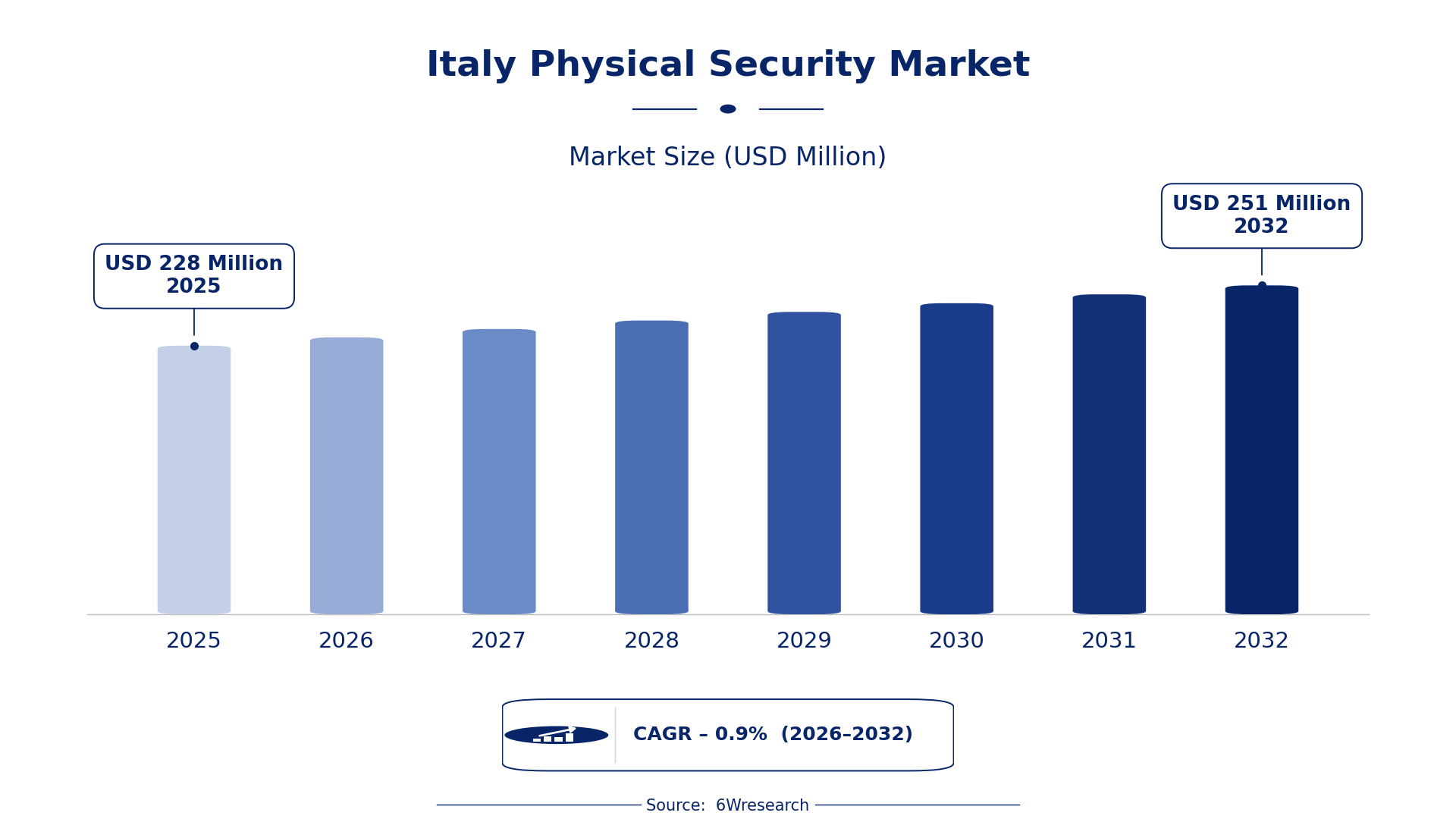
The Italy Physical Security Market was estimated at USD 228 Million in 2025 and is projected to reach USD 251 Million by 2032, growing at a CAGR of 0.9% from 2026 to 2032.
Italy Physical Security Market Synopsis
The escalating concerns over public safety and security threats are the primary forces driving the Italy Physical Security Market. As incidents of criminal activities and terrorist threats rise, both public and private sectors are increasingly investing in comprehensive security systems.
This market encompasses a wide array of solutions, including video surveillance systems, access control mechanisms, intruder alarms, and perimeter security installations. The urgency to safeguard critical infrastructure and commercial properties is reshaping how security technologies are implemented, with a clear focus on innovation and integration.
Italy Physical Security Market Year-wise Growth Rate and Key Drivers
This graph illustrates the annual growth rates of the Italy Physical Security Market from 2021 to 2032, highlighting a steady upward trajectory and projected expansion over the forecast period.
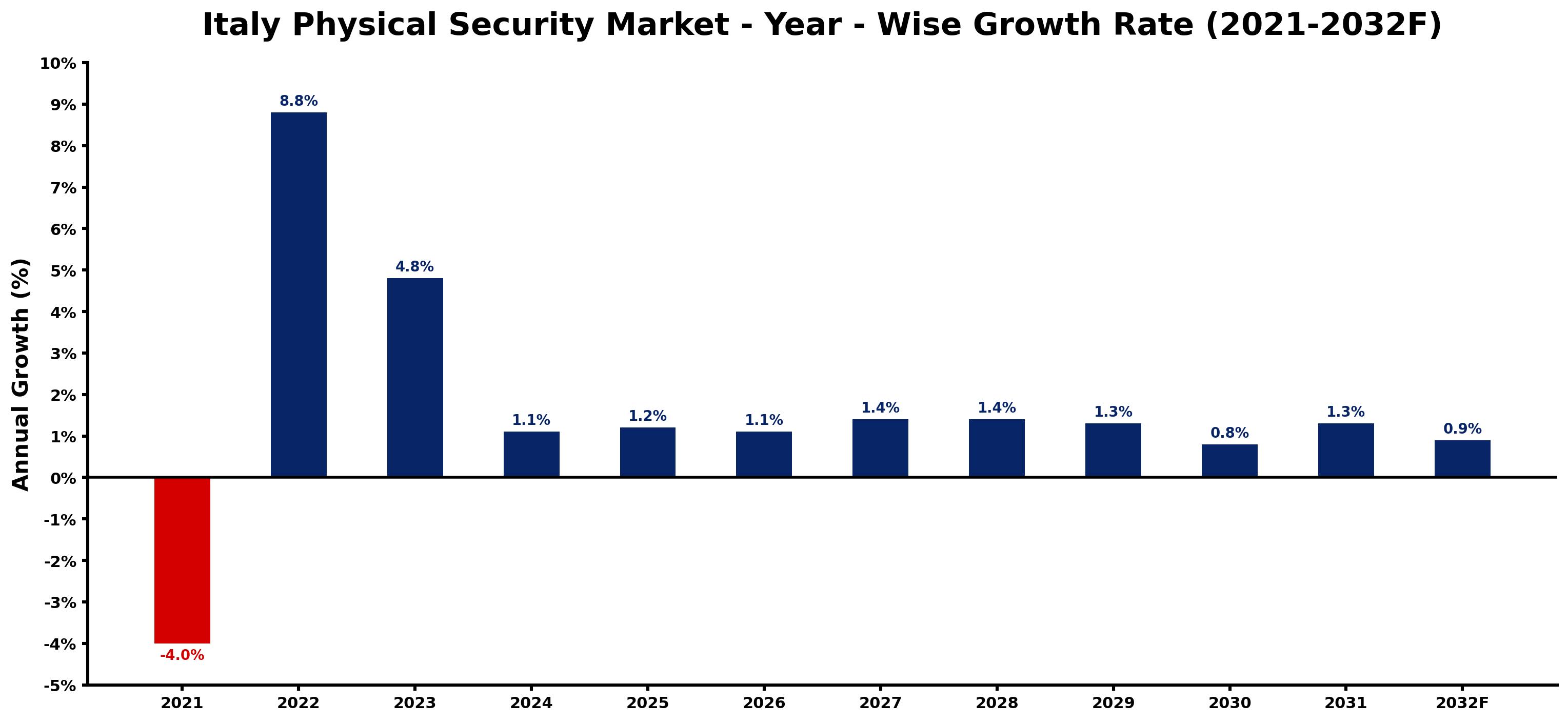
The table below presents the year‑wise growth rates along with the key drivers influencing the market
| Year | Growth Rate | Major Drivers |
| 2021 | -4.0% | Decreased demand from Italian public sector budgets. |
| 2022 | 8.8% | Increased demand for video surveillance under Italian safety laws |
| 2023 | 4.8% | Growing investment in cybersecurity for public infrastructure protection |
| 2024 | 1.1% | Rise in public safety concerns due to crime rates |
| 2025 | 1.2% | Implementation of stricter safety regulations for public venues |
| 2026 | 1.1% | Boost in smart home security technologies among consumers |
| 2027 | 1.4% | Government incentives promoting physical security innovation projects |
| 2028 | 1.4% | Support for local security firms due to regional partnerships |
| 2029 | 1.3% | Increased awareness of personal safety in urban areas |
| 2030 | 0.8% | Adoption of physical security technologies in aging infrastructure |
| 2031 | 1.3% | Growing number of events requiring enhanced security measures |
| 2032 | 0.9% | Rising need for security in small and medium enterprises |
Note: Market size estimations and growth projections presented in this report are based on 6Wresearch's proprietary forecasting methodology, utilizing the latest available industry data, government publications, and primary research inputs.
Italy Physical Security Market Key Takeaways
Below are some of the specific key takeaways from the market, including:
- The market is projected to grow steadily, driven by increasing investment in advanced security technologies.
- Demand for integrated security solutions is on the rise, combining various systems for comprehensive protection.
- Cloud-based security offerings are gaining traction, providing flexibility and scalability to users.
- Cybersecurity concerns are elevating the focus on securing networked physical security devices.
- Government regulations are shaping the deployment of security measures in public and private sectors.
Evaluation of Restraints in Italy Physical Security Market
Several factors are restraining growth in the Italy Physical Security Market. The increasing sophistication of cyber threats poses challenges for physical security systems, making integration of security measures essential but often complicated. Compliance with data protection regulations like GDPR adds a layer of complexity and cost for companies. Additionally, economic uncertainties can lead to budget constraints, limiting investments in advanced security solutions. In this environment, companies must innovate and address these hurdles to remain competitive and relevant.
Italy Physical Security Market Trends
Current trends indicate a significant shift towards advanced video surveillance systems equipped with analytics capabilities. This technology allows for enhanced monitoring and threat assessment. There is also a noticeable movement towards integrated security solutions that unify access control, video surveillance, and intrusion detection for comprehensive protection. The market is increasingly adopting cloud-based solutions, enabling organizations to manage their security systems with greater efficiency and flexibility. on top of that, the emphasis on cybersecurity has led companies to prioritize the security of connected physical security devices.
Italy Physical Security Market Opportunities
Investment opportunities in the Italy Physical Security Market are abundant, particularly within video surveillance, access control systems, and perimeter security solutions. With heightened security measures in public spaces and commercial establishments, innovative technologies that incorporate AI, cloud storage, and remote monitoring are gaining traction. The integration of physical security with smart building technologies and IoT devices is another avenue for growth. Strategic partnerships with local providers or through acquisitions can also help navigate this dynamic market effectively.
Government Initiatives in the Italy Physical Security Market
Government policies in Italy are crucial in shaping the physical security sector, focusing on public safety and the protection of critical infrastructure. There is an increasing push for the implementation of robust security measures across various sectors, reflecting a commitment to safeguarding citizens and property.
- A regulatory framework was introduced in 2025 mandating the installation of video surveillance systems in high-risk areas.
- The government is currently running a national initiative to enhance cybersecurity measures for physical security systems, which remains ongoing.
- A planned public-private partnership is expected to roll out new access control protocols for commercial buildings by 2028.
- Recent training programs for security personnel have been launched to ensure compliance with evolving security standards.
Future Insights of the Italy Physical Security Market
Looking ahead to 2026-2032, the Italy Physical Security Market is likely to experience steady growth driven by technology advancements and heightened security demands across various sectors. The emphasis on preventing security breaches will accelerate demand for integrated and AI-powered security systems. Cloud adoption will reshape how organizations implement security measures, reflecting a broader trend towards efficient and proactive solutions. As public entities and businesses prioritize security infrastructure, we anticipate a significant shift towards more intelligent systems capable of addressing complex threats.
Italy Physical Security Market Latest Developments
In the past year, the Italy Physical Security Market has seen significant developments. Companies are investing heavily in innovative technologies, responding to the growing demand for advanced security solutions. Recent industry dynamics indicate a strategic focus on integrating cybersecurity with physical security measures.
- A leading regional operator launched a new AI-driven video surveillance system in early 2025, enhancing monitoring capabilities for urban environments.
- In mid-2025, a major technology vendor began rolling out cloud-based access control solutions for commercial properties, gaining positive feedback from early adopters.
- A collaborative initiative between local government and private firms is expected to introduce updated perimeter security standards by late 2026.
- A pilot project focused on securing networked physical devices is currently underway, with results anticipated by mid-2026.
Italy Physical Security Market - Key Attractiveness of the Report
- 10 Years of Market Numbers
- Historical Data Starting from 2022 to 2025
- Base Year: 2025
- Forecast Data until 2032
- Key Performance Indicators Impacting the Market
- Major Upcoming Developments and Projects
Key Highlights of the Report:
- Italy Physical Security Market Outlook
- Market Size of Italy Physical Security Market, 2025
- Forecast of Italy Physical Security Market, 2032
- Historical Data and Forecast of Italy Physical Security Revenues & Volume for the Period 2022-2032F
- Italy Physical Security Market Trend Evolution
- Italy Physical Security Market Drivers and Challenges
- Italy Physical Security Price Trends
- Italy Physical Security Porter's Five Forces
- Italy Physical Security Industry Life Cycle
- Historical Data and Forecast of Italy Physical Security Market Revenues & Volume By Component for the Period 2022-2032F
- Historical Data and Forecast of Italy Physical Security Market Revenues & Volume By Systems (PACS, PSIM, PIAM, Video Surveillance, Fire and Life Safety) for the Period 2022-2032F
- Historical Data and Forecast of Italy Physical Security Market Revenues & Volume By Services for the Period 2022-2032F
- Historical Data and Forecast of Italy Physical Security Market Revenues & Volume By Vertical for the Period 2022-2032F
- Historical Data and Forecast of Italy Physical Security Market Revenues & Volume By BFSI for the Period 2022-2032F
- Historical Data and Forecast of Italy Physical Security Market Revenues & Volume By Government for the Period 2022-2032F
- Historical Data and Forecast of Italy Physical Security Market Revenues & Volume By Retail for the Period 2022-2032F
- Historical Data and Forecast of Italy Physical Security Market Revenues & Volume By Transportation for the Period 2022-2032F
- Historical Data and Forecast of Italy Physical Security Market Revenues & Volume By Residential for the Period 2022-2032F
- Historical Data and Forecast of Italy Physical Security Market Revenues & Volume By Telecom and IT for the Period 2022-2032F
- Historical Data and Forecast of Italy Physical Security Market Revenues & Volume By Other Verticals (Healthcare, Manufacturing, Energy and Utilities, and Education). for the Period 2022-2032F
- Historical Data and Forecast of Italy Physical Security Market Revenues & Volume By Organization Size for the Period 2022-2032F
- Historical Data and Forecast of Italy Physical Security Market Revenues & Volume By SMEs for the Period 2022-2032F
- Historical Data and Forecast of Italy Physical Security Market Revenues & Volume By Large Enterprises for the Period 2022-2032F
- Italy Physical Security Import Export Trade Statistics
- Market Opportunity Assessment By Component
- Market Opportunity Assessment By Vertical
- Market Opportunity Assessment By Organization Size
- Italy Physical Security Top Companies Market Share
- Italy Physical Security Competitive Benchmarking By Technical and Operational Parameters
- Italy Physical Security Company Profiles
- Italy Physical Security Key Strategic Recommendations






































